


Quantum computing sits at the intersection of national security and a trillion-dollar opportunity. Governments worldwide are racing to build systems that crack encryption, simulate molecules, and outpace rivals in everything from logistics to materials science.
Yet the field’s biggest hurdle remains scalability. Today’s quantum machines operate in isolation, limited by qubit type and short coherence times. Now, there is a fresh catalyst. IonQ (IONQ) just won a spot in the Defense Advanced Research Projects Agency's (DARPA) Heterogeneous Architectures for Quantum (HARQ) program, using its quantum memory and interconnect tech to link different qubit species into networked systems.
More Top Stocks Daily: Go behind Wall Street’s hottest headlines with Barchart’s Active Investor newsletter.
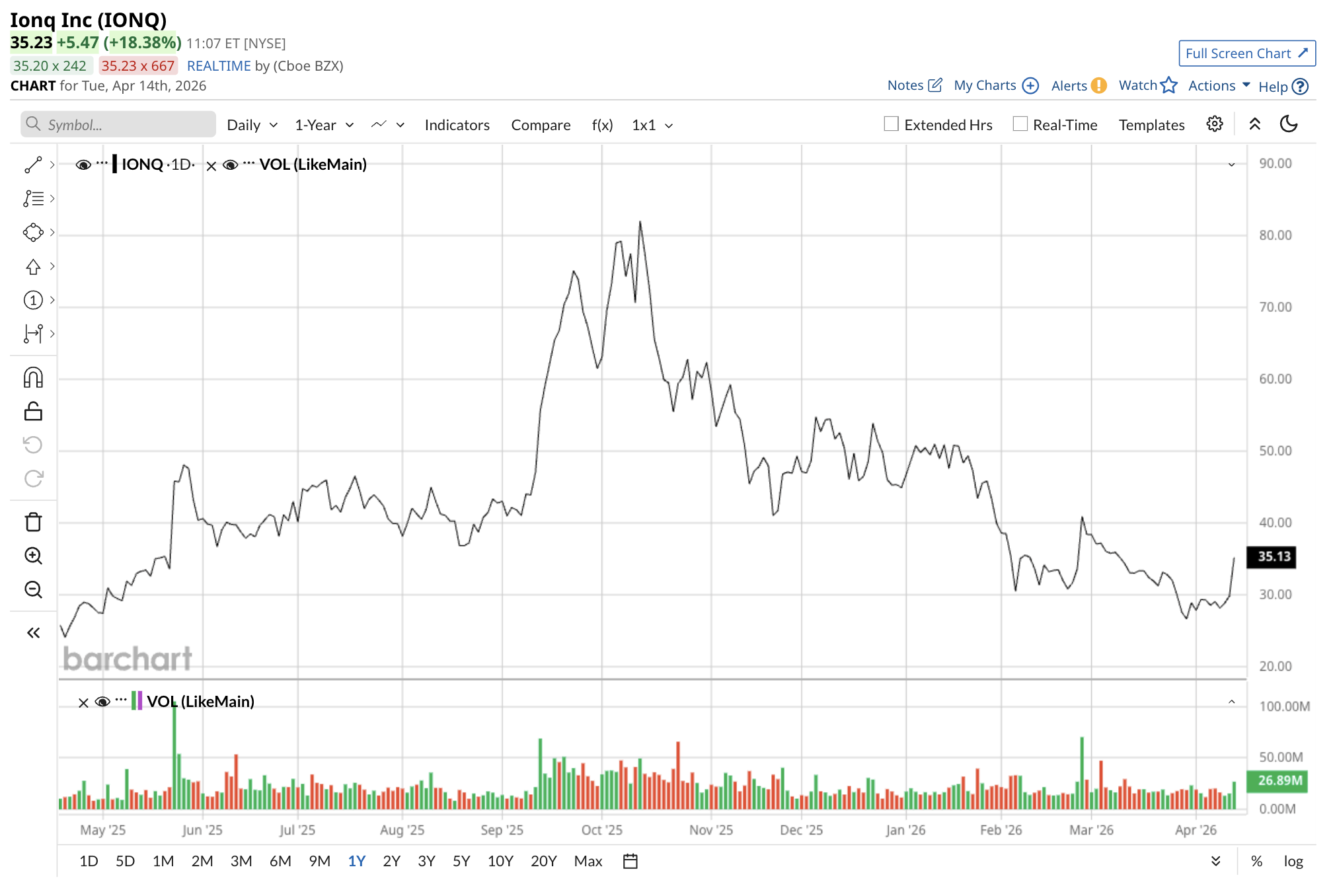
With IONQ stock down 6% year-to-date (YTD) — but up 18% on the HARQ announcement — let’s see what this means for investors who want exposure to the one pure-play quantum stock showing real commercial traction.
 www.barchart.com
 Breaking Down the DARPA HARQ Victory
DARPA established the HARQ program to move beyond single-qubit-type designs and create modular, high-performance quantum architectures. IonQ’s role centers on its quantum memories — chips fabricated from quantum-grade synthetic diamond — and photonic interconnects that distribute entanglement across distances. These components already lead in data center-scale networking and fiber optic qubit-to-photon conversion.
In plain English, IonQ’s tech lets trapped-ion, neutral-atom, and superconducting qubits talk to one another reliably. The result is scalable systems that combine the strengths of each approach instead of forcing one to rule them all. IonQ Chairman and CEO Niccolo de Masi put it this way: “IonQ’s pioneering quantum interconnect technology can enable modular scalability not only for ion traps, but for a wide range of quantum technologies.” The company will collaborate with DARPA to strengthen national security while building a backbone for both defense and commercial applications.
This marks another defense milestone for IonQ, which previously advanced in DARPA’s Quantum Benchmarking Initiative. Last month, the company revealed a collaboration with the Applied Research Laboratory for Intelligence and Security (ARLIS) on the U.S. Air Force-backed SEQCURE program. In February, the firm also won a Golden Dome contract. The HARQ selection validates its hardware edge at the exact moment that the Pentagon demands practical, networked quantum solutions.
How Does IonQ Stack Up Financially?
IonQ isn’t just talking a good game; the books back it up. According to its fourth-quarter and full-year 2025 results, full-year revenue reached $130 million — tripling from 2024 — while Q4 alone delivered $61.9 million. For 2026, management guides for revenue between $225 million and $245 million, with a strong commercial backlog of $370 million.
Compare those results to its closest pure-play peer, Rigetti Computing (RGTI). Trailing revenue for Rigetti sat at about $7.09 million as of the end of 2025 — less than 6% of IonQ’s haul — while IonQ’s market capitalization of roughly $13 billion dwarfs Rigetti’s $5.6 billion market cap. IonQ also holds $2.4 billion in cash against Rigetti’s $444 million and carries a manageable debt of $30 million versus Rigetti’s $7.17 million.
No matter how you slice it, IonQ outpaces the competition on every growth metric that counts for a pre-profit quantum leader.
The Road Ahead and the Risks
That said, IonQ remains unprofitable, as do all pure-play quantum companies at this stage. Operating losses reflect heavy R&D investment in scaling from today’s systems to the 256-qubit machines planned for 2026. Commercialization timelines can slip, and bigger players like IBM (IBM) continue to invest heavily in their own quantum roadmaps. Granted, those risks exist for anyone betting on breakthrough tech.
Yet the DARPA win reduces one key uncertainty: technical credibility. Defense contracts historically open doors to larger government and enterprise deals, and IonQ’s $370 million backlog already signals customer conviction. When all is said and done, the numbers show a company that turned 2025 into a breakout year and enters 2026 with momentum most peers can only envy.
 www.barchart.com
 What Does Wall Street Think About IONQ Stock?
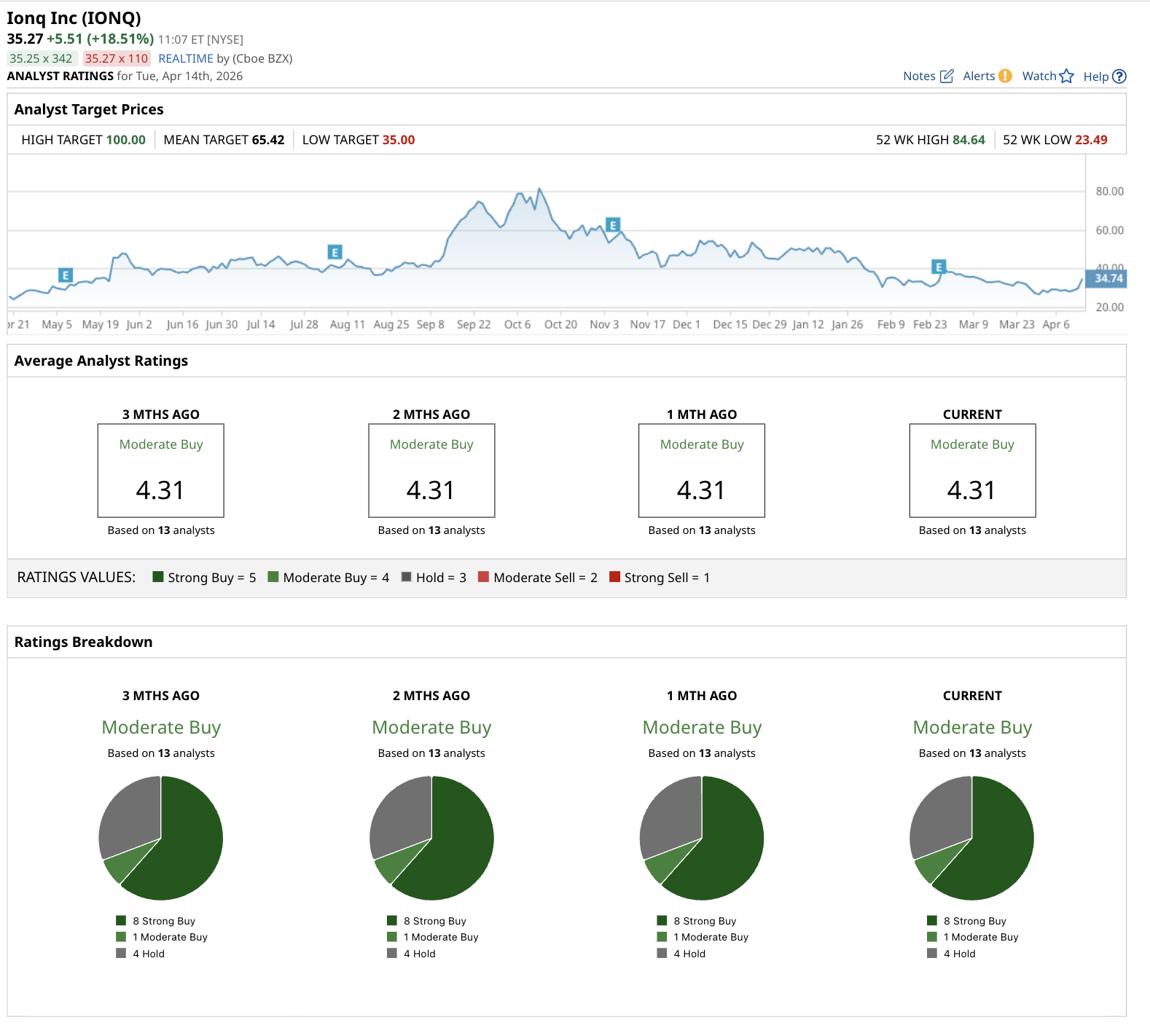
Let’s turn to the Street for a moment. According to Barchart’s latest analyst ratings data, Wall Street maintains a "Moderate Buy" consensus rating on IONQ stock. Of the 13 analysts with coverage, eight have a "Strong Buy," one analyst has a "Moderate Buy," and four offer a “Hold” rating.
The mean price target sits at $65.42, implying 53% potential upside from recent trading levels. The high target reaches $100, while the low stands at $35.
Firms such as Jefferies and Rosenblatt have shown particular enthusiasm with Street-high targets near $100, while more cautious voices like JPMorgan and DA Davidson hover in the $35 to $42 range.
The Key Takeaway
IonQ’s HARQ selection does more than add a government line item — it cements the company’s lead in the one area quantum computing must solve next: scalable networking. With revenue more than doubling, a robust backlog, and superior balance-sheet strength compared to Rigetti, IonQ stands out as the quantum computing stock retail investors can understand and own today.
If your portfolio has room for high-growth technology with national-security tailwinds, this is a name to consider adding now. The data makes a clear case that IonQ is pulling ahead.
On the date of publication, Rich Duprey did not have (either directly or indirectly) positions in any of the securities mentioned in this article. All information and data in this article is solely for informational purposes. For more information please view the Barchart Disclosure Policy here.
More news from Barchart
Macquarie Is Pounding the Table on CoreWeave Stock with a New ‘Outperform’ Rating. Should You Buy Here? Tesla Is Still a ‘Leader in Physical AI’ and You Should Buy TSLA Stock Now, Says UBS Turbine Season for Tech: John Rowland on the Next Era of AI Data Center Investments IonQ's DARPA Contract Win Makes It the Quantum Computing Stock to Own in 2026