


“ETFs are super hot right now,” I told Rob Isbitts, who happens to be our resident ETF columnist.
“Why are they super hot?” he asked, confident I wasn’t just making small talk.
More Yield, Less Trap: Sign up free to get Barchart’s daily Dividend Investor newsletter straight to your inbox.
I pulled up an article that Barchart’s Editorial Director, Sarah Holzmann, had shared in our Slack channel recently. As Seeking Alpha reports in this April 6, 2026, update on the Charles Schwab (SCHW) trading activity index:
Clients turned slightly bearish in the wake of the Iran war, spending less time trying to pick individual names and concentrating on diversified exchange-traded funds, the statement released by SCHW on Monday said.
"We haven't seen investors gravitate toward ETFs to the same extent on the net-buy list in some time. It's likely the sudden increase in market volatility is pushing investors to broader products," said Head Trading and Derivatives Strategist Joe Mazzola.
Elizabeth Volk: So it’s kind of this knee-jerk diversification — like when people want to diversify, or there's volatility, instead of stock picking, it's just, “let's pick up an ETF.”
Rob Isbitts: “I'm confused by this market. Let's ETF it.”
EV: Exactly.
RI: Yeah, so it seems. But the next step is, after you decide to “ETF it,” you realize it's a little more complicated than that.
You have to ETF yourself.
That’s a process, it turns out, that involves a good deal of education, a few Barchart tools, maybe a bespoke indicator or two, and an open conversation with our own history.
But first, before we ETF ourselves, a brief introduction.
Welcome to the ETF Industrial Complex
An increasingly popular way for retail investors to participate in equity markets is through exchange-traded funds (ETFs), which are vehicles that allow for diversified participation in a sector, industry, region, or investing theme through one single investment.
By purchasing shares of the Invesco QQQ Trust (QQQ), for example, an investor can quickly gain exposure to all of the top-performing Magnificent 7 stocks, along with the rest of the largest Nasdaq-listed non-financial companies. ETFs like QQQ that are benchmarked to broad indices typically aren’t actively managed, but membership in the index that it’s based on — the Nasdaq-100 — is periodically updated to remove underperforming companies and add in new market leaders. This means the QQQ ETF is purpose-built for optimal performance over time, making it an attractive (and relatively beginner-friendly) investment.
Over time, QQQ and its close cousins — such as the SPDR S&P 500 ETF Trust (SPY), which proxies the S&P 500 Index (SPX) — have gained a reputation as virtually “foolproof” vehicles for everyone from retirees to 0DTE options traders. As a result, these benchmark ETFs are now extremely popular, highly liquid, and have spawned more than one carbon copy ETF across the exchange-traded universe. (Like SPY? You’ll love VOO.)
The dawn of the ETF age hasn’t been without its impact on the market. By now, seasoned investors probably know that when stocks are added to major indices like the S&P 500 or Nasdaq-100, it results in forced institutional buying among ETF managers, who must buy shares to track their benchmark properly. That can create opportunities for nimble retail traders. Plus, stocks with a heavy institutional ownership presence can also feel reassuring to investors wary of market volatility.
But for every buyer, there’s a seller. The surging popularity of ETFs as vehicles to speculate, invest, and hedge has also created opportunities for companies looking to list these products, which generate revenue through management fees.
As a result, the U.S. ETF market has expanded from a small crop of sector SPDRs in the late 1990s to address nearly every industry, region, theme, niche, and mega-cap stock, along with double- and inverse-leveraged versions of the most popular listings. Thanks to Wall Street’s endless creativity, ETFs have ballooned to overtake the equities market itself. Data compiled by Morningstar last year tallied over 4,300 listed ETFs in the U.S. market, compared to only 4,200 stocks.
That means for all we hear about the art and science of stock-picking, it’s actually a bit more difficult, statistically speaking, to be a successful ETF picker.
And that’s where Rob Isbitts comes into the picture.
Late-Night Charting with Rob
“I will accuse myself sometimes of doing what is called ‘night charting,’” confessed Rob during our call. “You know, you're up too late charting stocks and ETFs?”
That’s how he fell into a routine with the Barchart website years ago, he told me.
This was back around 2012 — long before he became one of our regular contributors on the editorial side, covering ETFs and options strategies for our audience, and before our suite of tools helped inspire Rob to try and build his own legacy on the charts.
But we should go back even further than that, because that’s where Rob’s investing story really begins.
“It all started with my dad,” said Rob, describing how he learned charting over Carl Isbitts’ shoulder at age 16. “Once I got out of college, I realized I wanted to go into this field, and I got in with a Japanese bank in the World Trade Center, as a portfolio assistant.
“But I knew I wanted to actually make the investment decisions. I worked for a couple of big firms for about a decade, co-founded and grew a boutique RIA firm, and then started my own. I sold that practice in 2020, in part because I wanted to try to help a larger audience.”
EV: How did you get started using Barchart’s platform?
RI: What attracted me to it was the charts themselves. And it's funny because I was good with the basic snapshot chart — I didn't even use the interactive charts until I became a writer. Then I realized, “Wait a minute; these are much better and more customizable!” But with the basic chart, I got so used to the format.
And then the nice thing about Barchart from the beginning was the usability, the way that you can take that data and say, “Oh, that's an interesting screen.” Then boom, it's a watchlist. When I see other systems that can't do it, I'm like, “You've got to be kidding me!” The bar has been set very high by Barchart.
Along with the “charting efficiency,” Rob credits Barchart for helping to fill in the gaps in his analysis.
RI: I'm not a fundamental analyst. So to me, if I want to get a handle on the broader stock market, I'll look at the S&P 100, which is one of many watchlists I maintain. I take a few notes as I’m zipping through them, and look for patterns — say, the financials and the oils are fading. And it's like, OK, I've got my macro from the bottom up. I do the same thing with ETFs now, looking at the holdings.
EV: What are your other go-to indicators?
RI: I'm pretty sure the 20-day moving average is the best investor this side of Warren Buffett and Charlie Munger — not just in terms of is the trend up or down, but is it sustainable?
Sure; the 20-day is the “Smooth” by Santana ft. Rob Thomas of technical indicators. But there was another very specific Rob Isbitts staple I wanted to ask him about based on the articles I’d read.
EV: How did PPO become essential for you? I’m pretty familiar with technical analysis, but that’s not one I come across too often.
RI: That was from my dad. He created his own, sort of, more competent version of the PPO. And you know — look, in anything, whether it's writing or subsector or technical analysis, in this industry, if you do what everybody else does, you'll get average results.
The PPO is one I like; I'll use some moving averages that other people don't use; and I look at three-day charts as much as one-day and one-week. Because you want to know what everybody else is doing, but you also want to try to find an edge.
EV: What is PPO telling you? When you glance at it, what are you looking for specifically? What's your takeaway there?
RI: Let me pull one up and answer that.
[At this point, and please don’t be jealous, Rob gave me a five-minute personal tutorial on PPO.]
I'm looking for a crossover, short-term to long-term. But if the cross is below zero, it’s like trying to climb uphill. The crossover below zero is sort of a high-risk, high-reward.
And I'm using dailies, although I do look at, I look at daily, weekly, I will look at monthly. During times of high volatility, I will analyze as many as 12 different time frames, so I can determine at what point in the cycle a specific ETF, stock, or the broad market is currently in.
By the way, I am not the most sophisticated technician, and I thought about being more sophisticated. But then I looked at the results, and I was like, “No, I don't think I need to.”
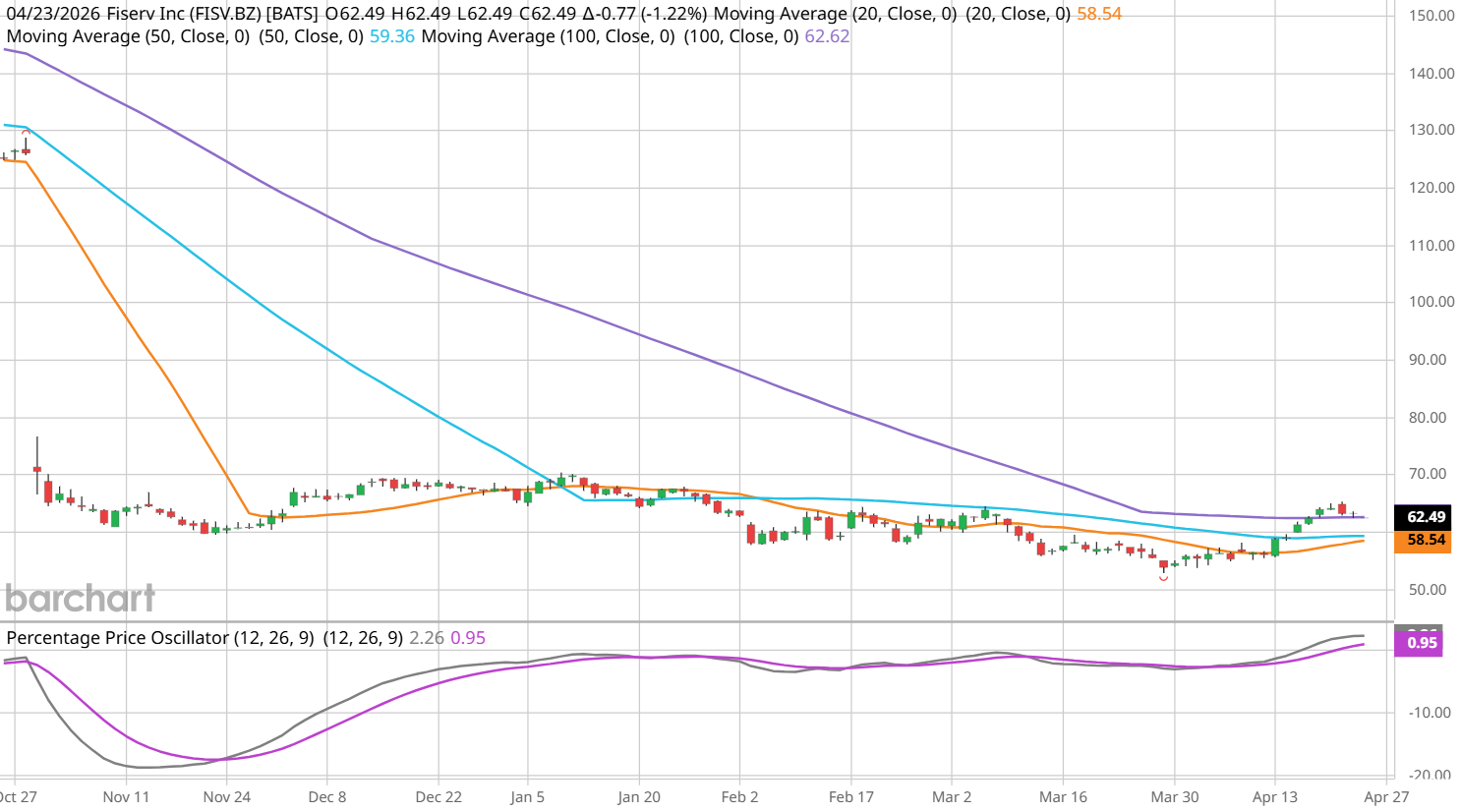 FISV stock with PPO
 How Barchart Opinion Gave Rise to ROAR
To say that Rob’s dad was a self-taught DIY investor does not quite cover it. Carl Isbitts, who attended Bronx Science High School in New York City and then post-graduate studies at Columbia, was something of a proto-vibe coder.
“My dad would put together his own customized indicators,” explained Rob. “So you have your regular indicators, but this is ‘the Carl Isbitts indicator,’ OK?”
Watching Carl hack together 10 or 20 different indicators to build his own custom charts gave Rob the inspiration to develop a methodology of his own:
RI: If you want to know where the ROAR score came from, it's just that it was me looking at the charts — the second generation of looking at the charts with much better analytics and saying, “Wait a minute, if I could, what can I do for the next generation as a legacy?” And maybe that’s to take how I look at charts, which is not identical to the way anybody else probably looks at them.
My father had one person he passed on his charting experience to: me. I have been fortunate to spend decades doing this. And now, as part of the Barchart platform, I can reach more people than Dad would have ever dreamed of.
The goal is way after I'm gone, that people might be able to actually say, “Oh, if Rob were reading the chart, this would be the takeaway.” And then they can decide how useful that is.
On a slightly less serious and more immediate note, you can also use ROAR to decide how Rob would read a chart if you’re simply in different states at the moment, as the two of us so often happen to be.
“So that was the main thing, but then I really started focusing on Barchart Opinion,” explained Rob.
For the uninitiated, our Barchart Opinion is a Carl Isbitts-esque calculation of 13 popular technical indicators, which you can find on each listed stock, and possibly on ETFs that the team at BlackRock hasn’t even imagined yet.
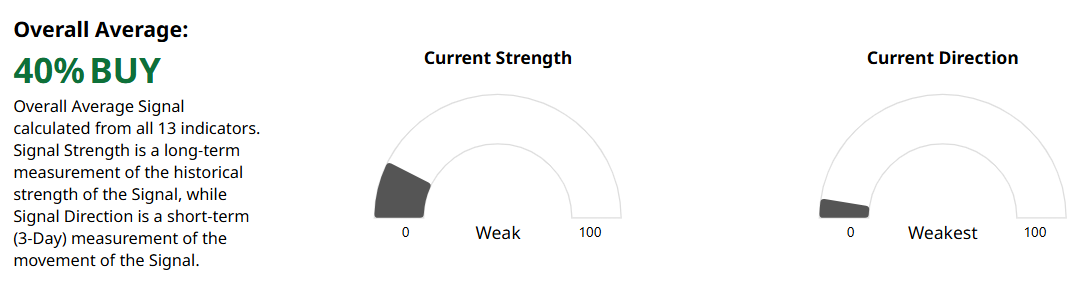 AAPL Barchart Opinion
 It's a wonderfully compact read on a stock's directional movement and trend strength, and ideal if you're stalking momentum. But if you're particularly risk-averse, or prone to hedging by nature, it's certainly the kind of indicator that might give you a moment's pause.
“I love the stuff that's there,” said Rob of Barchart Opinion. “There's nothing I don't like about it.
“But I can tell you the stuff that I find less useful for how I am trying to invest, because I am first about, ‘How much I can lose?’ And that goes back to the New York City Depression era, baby; that was my dad. It all comes from that.”
Rob has written a wonderful explainer for us already on ROAR (reward, opportunity, and risk), so I’ll let him take it from here:
...when I really thought hard about all of the data points available on Barchart, I determined that the ones I valued the most were the moving average signal, direction, and strength. But since ROAR scores are not about time, but about a set distance a stock price moves, I could not rely solely on one moving average time frame. So I use three different ones: 20-day, 50-day, and 150-day. Why? Trial and error.
In particular, Barchart’s characterization of those moving averages, converted to plain language, is one of the keys for me. I look at charts similarly, focusing on the shape of the lines. Again, this is about pattern recognition for me…
ROAR also deemphasizes the momentum element that many other stock-grading systems rely on. Momentum is a wonderful thing in investing… when it is positive. But I have found that systems that rely on it are prone to overshooting on both the upside and downside.
And so Rob, in creating ROAR, effectively married our Barchart tools and data with his core memories of his father.
However, please rest assured you can get a lot of benefit from our tools and data regardless of your relationship with your parents.
EV: How does ROAR center risk in the equation?
RI: The blanket assumption that I made is that any investment — stock or ETF — can go up in price at any time for any reason, any narrative, and it can go way up.
We know everything has a chance to go up, everything — even if they have nothing going for them, well, maybe there's a merger announcement. Maybe they're big in the index, like an Oracle (ORCL), and the rising tide is going to lift all boats at some point. There's a million reasons they can go up. That's what 99.99% of this industry focuses on: How do I find stuff that’s going to go up?
But the difference between these stocks at any point in time, which ROAR answers for, is: Which ones have a higher risk factor attached to that potential gain versus the others? Another way to think of it would be, I guess, you could say it's a Sortino ratio. Return adjusted for the downside risk you take.
And so that's what ROAR tries to measure as best we can, how much risk is attached.
EV: So they’re two different instruments obviously — do you feel like ROAR translates pretty cleanly in terms of equity analysis versus ETF analysis?
RI: This is my opinion; we haven't verified it yet, but I think my programming partners would agree with me. I'm gonna say it's probably two to three times better for ETFs than it is for stocks, and it's pretty strong for large-cap stocks.
To put ROAR’s abilities to the test, Rob built an automated portfolio with all 30 Dow Jones Industrial Average members and cash as a buffer. (“I'm one of the few people that thinks the Dow is the greatest index, not because of the weighting, but because of the 30 members,” he explained.)
“It automatically figures out the allocation to each Dow member based on ROAR, and it's doing really well,” Rob told me. “And depending on the ROAR score of the individual ones, it can be as much as maybe a 5%, 6%, maybe 7% weight. But all 30 stocks also have to be at least 1% of the portfolio, so that all 30 are owned all the time.
“Then we compared it to the Dow itself, and it's just been consistently beating the Dow, which says to me, ‘Aha! For large liquid stocks, this thing really works.’”
The Desert Island ETF, According to Rob
“This ETF Yourself brand, you know — build portfolios… using ETFs… by yourself. That's what it's saying,” said Rob, straight-faced, as though he had just helped me up from a hard tumble off the turnip wagon.
Then, seconds later: “Obviously, I came up with it for another reason — the double entendre.”
Frankly, it’s that double entendre part of the equation that concerns me right now, I told him.
EV: The ETF market is huge now. You've got the SPDRs, right, the OGs, and obviously, there was room to refine and build out the ETF market from where it started there.
But we've reached the point where it's like an ETF industrial complex. And you read things like, “investors are getting anxious and so they're fleeing to ETFs.” And to me, that's a bad combination because you have issuers on the other side that are really just cranking out product.
RI: Honestly, it's the same with ETFs as it is with so many other things, which is — you had enough information to make your own decisions, right?
But truthfully, I don't think investors are really looking at the data on that level and evaluating some of these ETFs based on questions like, “How well does it fit in your portfolio?” And maybe it doesn't fit your portfolio.
Also, people think the S&P 500 is diversified. It is not. I'm scouring the ETF universe, and I'm kind of whittling it down to, “What are the ETFs that are both not too diversified or, as Peter Lynch used to say, ‘de-worsified,’ and not entirely correlated to something else?”
The VanEck Rare Earth Strategic Metals ETF (REMX) — that’s unique; I don't think there's another tenured rare earth ETF. Now, it probably correlates a bit with materials, but my guess is there aren't too many things like REMX.
(The next day, Rob and I emailed each other excitedly about the launch of REXC, which is effectively an ex-China version of REMX.)
On the topic of de-worsification, Rob added, “If it were up to me, stock ETFs would have no more than 20 holdings and most of them would have 5 to 10. They would be market slices. That's it. Because other than that, you might as well just pick small caps or whatever, because they're all moving together.”
I was glad to hear him say so. That was right in the sweet spot for our Desert Island ETF exercise, where I asked him to pick just eight assets he would include in his ideal Isbitts fund.
First, it’s important to underscore that Rob takes the concept of risk management very, very seriously.
“When you say ‘desert island,’ the question is how much risk there is,” he told me, as though he really might find a signal from his remote location in the Pacific Ocean to manage these hypothetical positions via his Schwab app.
Anyway, to clarify, we’re using “desert island” in the purely metaphorical sense here.
That said, these are the eight assets and accompanying hedges that Rob Isbitts would launch as an ETF, if given the opportunity (as I assume every U.S. citizen soon will each year on our birthdays, given recent SEC trends).
Rob’s Desert Island Assets
Invesco QQQ Trust Series 1 (QQQ) SPDR Dow Jones Industrial Average ETF Trust (DIA)Between these two heavyweights, “I cover most of the market,” said Rob.
Invesco Optimum Yield Diversified Commodity Strategy No K-1 ETF (PDBC)This fund provides exposure to “broad-based commodities,” and as the name suggests, offers a relatively streamlined paperwork experience at tax time.
SPDR Bloomberg 1-3 Month T-Bill ETF (BIL) Invesco Equal Weight 0-30 Year Treasury ETF (GOVI) ProShares Short 20 Plus Year Treasury ETF (TBF)With this lineup, Rob’s got his bond exposure over short and long time frames, along with the requisite hedge.
ProShares VIX Short-Term Futures ETF (VIXY)This Cboe Volatility Index ($VIX) futures derivative “has to be in there because I basically need a put option in the form of an ETF.”
AGFiQ US Market Neutral Anti-Beta Fund (BTAL)Another equity hedge, BTAL uses a strategy that goes long on low-beta equities and short high-beta.
How to Find Your Missing Piece
While you might not share Rob’s penchant for risk aversion and fondness for built-in hedges, there’s great news — the ETF market has a product for you. Probably several, actually. Just be sure to conduct your due diligence, so you really understand what it is you’re adding to your portfolio and why.
“Investors should look at ETFs as puzzle pieces,” concluded Rob. “And think of your portfolio as the puzzle you’re filling out.
“Not everybody's gonna be a technician like me, not everybody's gonna know derivatives like you — but they will find, especially with Barchart, the ability of this data to show people how they can start building their own path.”
This interview has been edited and condensed for clarity. Follow Rob Isbitts on Barchart, at PiTrade, and at ETF Yourself, and subscribe to our official Barchart Substack for more exclusive content from this Q&A.
On the date of publication, Elizabeth H. Volk did not have (either directly or indirectly) positions in any of the securities mentioned in this article. All information and data in this article is solely for informational purposes. For more information please view the Barchart Disclosure Policy here.
More news from Barchart
What You Don’t Know About ETFs Might Hurt You. Rob’s Here to Help. The Iran War Has Made Oil Prices a Moving Target. That’s Why This ETF and Option Combination Makes Sense. Can Ethereum Make a Giant Comeback? Here’s the Bull Case.