


Black Diamond Therapeutics BDTX is widening the opportunity set for silevertinib by pushing beyond lung cancer and into glioblastoma, a move that leans on the same core attribute that has driven investor interest so far: central nervous system (CNS) penetration. The strategy also fits the company’s broader focus on genetically defined cancers, where one well-targeted medicine can open multiple shots on goal.
For investors, the key is separating near-term signal building in non-small cell lung cancer (NSCLC) from the longer-dated optionality that glioblastoma could bring if execution stays tight.
BDTX Why EGFR in Brain Tumors Is Back on the Radar
The rationale for expanding silevertinib beyond NSCLC is rooted in brain penetration and demonstrated CNS activity, an important differentiator in EGFR-driven disease where brain involvement is common and clinically consequential. In the company’s phase II frontline NSCLC dataset, CNS responses have stood out, and no patients developed de novo brain metastases as of the data cutoff, supporting the idea that CNS-relevant exposure can translate into meaningful clinical outcomes.
That CNS angle matters because Black Diamond’s platform approach is built to address families of oncogenic driver mutations, not just a single alteration. The company’s Mutation-Allostery-Pharmacology engine groups mutations by shared structural effects to guide selectivity and drug design, reinforcing a theme of precision oncology with medicines intended to work across mutation subsets, including those that affect the brain.
Black Diamond Builds a Second Value Driver Beyond NSCLC
Adding glioblastoma introduces multi-indication optionality for silevertinib, which matters because the company’s growth profile remains heavily concentrated in this single wholly owned clinical asset. A credible path in glioblastoma does not replace the NSCLC value driver, but it does broaden the long-term payoff profile if the drug continues to show durable CNS performance and manageable safety in larger datasets.
At the same time, timelines stay early. Black Diamond has no approved products and remains several years from commercialization, leaving valuation sensitive to clinical and regulatory outcomes. That reality keeps expectations calibrated: glioblastoma is a second lever, not a near-term revenue bridge.
BDTX What the GBM Trial Design Signals About Ambition
The glioblastoma program is built around a randomized phase II study in newly diagnosed EGFRvIII-positive patients, initiated in May 2026. The choice of a randomized design is an important signal. Compared with uncontrolled early-stage observations, randomization can strengthen data credibility by improving comparability across treatment arms and reducing the risk that outcomes are driven by patient selection rather than drug effect.
For investors trying to gauge ambition, this design choice suggests Black Diamond is aiming for a clearer evidentiary bar even at phase II. It also implicitly acknowledges that glioblastoma development is costly and complex, which raises the importance of disciplined execution and capital strategy as the program matures.
Black Diamond Therapeutics, Inc. Price and Consensus
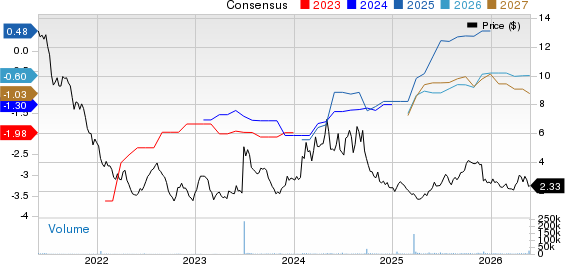
Black Diamond Therapeutics, Inc. price-consensus-chart | Black Diamond Therapeutics, Inc. Quote
BDTX’s Competition in the Target NSCLC Market
The NSCLC market is crowded, and competition is a real constraint on how investors should frame upside. AstraZeneca’s AZN Tagrisso remains a leading third-generation EGFR tyrosine kinase inhibitor with broad approvals across major markets and deep clinical familiarity. That sets a high bar for differentiation, particularly in frontline settings where standards of care are established and switching costs can be meaningful.
Johnson & Johnson JNJ has also strengthened its presence with Rybrevant in combination with Lazcluze, approved for first-line NSCLC in patients with EGFR exon 19 deletions or exon 21 L858R substitutions identified by an approved diagnostic test. This backdrop increases the importance of where silevertinib can be distinct, including breadth across non-classical mutations and CNS-relevant activity that can matter in brain-metastasis–prone disease.
Black Diamond Maps the Long-Dated Catalyst Timeline
The catalyst clock in glioblastoma is long. Interim data are anticipated in 2028, which places the program firmly in the “narrative and validation” bucket today rather than a near-term stock-moving readout. Still, a defined timeline can matter because it helps investors frame what success looks like over multiple years and how the company may sequence investment decisions.
That long-dated arc also sits alongside nearer-term regulatory planning in NSCLC. Black Diamond plans to meet with the FDA later in 2026 to discuss a pivotal development plan for frontline NSCLC in patients with EGFR non-classical mutations, an event that can help clarify the path from encouraging phase II signals to a registrational strategy.
BDTX Partnering Angle and the Platform Narrative
Partnerships have already been part of Black Diamond’s capital playbook. The company out-licensed BDTX-4933 to Servier Pharmaceuticals in the first quarter of 2025, receiving a $70 million upfront payment and retaining eligibility for up to $710 million in development and commercial milestones plus tiered royalties. That transaction also aligned with a tighter focus on silevertinib development.
Management continues to explore partnership opportunities for the FGFR2/3-selective candidate BDTX-4876, and potential new partnerships remain a stated catalyst as programs advance and development costs rise heading toward pivotal work. From an investor lens, credible partnering can extend runway, share risk, and validate platform value without forcing near-term dilution.
Black Diamond Links CNS Proof in NSCLC to GBM Optionality
The bridge between NSCLC and glioblastoma is the CNS response narrative. In the phase II frontline NSCLC update, silevertinib delivered a preliminary median progression-free survival of 15.2 months, with systemic objective response and disease control rates of 60% and 91%, respectively, and a CNS objective response rate that remained 86% under RANO-BM criteria. These signals, alongside manageable class-consistent safety and dosing refinement toward 150 mg once daily for pivotal development, shape the credibility of expansion into CNS-intensive disease settings.
Ultimately, the long-term value case leans on sustained CNS performance and execution clarity. If Black Diamond can carry that CNS profile forward while sharpening its pivotal NSCLC path and maintaining capital discipline into the second half of 2028, glioblastoma becomes more than an aspirational add-on. It becomes an embedded option that can elevate the ceiling for silevertinib over time.
BDTX Zacks Rank
Black Diamond currently carries a Zacks Rank #3 (Hold). You can see the complete list of today’s Zacks #1 Rank (Strong Buy) stocks here.
Research Chief Names "Single Best Pick to Double"
From thousands of stocks, 5 Zacks experts each have chosen their favorite to skyrocket +100% or more in months to come. From those 5, Director of Research Sheraz Mian hand-picks one to have the most explosive upside of all.
This company targets millennial and Gen Z audiences, generating nearly $1 billion in revenue last quarter alone. A recent pullback makes now an ideal time to jump aboard. Of course, all our elite picks aren’t winners but this one could far surpass earlier Zacks’ Stocks Set to Double like Nano-X Imaging which shot up +129.6% in little more than 9 months.
Free: See Our Top Stock And 4 Runners UpWant the latest recommendations from Zacks Investment Research? Today, you can download 7 Best Stocks for the Next 30 Days. Click to get this free report
AstraZeneca PLC (AZN): Free Stock Analysis Report
Johnson & Johnson (JNJ): Free Stock Analysis Report
Black Diamond Therapeutics, Inc. (BDTX): Free Stock Analysis Report
This article originally published on Zacks Investment Research (zacks.com).