


Black Diamond Therapeutics BDTX is building its equity story around one drug, silevertinib, a brain-penetrant, fourth-generation EGFR inhibitor being studied in EGFR–mutant non-small cell lung cancer.
The newest phase II update in May 2026 added detail on systemic activity, central nervous system outcomes, durability markers, and tolerability. The opportunity is meaningful, but so is the risk that comes with a small and still-maturing dataset.
BDTX Sets the NSCLC Context and Why It Matters
Black Diamond’s MasterKey strategy aims to tackle families of oncogenic driver mutations by targeting shared activating conformations. The company uses its Mutation-Allostery-Pharmacology engine to group mutations by structural effect and drug selectivity profile, then designs small molecules to match those mutation families.
Silevertinib fits this framework as a brain-penetrant, fourth-generation EGFR MasterKey inhibitor developed for non-classical EGFR mutations, a heterogeneous group that can be hard to address with existing approaches. The company has highlighted broad mutation coverage, spanning more than 50 classical and non-classical EGFR mutations.
A key positioning point is coverage of the C797S resistance mutation, which can emerge after treatment with third-generation EGFR inhibitors. The drug has received Fast Track Designation from the FDA for EGFR mutant C797S-positive non-small cell lung cancer that has progressed on or after a third-generation EGFR tyrosine kinase inhibitor.
Black Diamond Shows What the Phase II Data Really Say
The May 2026 phase II update focused on a frontline non-small cell lung cancer population with EGFR non-classical mutations treated with 200 mg once daily, with an April 11, 2026, data cutoff. As of that cutoff, 43 frontline patients had been treated, and the median follow-up was 11.2 months.
The mutation mix matters for interpretation. The enrolled population included a broad range of EGFR non-classical mutations, including compound mutations and P-Loop and C-Helix Compressing mutations. That breadth supports the “family-of-mutations” thesis, but it also means the sample is spread across many subtypes, limiting what investors can conclude about any single subgroup’s performance.
The dataset also included 19 patients with brain metastases, including seven with measurable central nervous system target lesions. That central nervous system evaluable subset is small, so changes in a few patients can move the headline rates.
BDTX Systemic Efficacy Signals and Durability Watchpoints
Systemic activity held steady versus earlier disclosures. The objective response rate by RECIST 1.1 remained 60%, and the disease control rate remained 91%. In addition, Black Diamond reported variant allele frequency reductions in all evaluable patients across 25 unique EGFR non-classical mutations, including P-Loop and C-Helix Compressing mutations.
Durability is where the debate typically shifts from “signal” to “confidence.” The May update disclosed a preliminary median progression-free survival of 15.2 months. At the cutoff, 23 of 43 patients, or 53%, remained on therapy, and the longest-treated patient was still on treatment at 23.5 months.
The median duration of response was not reached at the cutoff. That can be read as encouraging when many patients are still benefiting, but it is also an immaturity flag. Without a longer follow-up, the durability profile can still change as late progressions accumulate.
Black Diamond Therapeutics, Inc. Price and Consensus
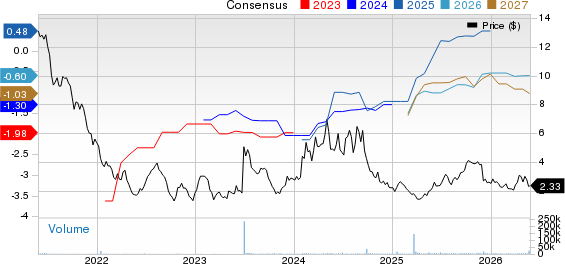
Black Diamond Therapeutics, Inc. price-consensus-chart | Black Diamond Therapeutics, Inc. Quote
Black Diamond Highlights CNS Outcomes as the Key Differentiator
Central nervous system activity is the feature that could ultimately separate silevertinib from many peers, given the clinical burden of brain metastases in EGFR–mutant non-small cell lung cancer. Black Diamond’s May update reiterated a central nervous system objective response rate of 86% assessed by RANO-BM criteria.
Equally notable, the company reported that no patients developed de novo brain metastases as of the data cutoff date. If that observation holds up in a larger, longer dataset, it could become a central part of the clinical narrative, because preventing new brain lesions would address a key driver of morbidity in this setting.
The competitive bar is not theoretical. AstraZeneca’s AZN Tagrisso remains a widely approved third-generation EGFR tyrosine kinase inhibitor in non-small cell lung cancer, and Johnson & Johnson JNJ has expanded its first-line footprint with Rybrevant in combination with Lazcluze for patients with exon 19 deletions or exon 21 L858R substitution mutations. A differentiated central nervous system profile is one of the cleaner paths for a new agent to stand out.
BDTX Safety, Dose Optimization, and What Changed
Safety is a key part of how investors are weighing the program. Black Diamond reported no new safety signals, but also emphasized that severe treatment-related adverse events declined after dose reduction, falling to 28%.
Importantly, the company stated that patients maintained or deepened clinical responses after dose reduction. That outcome supports the view that meaningful activity can be preserved while improving tolerability, which is often pivotal for longer-duration therapy in frontline disease.
Based on this experience, Black Diamond is aligning on 150 mg once daily as the dose for pivotal development. The flip side is that the need to optimize dosing can add execution risk and amplify scrutiny as the program moves toward a registrational strategy.
Black Diamond Catalysts Investors Should Track Next
From here, the near-term debate will center on whether the early efficacy and central nervous system signal persist with additional follow-up and broader enrollment. Black Diamond has also indicated plans to meet with the FDA later in 2026 to discuss a pivotal development plan in frontline non-small cell lung cancer with EGFR non-classical mutations.
The company is also expanding silevertinib into glioblastoma, with a randomized phase II study in newly diagnosed EGFRvIII–positive glioblastoma initiated in May 2026 and interim data anticipated in 2028. That creates a second long-duration catalyst track, though non-small cell lung cancer remains the primary near- and mid-term value driver.
With Black Diamond’s valuation heavily tied to silevertinib, upcoming clinical readouts, regulatory alignment, and any business development moves around late-stage execution remain the key swing factors investors will track next.
BDTX Zacks Rank
Black Diamond currently carries a Zacks Rank #3 (Hold). You can see the complete list of today’s Zacks #1 Rank (Strong Buy) stocks here.
Research Chief Names "Single Best Pick to Double"
From thousands of stocks, 5 Zacks experts each have chosen their favorite to skyrocket +100% or more in months to come. From those 5, Director of Research Sheraz Mian hand-picks one to have the most explosive upside of all.
This company targets millennial and Gen Z audiences, generating nearly $1 billion in revenue last quarter alone. A recent pullback makes now an ideal time to jump aboard. Of course, all our elite picks aren’t winners but this one could far surpass earlier Zacks’ Stocks Set to Double like Nano-X Imaging which shot up +129.6% in little more than 9 months.
Free: See Our Top Stock And 4 Runners UpWant the latest recommendations from Zacks Investment Research? Today, you can download 7 Best Stocks for the Next 30 Days. Click to get this free report
AstraZeneca PLC (AZN): Free Stock Analysis Report
Johnson & Johnson (JNJ): Free Stock Analysis Report
Black Diamond Therapeutics, Inc. (BDTX): Free Stock Analysis Report
This article originally published on Zacks Investment Research (zacks.com).