

AXT’s AXTI first-quarter 2026 results suggest the company is rapidly emerging as a critical supplier to the AI optical infrastructure buildout, but the key debate now is whether execution can keep pace with demand. Indium phosphide revenue surged to $13.6 million in the first quarter, accounting for more than half of total company revenue and driven primarily by AI data center and optical transceiver applications. Management also disclosed that indium phosphide backlog exceeded $100 million, reflecting sharply improving visibility from hyperscalers, optical module makers and Tier 1 laser customers.
The near-term trajectory remains exceptionally strong. Management expects second quarter to deliver the largest indium phosphide quarter in company history, supported by accelerating AI infrastructure spending in both the United States and China. AXT said its materials are already being deployed across multiple U.S. hyperscaler ecosystems, while Chinese AI supply-chain investment is driving rapid growth in domestic laser demand. China-related indium phosphide laser revenue more than doubled sequentially in the first quarter and is expected to double again during the second quarter.
To meet this demand surge, AXT is pursuing one of the industry’s most aggressive expansion plans. The company expects to double indium phosphide capacity in 2026 compared to levels in the fourth quarter of 2025 and then double it again in 2027 through a new adjacent facility. Management estimates quarterly indium phosphide capacity could rise from a historical peak near $17 million to roughly $35 million per quarter by the end of 2026, eventually reaching $65 million to $70 million quarterly by late 2027 or early 2028.
Still, sustainability depends heavily on flawless execution. Management repeatedly emphasized that adding capacity in indium phosphide is technically difficult, with crystal growth yields, clean-room scaling and export permit timing representing major operational constraints. While AXT’s vertically integrated supply chain and proprietary furnace technology provide competitive advantages, the company must prove it can consistently convert unprecedented AI demand into scalable, profitable production.
Peer Updates
Diodes DIOD delivered another strong quarter, with revenue rising 22% year over year to $405.5 million, supported by accelerating momentum in automotive, industrial and AI server-related applications. Automotive and industrial together accounted for 44% of product revenue, helping gross margin expand to 31.8% as higher-margin content and utilization improved. Growth was fueled by increasing semiconductor content in vehicles, AI-driven power infrastructure, industrial automation and data-center networking. Management also highlighted robust design wins in silicon carbide, power management and connectivity products. Sustainability appears favorable as AI infrastructure, automotive electrification and factory automation remain secular drivers, though management expects customer qualification cycles and fab loading normalization to extend into 2027–2028, suggesting growth should remain durable but gradual rather than explosive.
Lattice Semiconductor LSCC posted a robust quarter, with revenue surging 42% year over year to $170.9 million, driven primarily by AI data center demand, compute and communications strength and industrial automation recovery. Compute and communications reached record levels, accounting for 62% of revenue, while industrial and embedded products rebounded more than 20% sequentially. Growth is increasingly supported by Lattice’s expanding role in AI servers, where its low-power FPGAs enable security, power sequencing and platform management rather than competing directly with CPUs and GPUs. Sustainability appears strong, as bookings now extend into 2027, channel inventory has normalized to near two months, and management sees the company in the “early innings” of a multiyear cycle driven by AI infrastructure, networking and physical AI applications. However, supply-chain tightness and rising backend costs could moderate margin expansion.
AXTI’s Price Performance, Valuation and Estimates
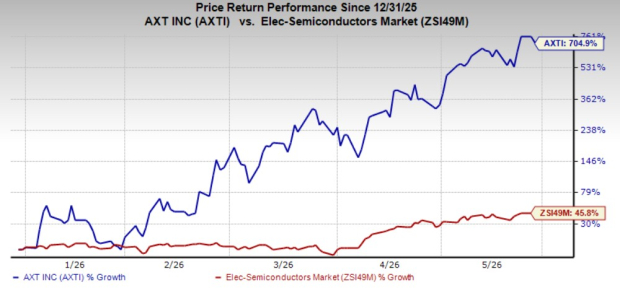
Shares of AXTI have skyrocketed 704.9% so far this year compared with the industry’s 45.8% growth.
Image Source: Zacks Investment Research
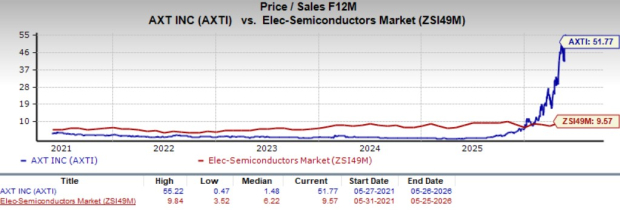
From a valuation standpoint, AXT trades at a forward price-to-sales ratio of 51.77, signifcantly above the industry average. It is also higher than its five-year median of 1.48. AXTI carries a Value Score of F.
Image Source: Zacks Investment Research
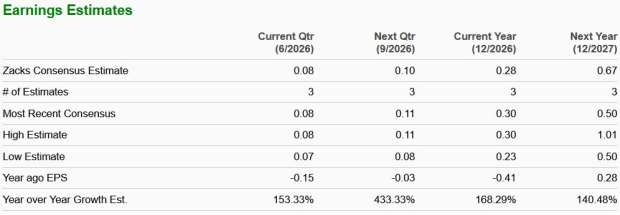
The Zacks Consensus Estimate for AXT’s fiscal 2026 earnings implies a 168.3% improvement from the year-ago period’s level.
Image Source: Zacks Investment Research
The stock currently carries a Zacks Rank #2 (Buy). You can see the complete list of today’s Zacks #1 Rank (Strong Buy) stocks here.
Beyond Nvidia: AI's Second Wave Is Here
The AI revolution has already minted millionaires. But the stocks everyone knows about aren't likely to keep delivering the biggest profits. AI’s second wave is moving from infrastructure to implementation and these companies are at the forefront of this transition, positioned to become what Amazon and Google were to the internet era.
See Stocks Now >>Want the latest recommendations from Zacks Investment Research? Today, you can download 7 Best Stocks for the Next 30 Days. Click to get this free report
Lattice Semiconductor Corporation (LSCC): Free Stock Analysis Report
Diodes Incorporated (DIOD): Free Stock Analysis Report
AXT Inc (AXTI): Free Stock Analysis Report
This article originally published on Zacks Investment Research (zacks.com).