


AbbVie ABBV announced the FDA approval of Decnupaz (pivekimab sunirine-pvzy) for the treatment of adult patients with blastic plasmacytoid dendritic cell neoplasm (BPDCN). The disease is an ultra-rare and aggressive hematologic malignancy with limited treatment options.
The approval gives AbbVie its first antibody-drug conjugate (ADC) approved for a blood cancer and adds a new treatment option for a patient group with high unmet need.
Decnupaz, a CD123-targeting ADC, is differentiated as the first and only ADC approved for BPDCN that can be initiated in an outpatient setting. This targeted approach may be meaningful for patients with this disease, which can progress rapidly from skin lesions to the bone marrow, lymph nodes and central nervous system (CNS).
Despite initial treatment with intensive chemotherapy, sometimes followed by stem cell transplantation, many patients eventually relapse, underscoring the need for new therapies and making Decnupaz’s approval particularly important.
FDA Nod for ABBV’s Decnupaz Backed by Strong Phase I/II Data
The FDA nod is supported by results from the global phase I/II CADENZA study, evaluating the safety, tolerability, pharmacokinetics, immunogenicity and anti-leukemia activity of Decnupaz in patients with CD123-positive hematologic malignancies, including BPDCN. Results included 84 patients, comprising 33 newly diagnosed patients without CNS involvement and 51 patients with relapsed or refractory disease without evidence of active CNS disease.
The efficacy data showed clinically meaningful activity, especially in newly diagnosed BPDCN. In the frontline group, Decnupaz therapy led to a composite complete response rate of 69.7%, with a median duration of response of 9.7 months. Out of the lot, 13 patients (39.4%) were able to receive post-study stem cell transplant. In the relapsed or refractory group, the composite complete response rate was 15.7%, with a median duration of response of 9.2 months. In this group, six patients (11.8%) proceeded to post-study stem cell transplant. These findings formed the core clinical basis for the FDA’s decision.
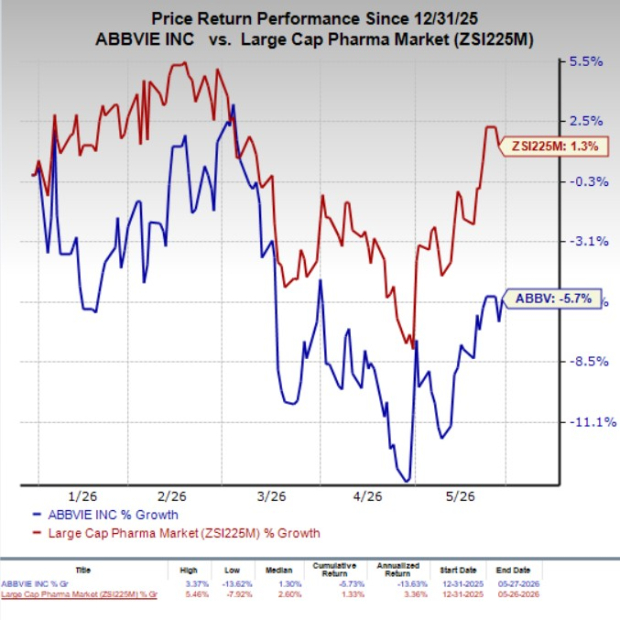
Year to date, AbbVie shares have lost 5.7% against the industry’s 1.3% growth.
Image Source: Zacks Investment Research
However, the drug’s safety profile includes several notable risks. The most common adverse reactions, occurring in at least 20% of patients, were edema, fatigue, musculoskeletal pain, hemorrhage, infusion-related reactions, nausea and diarrhea. Decnupaz also carries a boxed warning for hepatotoxicity, including hepatic veno-occlusive disease. Additional warnings and precautions include infusion-related reactions, edema, sulfite allergic reactions and embryo-fetal toxicity.
AbbVie Builds Oncology Portfolio Around Its Growing ADC Platform
The latest U.S. approval also fits AbbVie’s broader push to strengthen its oncology portfolio through ADCs, a drug class viewed as a disruptive innovation in cancer treatment. ADCs combine the targeting ability of antibodies with cytotoxic payloads designed to attack tumor cells more selectively.
AbbVie now has three ADCs in its commercial portfolio: Elahere, Emrelis and Decnupaz. Emrelis, formerly known as Teliso-V, was approved in the United States in May 2025 for previously treated non-squamous non-small cell lung cancer with high c-Met expression. Elahere entered AbbVie’s oncology portfolio through the February 2024 acquisition of ImmunoGen and is approved for certain adults with folate receptor alpha-positive, platinum-resistant ovarian, fallopian tube or primary peritoneal cancer after one to three prior systemic regimens.
AbbVie is also advancing additional ADC candidates across multiple tumor types. Temab-A is in phase III development for metastatic colorectal cancer and is also being studied in phase II studies for gastroesophageal cancer, solid tumors and non-small cell lung cancer. Pivekimab sunirine is also being evaluated for a second indication in acute myeloid leukemia in a phase II study. Beyond these programs, AbbVie has other early-stage ADC assets in development, underscoring its intent to build a broader ADC platform across both hematologic malignancies and solid tumors.
AbbVie Inc. Price and Consensus
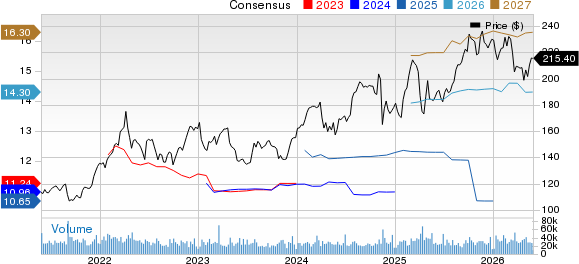
AbbVie Inc. price-consensus-chart | AbbVie Inc. Quote
ABBV’s Zacks Rank & Stocks to Consider
AbbVie currently carries a Zacks Rank #3 (Hold).
Some better-ranked stocks in the biotech sector are Liquidia Corporation LQDA, Indivior Pharmaceuticals INDV and Immunocore IMCR, each sporting a Zacks Rank #1 (Strong Buy) at present. You can see the complete list of today’s Zacks #1 Rank stocks here.
Over the past 60 days, estimates for Liquidia Corporation’s 2026 EPS have increased from $1.50 to $2.97. Over the same period, EPS estimates for 2027 have also increased from $2.91 to $4.81. LQDA shares have rallied 79.9% year to date.
Liquidia Corporation’searnings beat estimates in three of the trailing four quarters and missed in the remaining one, with the average surprise being 54.40%.
Over the past 60 days, estimates for Indivior Pharmaceuticals’ 2026 earnings per share have increased from $3.10 to $3.35. Over the same period, EPS estimates for 2027 have risen to $3.69 from $3.47. INDV shares have risen 3.4% year to date.
Indivior Pharmaceuticals’ earnings beat estimates in each of the trailing four quarters, with the average surprise being 65.44%.
Over the past 60 days, estimates for Immunocore’s 2026 loss per share have narrowed from 97 cents to 16 cents. On the other hand, its 2026 EPS is currently pegged at 11 cents. IMCR shares have lost 17.8% year to date.
Immunocore’s earnings beat estimates in three of the trailing four quarters, while missing the same on the remaining occasion, with the average surprise being 46.66%.
Radical New Technology Could Hand Investors Huge Gains
Quantum Computing is the next technological revolution, and it could be even more advanced than AI.
While some believed the technology was years away, it is already present and moving fast. Large hyperscalers, such as Microsoft, Google, Amazon, Oracle, and even Meta and Tesla, are scrambling to integrate quantum computing into their infrastructure.
Senior Stock Strategist Kevin Cook reveals 7 carefully selected stocks poised to dominate the quantum computing landscape in his report, Beyond AI: The Quantum Leap in Computing Power .
Kevin was among the early experts who recognized NVIDIA's enormous potential back in 2016. Now, he has keyed in on what could be "the next big thing" in quantum computing supremacy. Today, you have a rare chance to position your portfolio at the forefront of this opportunity.
See Top Quantum Stocks Now >>Want the latest recommendations from Zacks Investment Research? Today, you can download 7 Best Stocks for the Next 30 Days. Click to get this free report
AbbVie Inc. (ABBV): Free Stock Analysis Report
Liquidia Corporation (LQDA): Free Stock Analysis Report
Immunocore Holdings PLC Sponsored ADR (IMCR): Free Stock Analysis Report
Indivior Pharmaceuticals Inc. (INDV): Free Stock Analysis Report
This article originally published on Zacks Investment Research (zacks.com).