


Oracle ORCL is scheduled to report its fourth-quarter fiscal 2026 results on June 10.
For the fourth quarter of fiscal 2026, revenues are expected to grow from 18% to 20% in constant currency (cc) and from 19% to 21% in dollar terms at current exchange rates.
The Zacks Consensus Estimate for revenues is currently pegged at $19.08 billion, suggesting growth of 19.98% from the year-ago quarter’s reported figure.
Non-GAAP earnings per share are expected to grow 15-17% and be between $1.92 and $1.96 in cc. Non-GAAP earnings per share are expected to be between $1.92 and $2 in USD.
The consensus mark for earnings is pegged at $1.96 per share, unchanged over the past 30 days. The figure indicates 15.29% growth from the year-ago period.
Image Source: Zacks Investment Research
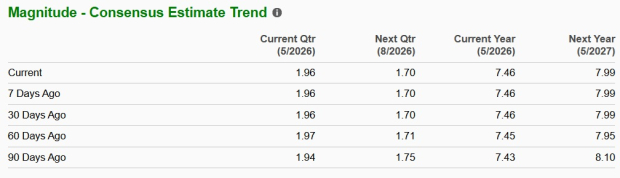
ORCL’s Earnings Surprise History
In the last reported quarter, Oracle delivered an earnings surprise of 5.29%. The company’s earnings beat the Zacks Consensus Estimate in each of the trailing four quarters, the average being 11.9%.
Oracle Corporation Price and Consensus
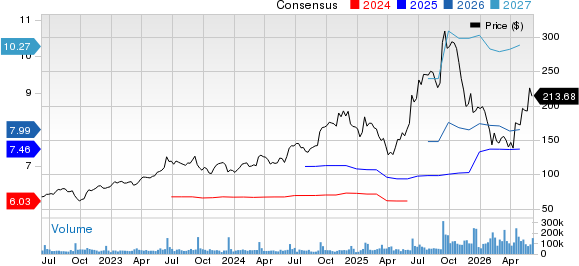
Oracle Corporation price-consensus-chart | Oracle Corporation Quote
Find the latest earnings estimates and surprises on the Zacks Earnings Calendar.
Earnings Whispers
Our proven model does not predict an earnings beat for Oracle this time around. The combination of a positive Earnings ESP and a Zacks Rank #1 (Strong Buy), 2 (Buy) or 3 (Hold) increases the odds of an earnings beat. You can uncover the best stocks to buy or sell before they are reported with our Earnings ESP Filter.
Oracle has an Earnings ESP of -0.04% and a Zacks Rank #3 at present. You can see the complete list of today’s Zacks #1 Rank stocks here.
Factors Likely to Shape Oracle’s Fiscal Q4 Results
Oracle's cloud application business is likely to have experienced solid momentum in the to-be-reported quarter. In the fiscal third quarter, cloud applications revenues grew 11% in constant currency to a $16.1 billion annualized run rate, with Fusion ERP up 14%, Fusion SCM and HCM each up 15%, and NetSuite up 11%. Deferred cloud applications revenues had outpaced recognized revenues in the fiscal third quarter, signaling potential acceleration into fiscal fourth quarter.
During the quarter, Oracle launched Fusion Agentic Applications across finance, supply chain, HR and customer experience workflows. Oracle also expanded the NetSuite AI Connector Service in April 2026, enabling customers to connect AI models directly to NetSuite data, aimed at increasing platform stickiness.
Oracle entered the fiscal fourth quarter targeting 22 live AWS regions for its multicloud database service, up from eight at the third quarter's close. In April 2026, Oracle and AWS announced plans to expand multicloud networking by establishing private, high-performance connectivity between Oracle Interconnect and AWS Interconnect. This broadening coverage across Microsoft Azure, Google Cloud and AWS was expected to support continued strong multicloud database revenue growth.
In the to-be-reported quarter, Oracle secured a $30 billion cloud infrastructure agreement with the U.S. government, positioning itself as a key provider for national security and defense workloads. On the healthcare side, Oracle Health faced ongoing competitive pressure from Epic Systems, with its EHR market share declining from approximately 25% to 22.9%, which might have weighed on vertical SaaS performance.
On the non-operating side, Oracle's 15% equity stake in TikTok US is expected to have contributed to non-operating income in the fiscal fourth quarter for the first time, accounting for the period from the late-January investment close through March 31 under the equity method.
Partially offsetting these developments, legacy software revenues had grown only 3% in USD and declined 1% in constant currency in the fiscal third quarter, with similar pressure expected to persist in the to-be-reported quarter amid continued migration toward cloud subscription models.
Price Performance & Valuation
It is also important to consider whether the stock's current valuation accurately reflects the company's long-term growth potential and ability to navigate the competitive landscape.
The stock currently trades at a forward twelve-month price-to-earnings ratio of 26.57 times, notably above the Zacks Computer-Software industry average of 22.25 times and substantially elevated compared to Oracle's own five-year median of 23.72 times.
ORCL’s P/E F12M Ratio Depicts Stretched Valuation
Image Source: Zacks Investment Research
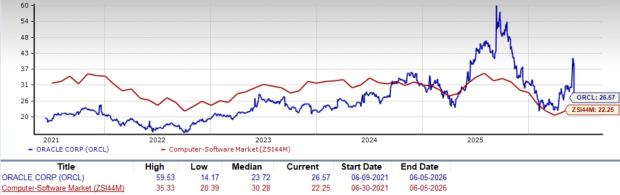
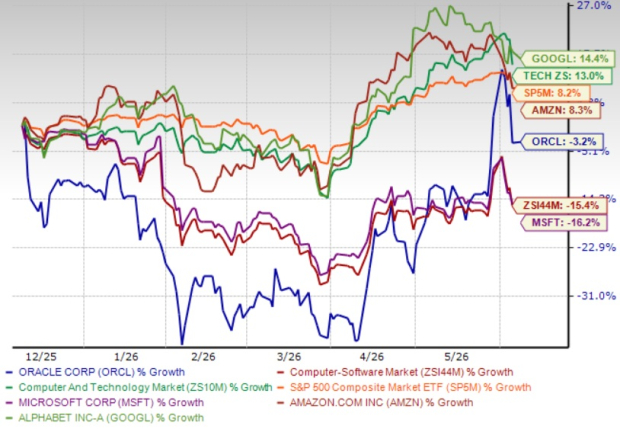
Shares of ORCL have lost 3.2% in the past six-month period compared with the Zacks Computer and Technology sector’s return.
While Oracle has a strong foothold in the database management and ERP software markets, its competitors are making significant inroads in the cloud space. Oracle continues to rank No. 5 for the global cloud infrastructure services market share quarter after quarter. The company had 3% share of the global cloud market in the fourth quarter of 2025.
In terms of competitive positioning, Amazon AMZN maintains a strong lead in the market, though Microsoft MSFT and Alphabet GOOGL-owned Google continue to achieve higher growth rates. Amazon, Microsoft and Alphabet’s first-quarter 2026 worldwide market shares were 28%, 21% and 14%, respectively, according to new data from Synergy Research Group.
ORCL’s 6-Month Performance
Image Source: Zacks Investment Research
Investment Considerations: Balancing Risk and Reward
Oracle's accelerating cloud momentum — reflected in expanding multicloud database coverage, a wave of Fusion Agentic Application launches and a $30 billion U.S. government cloud agreement — underscores the company's strengthening competitive positioning heading into fourth-quarter fiscal 2026 results. However, persistent legacy software declines, Oracle Health's shrinking EHR market share and intensifying cloud competition warrant caution. Coupled with a premium valuation that already prices in substantial execution, investors may find it prudent to hold existing positions or await a more attractive entry point until fiscal fourth-quarter results provide greater clarity on cloud revenue conversion and margin trajectory.
Conclusion
Oracle's expanding cloud portfolio, multicloud database momentum, and significant government contract wins present a compelling growth narrative. However, premium valuation, legacy software headwinds and Oracle Health's declining market share introduce meaningful uncertainty ahead of the fourth quarter of fiscal 2026 print. Investors may be better served holding existing positions or awaiting the results before committing fresh capital at current levels.
Beyond Nvidia: AI's Second Wave Is Here
The AI revolution has already minted millionaires. But the stocks everyone knows about aren't likely to keep delivering the biggest profits. AI’s second wave is moving from infrastructure to implementation and these companies are at the forefront of this transition, positioned to become what Amazon and Google were to the internet era.
See Stocks Now >>Want the latest recommendations from Zacks Investment Research? Today, you can download 7 Best Stocks for the Next 30 Days. Click to get this free report
Amazon.com, Inc. (AMZN): Free Stock Analysis Report
Microsoft Corporation (MSFT): Free Stock Analysis Report
Oracle Corporation (ORCL): Free Stock Analysis Report
Alphabet Inc. (GOOGL): Free Stock Analysis Report
This article originally published on Zacks Investment Research (zacks.com).