

The SpaceX initial public offering (IPO) is quite an event. While I’ll admit I am not hyper-focused on it as so many are, it does seem to be well-timed for the beginning of summer camp all around the United States.
Because Elon Musk’s blockbuster corporate debut for this intriguing long-term project, including space exploration (and eventual occupation?), is clearly packaged with a lot of other paraphernalia (I’m using that word very specifically). It seems to me to be akin to if space camp and fantasy sports camp came together.
Can’t Get Enough Options?: Join the list for Barchart’s daily unusual options report, delivered free.
The financial media is already salivating over the SpaceX IPO. It has all the ingredients of a classic, modern speculative bubble: a visionary, polarizing founder; a business model that touches the literal stars; and a massive, built-in army of retail fans ready to buy the stock at any price simply because Mars is the future.
For their sake, I hope it doesn’t turn out like many other IPOs do in the weeks and months following their debut.
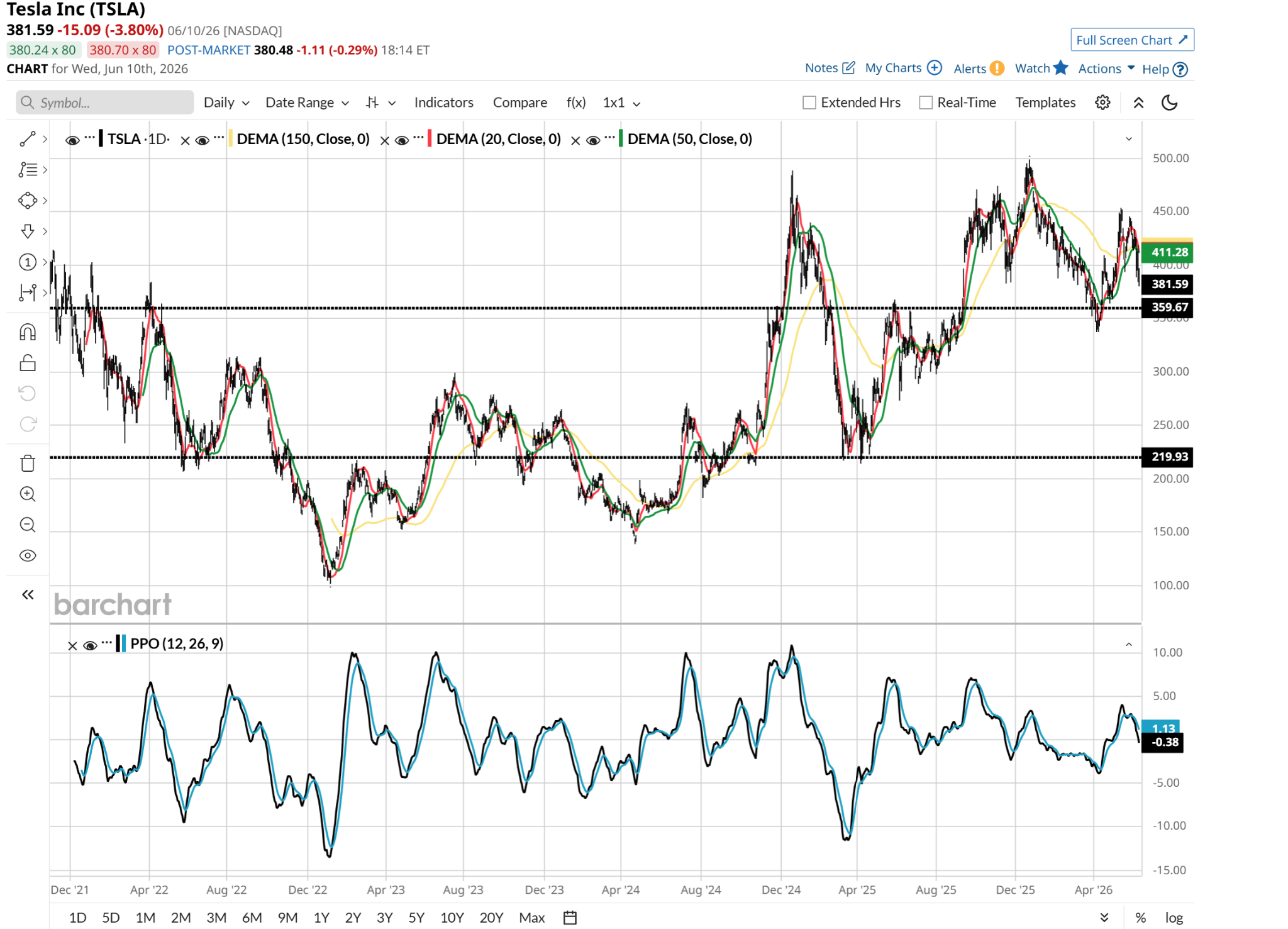
Or, as Tesla (TSLA) has since November 2021. TSLA is up about 0% the past four and a half years. And that chart is not sending strong signals about bullish turns.
 www.barchart.com
 Let’s get one thing straight out of the gate: I have zero interest in buying SpaceX stock at the initial public offering price and holding it in romantic anticipation of a multi-decade compounding journey. Yet I am one investor. And I never intend to tell anyone else what to do. I just try to report from my experience.
When a company with this much cultural momentum hits the public markets, the initial pricing is rarely based on boring fundamental metrics like free cash flow or enterprise value. It is priced for absolute perfection based on sheer hype. SpaceX, the core business, is a compelling proposition in the longer term. But the corporate structure is loaded up with far less desirable assets. That won’t stop Friday from being a circus.
The Strategy
My first thought when looking at this upcoming listing is simple: When can I start trading options around it? I am not looking to play the long side of this hype machine. Instead, I am drawing up a highly specific, tactical blueprint to try to exploit the inevitable post-IPO bubble when it inevitably pops and leaves late-stage retail investors holding the bag. Provided conditions comply by mid-late next week when options trading commences, I hope to implement this personally. Not for a fortune, not even a small one. But 100 shares worth.
Because when you own 100 shares, you can sell one call option against it. And use that cash flow, in part, to buy more than one put option. Quite a bit out of the money. What we call a convexity hedge.
This is essentially an option collar, the strategy I’ve discussed here many times. However, the roles of the three pieces of the collar are different. The stock holding is really just a “sacrificial lamb” that allows me to bring in some decent cash flow from selling calls against it. The volatility on this stock will be outrageous, and so the call premium will be too. That’s my assumption, a week out.
The difference on the put side, versus my usual collar routine, is that the puts are not interested in keeping tight tabs on the downside. I might strike the puts 10% to 15% out of the money, even 20%, we’ll see. But I’ll be buying as many as I consider reasonable. What happens when you own 100 shares but the stock is falling like a knife, and your put options reach the point where they start acting like you are short 300, 400, 500 shares of stock? Good things!
To demonstrate this, since SpaceX stock and options do not trade as of this writing, I’ll use Elon’s other business, TSLA.
The goals:
If the stock rises, get some fraction of that upside. If the stock falls a little or rises a little, I make or lose a little. If the stock tanks, the more rapidly it descends, the more those “convexity” put option profits explode in value, overwhelming the decline in the stock since the options will essentially turn into a “short” position on several hundred shares of stock. And the call options will increase in value on the stock’s decline as well.The Tesla Proxy Example
 www.barchart.com
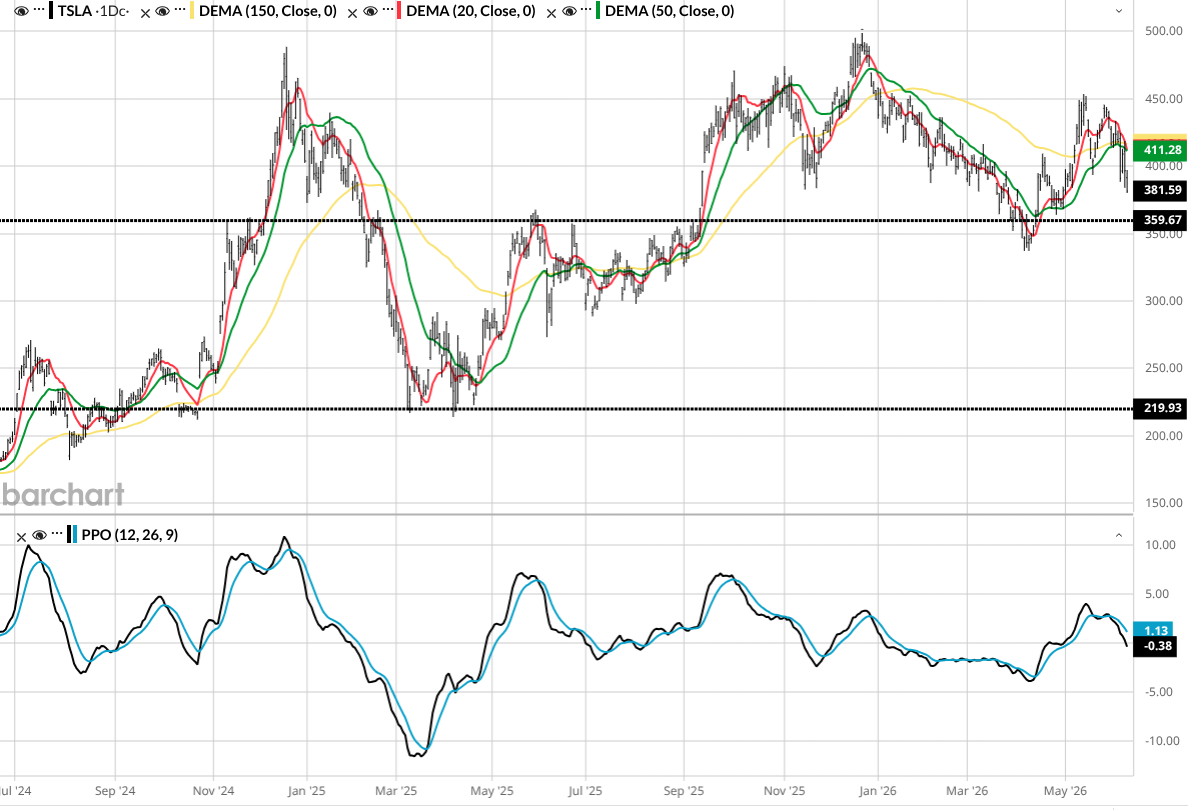
 The chart of TSLA, the stand-in for SpaceX in this example, is above. Shares closed for about $382 (rounded) on Wednesday. So 100 shares cost me roughly $38,000.
 www.barchart.com
 I sell one call out to 12/18/26 and cap my upside just a few percent higher at $400. That awards me $5,200 in option premium. If I want to use that as my “put option purchase budget,” I can, and I will, to keep this simple. It costs me $1,300 to buy the right to sell 100 shares of TSLA at $275 during the next six months. That’s the put option side, the driver of this.
That means I can buy four put options ($5,200 cost) without laying out additional dollars. The option cost and proceeds offset each other. But the action I’m looking for is the stock falling sharply, say to well below $350, perhaps $300 or lower, within the first month or so.
To be clear, this trade sample is really strategic speculation. It is not my go-to by any means. But if the setup is there, I may do it. And if the stock falls that hard, I’m essentially short 400 shares versus 100 “long,” plus the call option premium I took in ($5,200) will crash toward zero. That is, I can exit that for much less than I took in up front.
If SpaceX stock is as big an event as many anticipate, this will be on my docket for next week. And if so, I’ll write a follow-up article on it, once the story plays out.
SpaceX: The Real Deal on the Biggest-Ever IPO
Don't buy into the romance of the listing. Treat the SpaceX IPO for what it mathematically is: a high-velocity casino event where the sharpest play isn't trying to guess how high the rockets can fly, but rather engineering a framework that lets the crowd pay for your ticket while you wait for gravity to do the heavy lifting.
Rob Isbitts created the ROAR Score, based on his 40+ years of technical analysis experience. ROAR helps DIY investors manage risk and create their own portfolios. For Rob's written research, check out ETFYourself.com.
On the date of publication, Rob Isbitts did not have (either directly or indirectly) positions in any of the securities mentioned in this article. All information and data in this article is solely for informational purposes. For more information please view the Barchart Disclosure Policy here.
More news from Barchart
The SpaceX IPO: Why I Think Next Week, Not Friday, Is the Real Event Unusual Options Activity Points to Bullish Bets on MSFT, CSX, and SCHW Bearish Setups Alert: June 11th Bear Put Spread Scan Results Investors Buy Long-Dated Microsoft Call Options in Huge Volumes - A Very Bullish Signal