


The final day of the trading week looks set to play out uneventfully.
While the S&P 500 and Nasdaq 100 are poised to open in the red on Friday, it shouldn’t be too painful. Crude oil prices have calmed on the news that peace talks continue despite Iran and the U.S. trading missiles earlier this week.
Can’t Get Enough Options?: Join the list for Barchart’s daily unusual options report, delivered free.
Yesterday, all of the major stock indexes were up nicely -- S&P 500 (0.81%), Nasdaq Composite (1.30%), Dow (0.27%) and the Russell 2000 (1.22%) -- thanks to lower oil prices and big gains in semiconductor stocks. Through the first four days of trading, the S&P 500 is up 0.81%.
In Thursday’s unusual options activity -- I define it as options with 500 contracts traded and expiring in seven days or longer -- Rocket Companies (RKT) had the highest Vol/OI (volume-to-open interest) ratio at 113.43. That was the only option with a ratio over 100. Unsurprisingly, the total options volume yesterday was 54.18 million, well below the 90-day average of 63.07 million. Investors are on vacation.
A week ago, I flagged an unusually active call option on QXO (QXO), a building-materials distribution consolidator run by Brad Jacobs, a veteran of industry roll-ups. Today, I go back to the QXO trough.
Although its four unusually active options yesterday didn’t have high Vol/OI ratios, I remain interested in the stock given the significant negative sentiment surrounding it.
Have an excellent weekend.
The QXO Options in Question

The two options that I’m interested in are the March 19/2027 $18 and $25 calls expiring in 253 days. QXO’s overall options volume yesterday was 75,392, nearly double the 30-day average; the fifth-highest in the past three months. The two options accounted for 62% of the day’s volume.
Both calls are well OTM (out of the money). The stock last traded at $18 in late June and $25 in mid-April. So it’s entirely possible to revisit those levels in the next 8-9 months.
Breaking down the trades on these two calls, two particular trades stand out, and they, uncoincidentally, happened at the same time.

The 12,000 trade was at $2.39, and the 24,000 was at $1.00, both at or near the midpoint of the bid and ask prices. That’s indicative of an institutional trader/investor. The most likely options strategy here is a Long Call Ratio Spread or Call Ratio Backspread.
Why a QXO Long Call Ratio Spread?
The trader/investor is bullish on QXO stock and is expecting increased volatility and a big move in its share price by early spring.
Based on the two trades, they sold 12,000 contracts of the $18 call for $2,868,000 in premium and simultaneously bought 24,000 contracts of the $25 call for $2,400,000, resulting in a net credit of $468,000, or $0.39 per spread.
Typically, a trader/investor using a spread strategy buys equal amounts of options in both legs of a multi-leg trade. In a ratio spread, the ratio is uneven; in this case, a 1:2 ratio.
The Long Call Ratio Spread is, in fact, two strategies combined: a Bear Call Spread, which is bearish, and a Long Call, which is bullish. The trader/investor does this to create defined downside risk and unlimited upside reward.
Here’s a look at the bear call spread based on Friday morning activity.

In this example, the bear call spread involves selling one $18 call for $165 in premium and buying one $25 call for $135 in premium, resulting in a net credit of $30. The maximum loss (defined risk) is $670 [$25 strike price - $18 strike price- $0.30 net credit * 100]. Under a Long Call Ratio Spread strategy, they would then buy a second $25 call for another $135.
Let’s assume QXO is trading 19.33% higher at $17.31 at expiration next March. That’s below the $18.30 breakeven. Therefore, you make a maximum profit of $30. That’s the downside protection.
If you’re extremely bullish about QXO, you buy 12,000, 24,000 or whatever number of calls you can afford and go long. Here’s what the March 19/2027 $25 call looks like early in Friday trading:

At the $1.35 ask price, the stock has to move higher by 81.6% over the next 252 days for the trader/investor to break even on this long call. The expected move is 19.33%, which explains the low 14.51% probability of breaking even or better.
Most traders aren’t in the habit of spending $2.4 million on calls that will likely expire worthless, as is the case with the QXO $25 calls bought by this particular trader/investor. By adding 12,000 short $18 calls, generating a net credit, they provide themselves with a potential return of $468,000, even if the share price doesn’t move higher as expected.
The Bottom Line on QXO’s Long Call Ratio Spread
QXO stock should possess above-average volatility over the life of the $18 and $25 call options. That’s good news for this particular trader/investor because this results in greater price movement, higher and lower.
Because there is a net credit of $39 per spread in this long call ratio spread, there are two breakeven points. The first, for the lower strike, is $18.39, while the breakeven for the upper strike is $31.61.
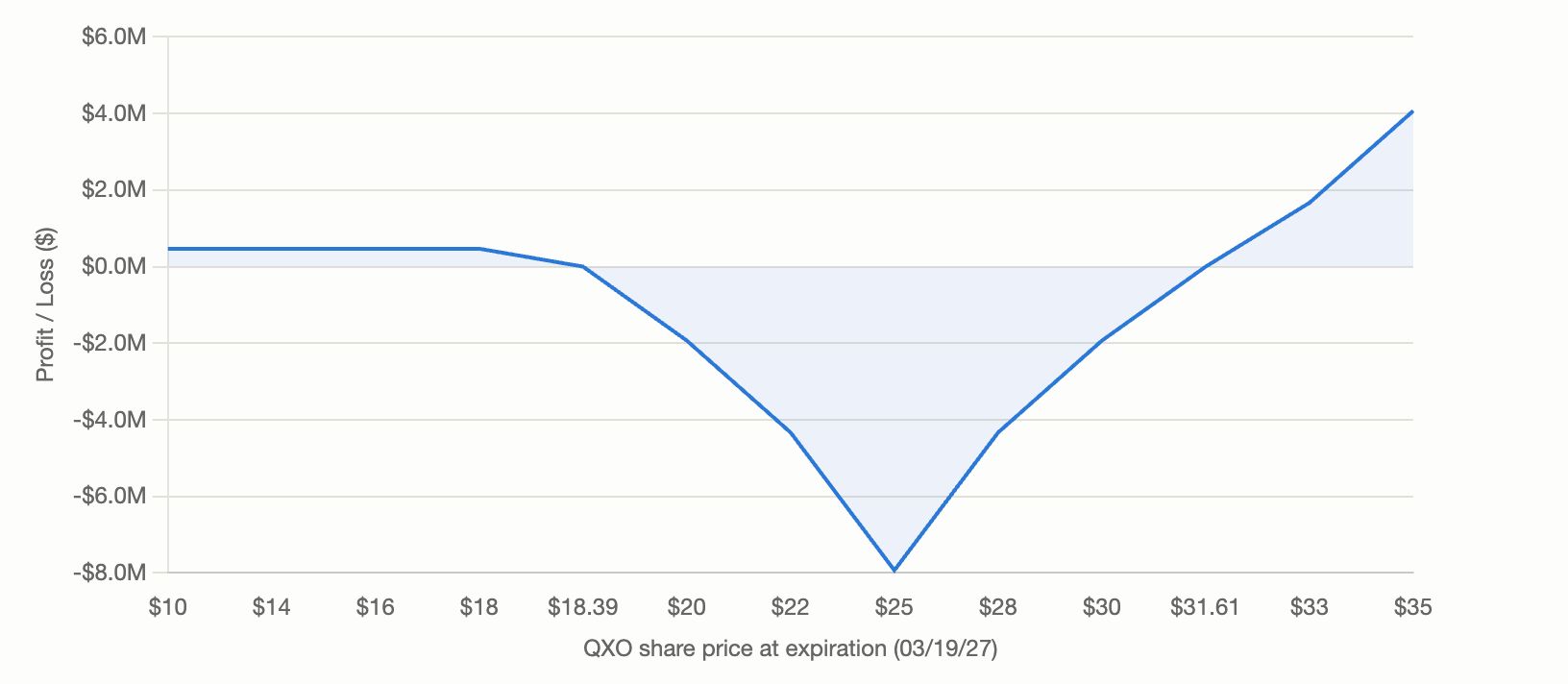
Source: Barchart.com and Claude Sonnet 5.0
The worst-case scenario would be if the share price were $25 at expiration. That would result in a $7.932 million loss [$25 share price - $18.39 lower breakeven price * 12,000 contracts * 100 shares] for the trader/investor.
If QXO’s share price is $35 at expiration, the trader/investor’s profit would be $4.07 million [$35 share price - $31.61 upper breakeven *12,000 contracts * 100 shares].
While it might seem that the worst case is worse than the best case, the best case isn’t $4.07 million; it’s unlimited. The profits rise by approximately $1.2 million for every dollar above the upper breakeven of $31.61. Meanwhile, the downside risk is capped at $7.932 million.
The other thing to keep in mind here is that the trader/investor in question may have other options strategies in place that we’re unaware of to address this concern.
Ultimately, this is a bet that the share price will either barely move by next March or jump considerably higher on good earnings or other news-related catalysts.
On the date of publication, Will Ashworth did not have (either directly or indirectly) positions in any of the securities mentioned in this article. All information and data in this article is solely for informational purposes. For more information please view the Barchart Disclosure Policy here.
More news from Barchart
Unusual Options Activity in This 1 Stock Highlights a Bet on Big Volatility with Capped Downside and Unlimited Upside EQT Stock Is Near a Trough, Attracting Value Investors Ahead of Earnings Occidental Petroleum Stock’s Unusual Options Activity Signals Bullish Bets Amid Oil Rally With Iran Tensions Heating Up Again, Chevron Stock Looks Enticing