


When Michael Burry makes a move, Wall Street rarely shrugs it off. The investor who famously predicted the 2008 U.S. housing market collapse – later immortalized in The Big Short – has built a reputation for spotting opportunities long before the crowd catches on. So, when he starts buying a stock and doubles down on a broader investment theme, investors naturally start asking what he sees that everyone else might be missing.
That is exactly what’s happening now.
More Top Stocks Daily: Go behind Wall Street’s hottest headlines with Barchart’s Active Investor newsletter.
Burry disclosed that he had added to his position in Chinese e-commerce giant JD.com (JD). Then he went a step further, telling investors that now is “a particularly good time” to hunt for bargains in Hong Kong stocks, arguing that the spotlight could gradually shift away from the markets that have dominated this year’s AI-fueled rally.
It’s a timely call. While South Korea’s chip-heavy market ($KSI), Japan’s Nikkei ($NKY), and semiconductor stocks have enjoyed massive gains as artificial intelligence (AI) enthusiasm swept global markets, Hong Kong has largely been left standing on the sidelines. The Hang Seng Index ($HSI) has struggled to keep pace with its global peers this year, weighed down by sluggish consumer spending, softer growth across China’s e-commerce sector, and investors’ growing preference for AI-driven winners over traditional Chinese equities.
Yet Burry has never been one to chase what everyone else already loves. Instead, he has built his career by buying what others overlook. That brings the focus squarely to JD.com, China’s second-largest e-commerce company. Unlike many online marketplaces, JD operates much like Amazon (AMZN), owning its warehouses, logistics network, and supply chain – a capital-intensive model that delivers a more reliable customer experience and stronger long-term economics.
With Hong Kong equities creeping back onto institutional investors’ radar and Burry putting fresh money behind JD, could this be the start of the stock’s next leg higher? Let’s unpack why he is betting on JD stock now.
About JD.com Stock
Founded in 2006 and headquartered in Beijing, China, JD.com is a leading supply chain-focused technology and e-commerce company with a market capitalization of $38.2 billion. Beyond online retail, the company generates revenue through marketplace services, digital marketing, healthcare offerings, logistics, and technology-driven supply chain solutions.
It also operates one of China’s largest logistics networks, serving both consumers and third-party businesses. As consumer spending gradually recovers, JD is increasingly focused on expanding its higher-margin service businesses and growing its international footprint to support long-term profitability and sustainable growth.
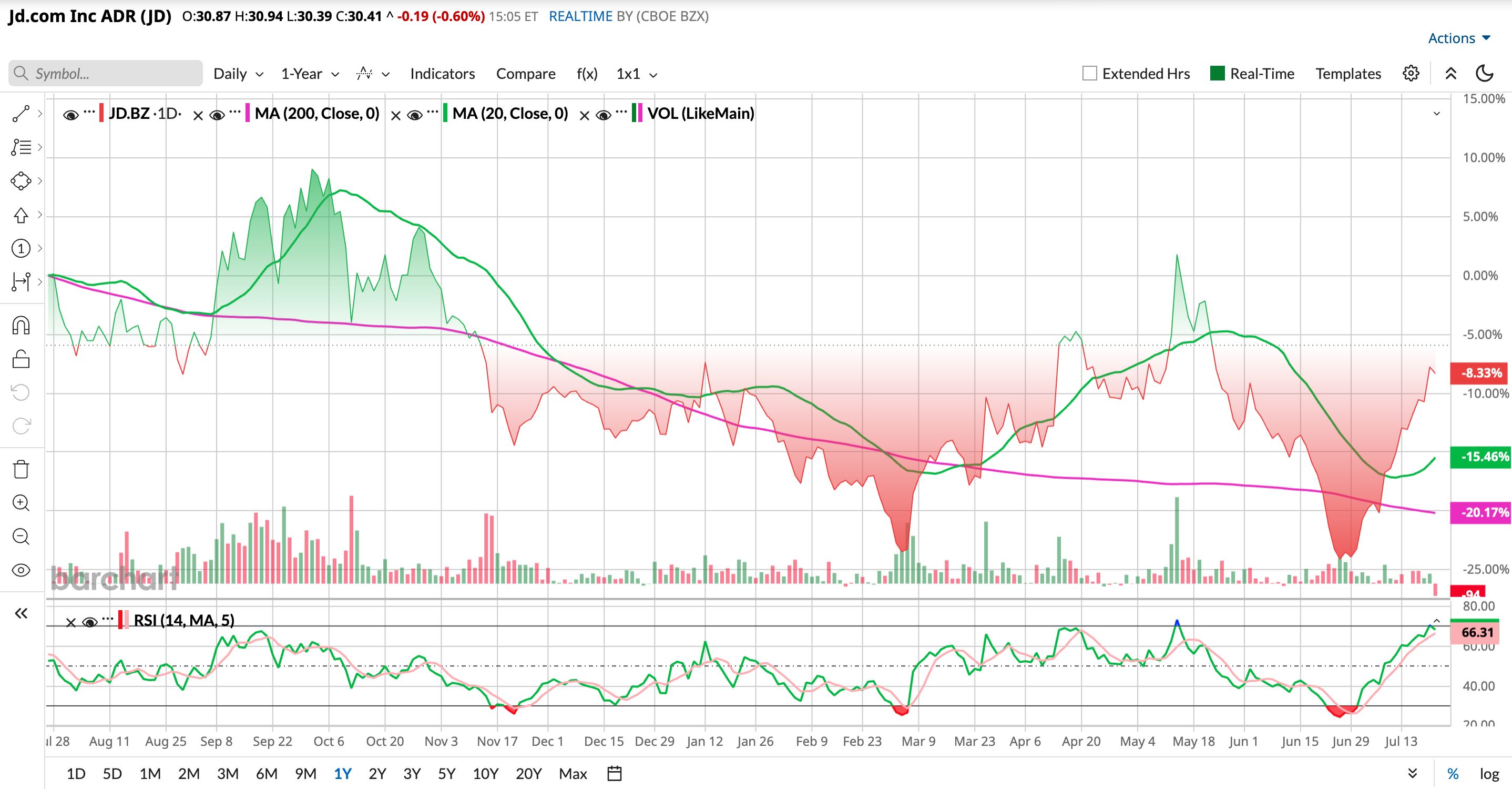
JD.com’s shares are quietly regaining their footing after a volatile start to the year. The stock broke out to a fresh 2026 high in May following better-than-expected first-quarter earnings, before pulling back with the broader Chinese technology sector. Even after that retreat, JD has climbed about 24.1% from its early-March low of $24.51 and recently reclaimed the psychologically important $30 level, putting it within striking distance of its 2026 peak, although it still sits 12.7% below that high.
The recent momentum has been notable. Year-to-date (YTD), JD is up 5.9%, while the stock has gained 10.3% over the past month and 5.4% over the last five trading sessions alone.
The technical picture is also steady. JD’s 20-day moving average has turned higher again as the recent rally gathered momentum, signaling improving short-term trend strength. The stock has reclaimed its 200-day moving average for the first time since May – often viewed as a sign that the longer- term trend is strengthening. Even so, the shares remain 36.7% below their late-2024 high, leaving room for further upside if momentum continues to build.
Adding to the bullish setup, JD’s 14-day Relative Strength Index (RSI) has now climbed to 68.01, pushing the stock near overbought territory. While that reflects strong upward momentum and growing investor optimism, it also suggests the shares may be due for a period of consolidation or short-term profit-taking after their recent rally.
 www.barchart.com
 Valuation-wise, JD still looks inexpensive. The stock is priced at just 9.41 times forward adjusted price-to-earnings and 0.20 times forward sales, well below both its sector averages and its own historical median. If the company delivers on expectations for stronger revenue and earnings growth, that discount could become harder for the market to ignore.
And the appeal does not stop with its inexpensive valuation. JD.com also rewards shareholders with an annual dividend yielding 3.31%, backed by a healthy 55.58% payout ratio, offering a compelling mix of value, growth, and income.
A Snapshot of JD.com’s Q1 Numbers
JD.com’s first quarter of fiscal 2026 was mixed but painted an increasingly encouraging picture. While some of its legacy businesses continued to face headwinds, the company delivered stronger overall revenue growth, improved profitability across key segments, and growing momentum in newer businesses that are becoming increasingly important to its long-term strategy.
For Q1, the company generated revenue of RMB 315.7 billion ($45.8 billion), up 4.9% year-over-year (YOY). Non-GAAP earnings came in at RMB 5.12 per ADS ($0.74). Although earnings declined from the prior-year period, management emphasized that the quarter marked a solid start to the year, supported by improving business trends and stronger execution. CEO Sandy Xu said JD entered 2026 “on firm ground,” pointing to a sequential recovery in its electronics and home appliances business, continued double-digit growth in general merchandise, accelerating marketplace revenue, and healthier profitability across the organization.
The company’s traditional electronics and home appliances segment remained under pressure, with revenue falling 8.4% YOY. Management attributed much of the weakness to a difficult comparison against last year’s government-backed trade-in program, along with higher smartphone and PC prices driven by rising memory costs. Even so, Xu noted that consumers are increasingly gravitating toward premium products and leading brands – a trend that plays to JD’s strengths in supply chain management and customer service. Looking ahead, she expects growth in home appliances to accelerate during the second half of the year as comparisons become easier and JD’s expanding omnichannel retail network gains traction.
Meanwhile, general merchandise revenue climbed 14.9%, fueled by strong demand for supermarket products, healthcare, apparel, and home goods. JD Supermarket maintained double-digit growth while further accelerating from the previous quarter. Marketplace and marketing revenue jumped nearly 19%, while advertising revenue recorded its sixth consecutive quarter of double-digit growth. JD’s merchant ecosystem also continued expanding rapidly, with the active merchant base posting triple-digit annual growth thanks to new brands, industrial suppliers, and restaurant partners joining JD Food Delivery.
Third-party merchants accounted for more than half of all orders, with their sales outpacing both JD's first-party business and overall platform growth, helping lift margins through advertising and commission revenue. Customer engagement also strengthened, with quarterly and annual active users rising more than 20%, shopping frequency jumping 37%, and JD PLUS membership posting another quarter of double-digit growth. Meanwhile, JD Food Delivery sharply narrowed losses while boosting monetization, and JD Logistics delivered 29% revenue growth as AI, robotics, and operational efficiencies drove a sixfold increase in non-GAAP operating income.
JD’s international expansion is gaining traction. Its European retail platform, Joybuy, now serves over 30 major cities and 40 million consumers. Meanwhile, AI adoption accelerated as Jingyan more than tripled user engagement, while JoyStreamer and warehouse robotics saw rapidly growing use across merchants and logistics operations.
JD ended the quarter with a strong RMB 216 billion in cash, cash equivalents, restricted cash, and short-term investments. It also returned capital to shareholders by repurchasing $631 million in stock, retaining $1.4 billion in buyback authorization, and paying a $1.4 billion annual dividend, or $1 per ADS.
Wall Street expects JD.com to maintain its growth momentum in the second quarter, with revenue projected to reach approximately $50.6 billion, while EPS is expected to be $0.77 per share, representing a robust 40% annual increase. Looking further ahead, analysts expect full-year fiscal 2026 EPS to climb 30.5% YOY to $2.78, followed by another 19.8% annual increase to $3.33 in fiscal 2027, reflecting confidence in the company’s long-term earnings trajectory.
What Does Wall Street Expect of JD Stock Now?
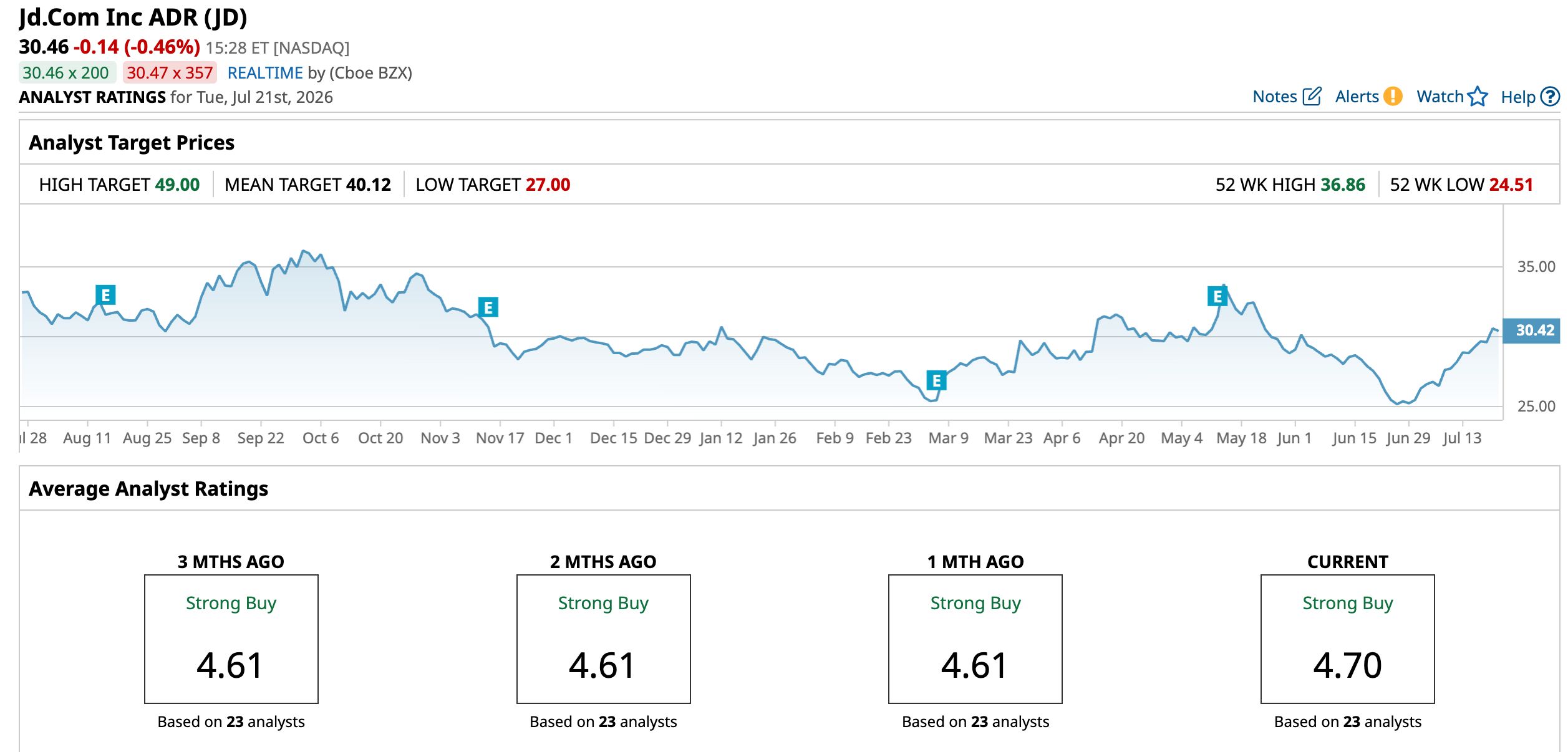
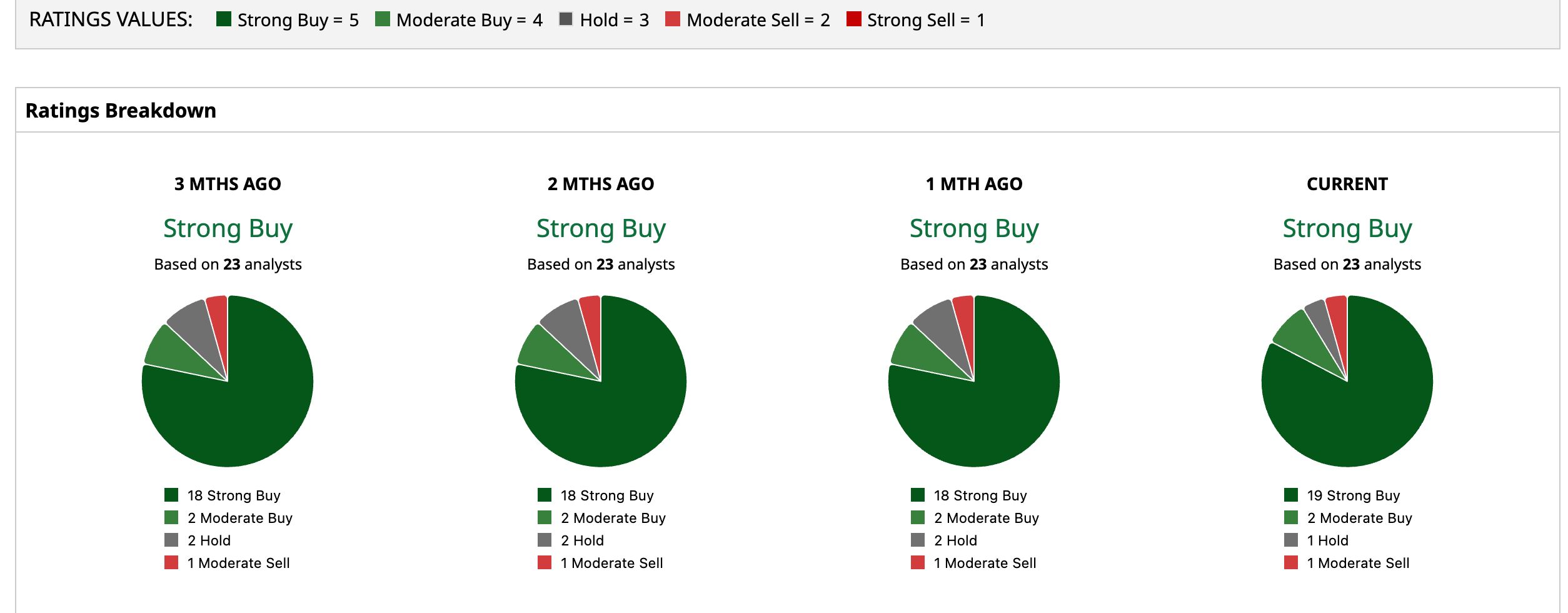
Overall, JD stock carries a “Strong Buy” rating. Of the 23 analysts covering the stock, 19 recommend a “Strong Buy,” two have a “Moderate Buy,” one suggests a “Hold,” and the remaining one is advising a “Moderate Sell.”
At current levels, the average price target of $40.12 suggests that JD stock has upside potential of 31.7%. Meanwhile, the Street’s highest price target of $49 implies JD could rally as much as 60.9%.
 www.barchart.com
  www.barchart.com
 In Conclusion
Michael Burry has built a career by spotting value where others see uncertainty, and his latest bet suggests he believes JD.com’s story is far from over. Whether his thesis fits one's portfolio ultimately comes down to their views on Chinese equities, appetite for risk, and how long they are willing to stay invested. But with improving fundamentals, an inexpensive valuation, and multiple growth catalysts taking shape, JD looks like a stock that deserves far more attention than it’s currently getting.
On the date of publication, Sristi Suman Jayaswal did not have (either directly or indirectly) positions in any of the securities mentioned in this article. All information and data in this article is solely for informational purposes. For more information please view the Barchart Disclosure Policy here.
More news from Barchart
Michael Burry Is Betting Big on Hong Kong Stocks. Why He Likes JD.com Shares Here. Morgan Stanley Just Downgraded Adobe Stock. Here's Why. Tesla’s Q2 Deliveries Could Lift Results. But TSLA Stock Needs More Than Strong EV Sales. Google Is Developing a Chip for Its Own AI Models. What This Means for GOOGL Stock.