

Oklo (OKLO), a clean energy technology firm headquartered in Santa Clara, California, was launched in 2013 by CEO Jacob DeWitte and co-founder Caroline Cochran. The firm designs and builds Aurora fast fission powerhouses, compact, modular nuclear reactors capable of generating 15 to 75 megawatts of electricity, while operating an integrated platform for nuclear fuel recycling and production.
Oklo’s commercial model covers three main pillars: power generation, nuclear fuel services, and medical and industrial radioisotopes produced via its Groves reactor initiative. Backed by a contracted customer pipeline of over 14 GW across AI data centers, defense, industrial, and government clients, and $2.5 billion in cash secured through a successful $1.2 billion ATM offering, Oklo is positioning itself as a core advanced fission provider for the AI infrastructure market.
Don’t Miss a Day: From crude oil to coffee, sign up free for Barchart’s best-in-class commodity analysis.
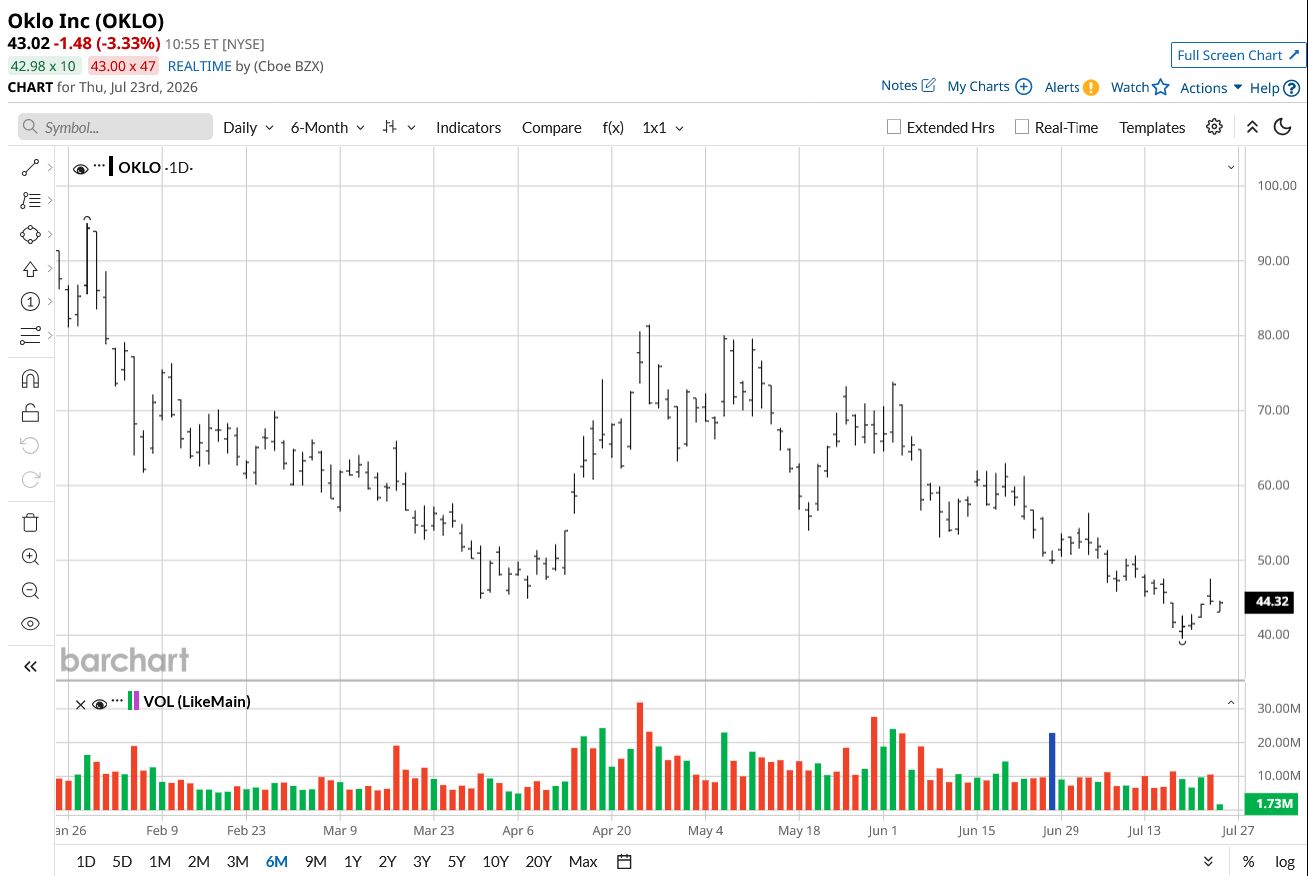
OKLO Stock Falls From Highs
OKLO shares are trading within a 52-week range of $40.98 to $193.84 and hold a market capitalization of roughly $7.67 billion, a pullback of about 77% from its 52-week peak. The company's valuation has contracted substantially from its previous highs, with the equity down 28.76% over the past year.
In contrast to the Russell 3000 Index (IWV), which gained ground on AI expansion trends through 2026, OKLO lagged its benchmark due to its pre-revenue position, heavy capital spending requirements, and a broader shift away from speculative clean energy assets, even as regulatory milestones and a key Department of Energy (DOE) safety approval for the Groves reactor highlighted ongoing operational progress.
 www.barchart.com
 Q1 Results Meet Estimates
Oklo delivered Q1 2026 EPS of -$0.19, landing right in line with Wall Street estimates, while recording no revenue as commercial operations remain underway. Despite meeting bottom-line targets, the stock dropped 10.84% in post-market trading, driven by market focus on commercialization timelines and heavy capital outlays ahead of initial power generation. The company finalized its 2025 at-the-market equity offering in the first quarter of 2026, raising about $1.18 billion in net proceeds by issuing 12.4 million shares.
The net loss for Q1 2026 reached $33.1 million, as a $51.2 million operating loss was offset by $21.3 million in net interest and dividend earnings. Operating cash outflow was $17.9 million, while investing activities absorbed $359 million, mainly allocated to marketable securities alongside $32.8 million in capital expenditures. Reserves of cash, cash equivalents, and marketable securities reached $2.54 billion as of March 31, 2026, offering substantial runway to fund multi-year construction across its energy, fuel, and radioisotope segments.
Management reiterated its full-year 2026 outlook, calling for $80–$100 million in operating cash utilization and $350–$450 million in capital expenditures for property, plant, and equipment, fully backed by its $2.5 billion balance sheet. Key developments during the period featured groundbreaking at the Aurora-INL site at Idaho National Laboratory, progress on its 1.2-gigawatt campus in Ohio, and plans to bring the Groves radioisotope reactor to criticality by July 4, 2026. By integrating AI and strategic partnerships to speed up reactor and fuel supply design, Oklo is building core facilities like the Aurora Fuel Fabrication Facility and the Tennessee Advanced Fuel Center, key drivers in its push to deploy modular nuclear power at scale for data centers and defense applications.
Oklo Joins Trump Admin Initiative
Oklo shares surged 5.8% in post-market trading on Tuesday after Bloomberg reported that the advanced fission company is joining a $200 million Donald Trump administration initiative aimed at accelerating the deployment of nuclear reactors for AI data centers. The program, also involving X-Energy (XE), Microsoft (MSFT), and Nvidia (NVDA), is expected to be formally announced at a U.S. Department of Energy AI energy summit as early as Wednesday.
The initiative targets steep reductions in the time required to design, license, and build new nuclear plants, while also cutting the staffing levels needed to operate them, addressing two of the most significant bottlenecks slowing advanced nuclear commercialization. The program comes amid mounting concerns that explosive AI data center growth is driving electricity prices sharply higher nationwide. The DOE estimates approximately 300 GW of new nuclear capacity will be required by 2050, a timeline that positions Oklo's Aurora fast fission powerhouses as a compelling near-term solution given their modular design, compact footprint, and advanced licensing progress.
Should You Buy OKLO Stock?
Oklo's inclusion in a $200 million Trump administration nuclear acceleration program, alongside Microsoft and Nvidia, is a landmark validation of its Aurora fission technology and a powerful regulatory tailwind at a critical moment in the company's commercialization journey.
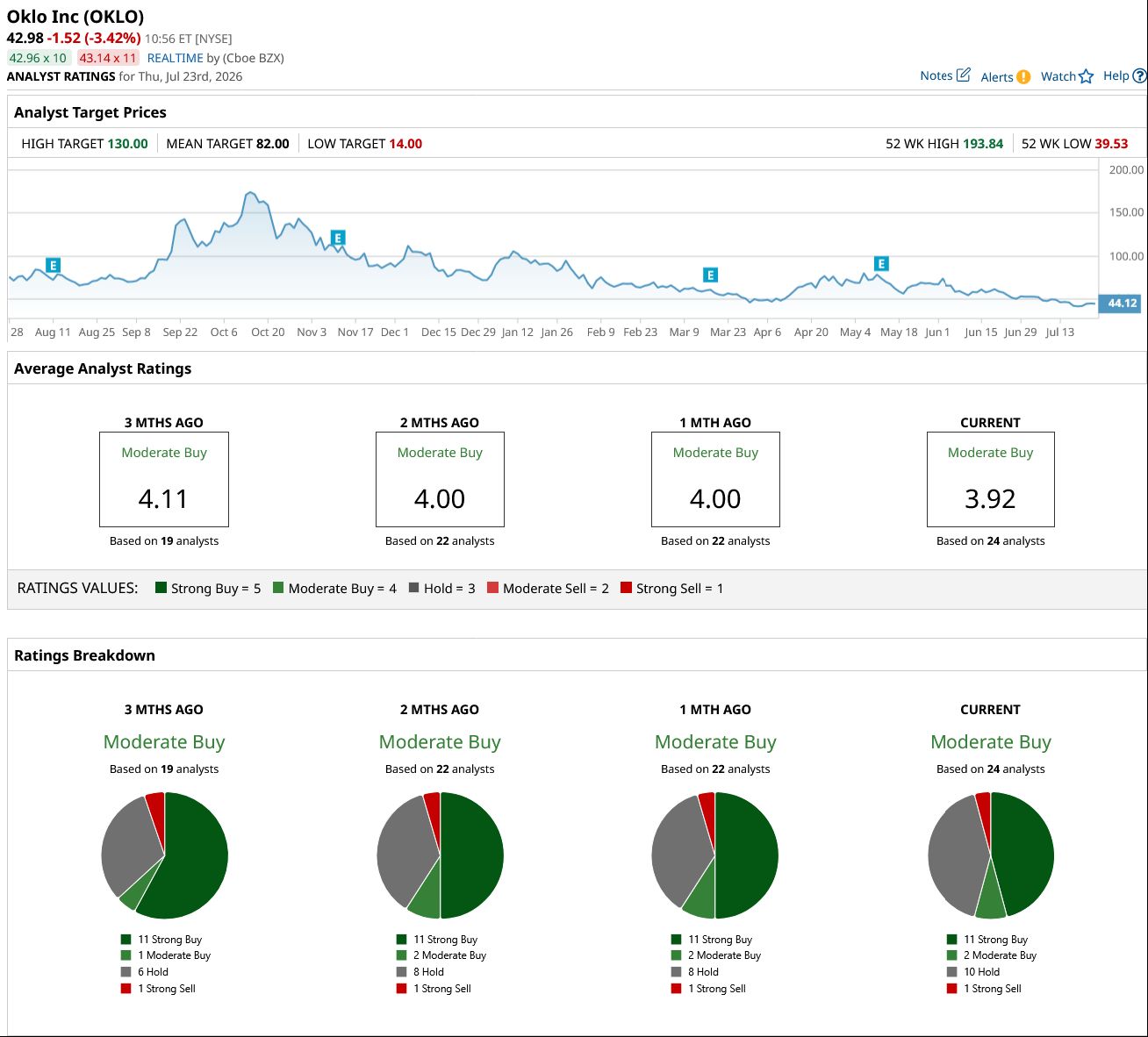
Wall Street remains cautiously optimistic, giving OKLO a consensus "Moderate Buy" rating across 24 analyst ratings, comprising 11 “Strong Buy,” two “Moderate Buy,” 10 “Hold,” and one “Strong Sell,” a notably split verdict reflecting both the transformative opportunity and the pre-revenue execution risk. The mean price target of $82 implies a compelling 91% upside from current levels, making OKLO one of the most asymmetric clean energy plays in the market today.
 www.barchart.com
 On the date of publication, Ruchi Gupta did not have (either directly or indirectly) positions in any of the securities mentioned in this article. All information and data in this article is solely for informational purposes. For more information please view the Barchart Disclosure Policy here.
More news from Barchart
Oklo Joins Trump’s $200M Nuclear Push for AI. Here’s What It Means for OKLO Stock. Here’s Why BofA Thinks Fervo Energy’s Pullback Is a Buying Opportunity Costco Officially Launched Standalone Gas Stations. Don’t Count on This Fueling Another Leg Higher in COST Stock. Fervo Energy Just Scored a New ‘Buy’ Rating. Here’s Why.