

Super Micro Computer (SMCI) may have grabbed the headlines with its preliminary fourth-quarter results, but Wall Street’s attention quickly shifted beyond the company itself. While investors digested what the AI server maker delivered, brokerage firm Wedbush highlighted potential winners from the update, pointing to positive implications for the famous Silicon Valley chipmaker Nvidia Corporation (NVDA), along with some other players.
Analyst Matt Bryson argued that Super Micro’s better-than-expected gross margins are more than just a company-specific win. They also signal that demand for AI infrastructure continues to outpace supply, creating a favorable backdrop for the broader AI hardware ecosystem. And with Nvidia's GPUs powering the vast majority of AI servers shipping today, the chip giant appears to be in the strongest position to capitalize on that trend.
More Yield, Less Trap: Sign up free to get Barchart’s daily Dividend Investor newsletter straight to your inbox.
The analyst believes Nvidia's supply chain advantage, combined with relentless demand for artificial intelligence (AI) chips, could make it one of the biggest beneficiaries of the same trends driving Super Micro’s impressive preliminary update. If that’s the case, SMCI’s earnings surprise may be telling investors just as much about Nvidia's future as it does about Super Micro’s own.
With that in mind, let’s take a closer look at Nvidia now.
About Nvidia Stock
Founded in 1993 and headquartered in Santa Clara, California, Nvidia has come a long way from making graphics chips for gamers. Today, it is the company powering much of the world’s AI boom, with its GPUs driving everything from massive data centers and cloud computing to robotics, autonomous vehicles, and advanced scientific research.
As businesses continue pouring billions into AI infrastructure, Nvidia has transformed into one of the world’s most valuable companies, boasting a market capitalization of over $5.1 trillion. Plus, it is investing in energy-efficient computing and next-gen technologies, further strengthening its position as one of the defining forces in the future of AI.
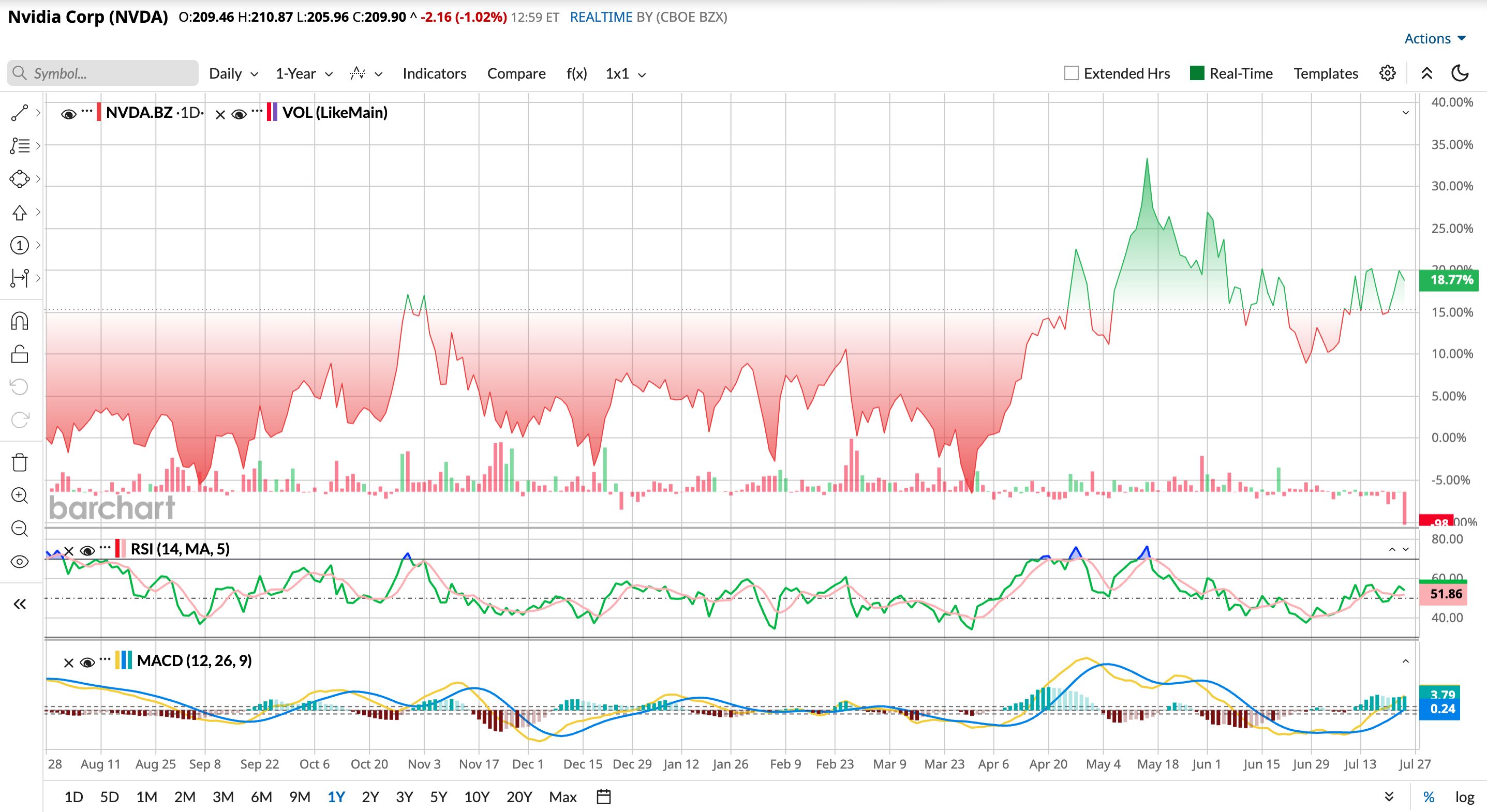
Nvidia has spent the past year reminding Wall Street why it remains the poster child of the AI revolution. But if there’s one lesson investors have learned in 2026, it is that even the market’s hottest stock does not travel in a straight line. The first few months of the year were far from smooth, with NVDA stock caught in a tug-of-war between sky-high expectations and bouts of profit-taking. Then came April, when buyers stepped back in, reigniting the stock’s momentum.
That comeback gathered steam through May, with Nvidia racing to a record high of $236.54 on May 14. Since then, however, the stock has eased 11.4% from its peak as investors took some money off the table amid questions over the pace of AI spending, hyperscaler capital expenditures, and growing competition across the semiconductor space. Even so, the broader trend hardly looks broken.
NVDA has delivered a jaw-dropping return of roughly 14,755% over the past decade. Over the past 52 weeks, the stock is up about 22.8%, while year-to-date (YTD), it has gained 12.5%. Even after slipping below the psychologically important $200 mark in late June, the shares have bounced back 10%, suggesting buyers were more than willing to scoop up the dip rather than run for the exits.
Technically, the picture appears steady. The 14-day RSI sits at 53.85, signaling neutral momentum with room for further upside before entering overbought territory. Meanwhile, the MACD oscillator has flashed a fresh bullish crossover, with the MACD line moving above the signal line and the histogram turning positive. It is not exactly a green light to floor the accelerator just yet, but it does suggest momentum is quietly shifting back in the bulls’ favor.
 www.barchart.com
 For a company that’s become synonymous with the AI boom, Nvidia's valuation is surprisingly grounded. The stock trades at 23.59 times forward price-to-earnings, below both its historical average and the broader sector, suggesting investors are not paying nosebleed prices despite its blockbuster run. Its price-to-sales ratio of 13.05 times still carries a premium, but that’s the price of owning the industry’s clear AI leader.
Also, Nvidia is sharing the wealth, boosting its quarterly dividend from $0.01 to $0.25 per share – a strong vote of confidence in its cash-generating power and long-term outlook.
A Snapshot of Nvidia's Q1 Numbers
The chip giant reported fiscal first-quarter 2027 earnings in May, and it did not just beat expectations, but raised the bar yet again. Despite all the chatter about slowing AI spending, customers are still opening their wallets in a big way, and Nvidia continues to be the biggest beneficiary. Revenue soared 85% year-over-year (YOY) to $81.6 billion, while adjusted EPS jumped 140% annually to $1.87.
At the same time, Nvidia streamlined its reporting structure into two major platforms – Data Center and Edge Computing – reflecting how AI is spreading far beyond traditional cloud computing into nearly every corner of the economy. Revenue from the Data Center business segment jumped 92% annually to $75.2 billion, fueled by relentless AI infrastructure spending from hyperscale cloud providers, enterprises, governments, and industrial customers. Demand for the company’s Blackwell AI systems and networking products remained resilient. Hyperscale cloud customers alone generated $37.9 billion in revenue, up 115% YOY, while Nvidia's AI Cloud, Industrial, and Enterprise business climbed 74% to $37.4 billion.
Meanwhile, the Edge Computing segment delivered $6.4 billion in revenue, a healthy 29% increase, helped by resilient workstation demand despite a sluggish consumer PC market.
In addition, the company kept printing cash. Nvidia finished the quarter with $80.6 billion in cash and investments while generating a massive $48.6 billion in free cash flow. It rewarded shareholders with $19.3 billion in share repurchases and $243 million in dividends.
Looking ahead, management expects Q2 revenue of roughly $91 billion, plus or minus 2%, which implies roughly 12% sequential growth and approximately 95% YOY growth at the midpoint.
Meanwhile, analysts estimate fiscal Q2 2027 revenue to be around $918 billion, and EPS is anticipated to jump 103% YOY to $2.01. For fiscal year 2027, the bottom line is expected to surge 92.3% annually to $8.79 per share, before rising by another 37.9% YOY in fiscal 2028 to $12.12 per share.
Why Wedbush Thinks Super Micro’s Update Is Also a Win for Nvidia
Super Micro’s preliminary results may have exceeded expectations, but Wedbush believes the bigger takeaway extends well beyond the server maker itself. According to analyst Matt Bryson, the sharp jump in gross margins suggests that demand for AI infrastructure is still running ahead of available supply, a dynamic that could work in Nvidia's favor.
The brokerage firm pointed to steady industry commentary throughout June and July indicating that demand for AI server components, including Nvidia's Grace Blackwell, Blackwell, and Hopper platforms, continues to outpace supply. That shortage has likely allowed companies like Super Micro to command better pricing and sell a richer mix of high-end AI systems, helping lift profitability.
And, Wedbush believes some large data center projects may have been delayed, temporarily weighing on Super Micro’s revenue while improving its product mix. Plus, the company’s growing order backlog signals that customers are still placing sizable AI infrastructure orders for future deployment.
For Nvidia, that’s an encouraging backdrop. Wedbush notes that the overwhelming majority of AI servers built by Super Micro and other original equipment manufacturers rely on Nvidia GPUs. Wedbush believes that Nvidia has done one of the best jobs in the industry of securing its supply chain, putting it in a strong position to capitalize as AI server shipments ramp higher and demand remains robust.
What Do Analysts Expect for Nvidia Stock?
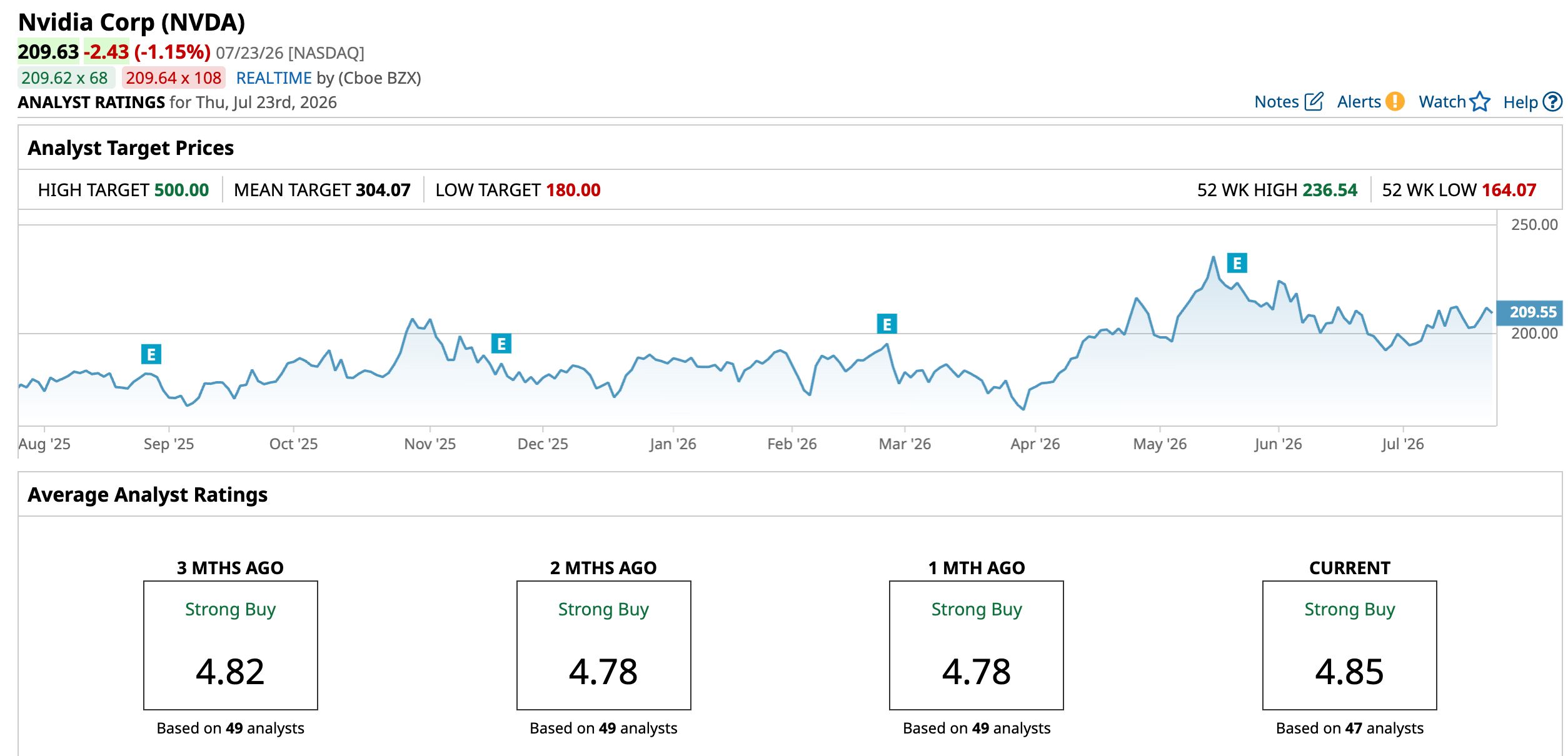
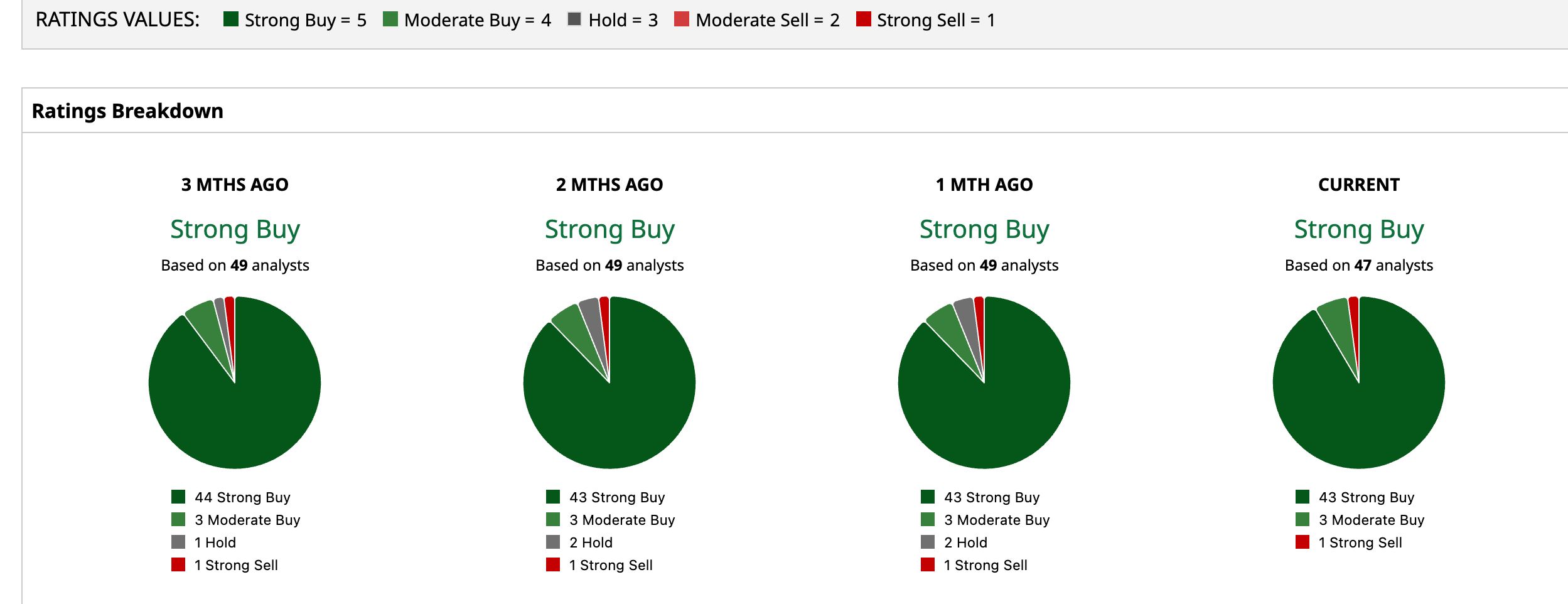
Overall, analysts are optimistic about Nvidia's growth potential, giving the stock a consensus rating of “Strong Buy.” Of the 47 analysts covering the stock, 43 advise a “Strong Buy,” while three suggest “Moderate Buy,” and only one suggests a “Strong Sell.”
The average analyst price target for NVDA is $304.07, indicating potential upside of 45.1%. The Street-high target price of $500 suggests that the stock could rally as much as 138.5% from here.
 www.barchart.com
  www.barchart.com
 On the date of publication, Sristi Suman Jayaswal did not have (either directly or indirectly) positions in any of the securities mentioned in this article. All information and data in this article is solely for informational purposes. For more information please view the Barchart Disclosure Policy here.
More news from Barchart
Seagate Stock Is Off 20% From Its High. Why July 28 Earnings Could Trigger a Rebound. Oil’s Surge Sparks Unusually Active Options Bets on Petrobras, Nike, Goldman Sachs and Other 120+ DTEs How Nvidia Stock Could Be the Biggest Winner from Super Micro’s Preliminary Results Why This Analyst Is Pounding the Table on ‘Pioneer’ CoreWeave Stock