

When people talk about the artificial intelligence (AI) race, they usually mean chips. But Nvidia’s (NVDA) latest launch points to a quieter bottleneck that is becoming just as important. Nvidia recently unveiled a new networking system called Spectrum-6. The system is designed to connect the enormous number of chips inside modern AI data centers. Spectrum-6 doubles the capacity of the previous generation and is designed for facilities running hundreds of thousands of chips at once.
Here is why that matters. As AI data centers get bigger, the challenge is no longer just having enough chips, but keeping them all working together. If even one connection is slow, every other chip has to wait, and hugely expensive hardware sits idle. Networking ties the chips together, and it has become one of the biggest factors in how well an AI factory runs. Spectrum-6 is Nvidia’s answer to that problem. It also means that Nvidia is now selling far more than just chips.
More Top Stocks Daily: Go behind Wall Street’s hottest headlines with Barchart’s Active Investor newsletter.
The list of early adopters is the interesting part. Alongside cloud providers like Microsoft (MSFT), CoreWeave (CRWV), and Nebius (NBIS), two names stand out: Tesla (TSLA) and SpaceX (SPCX). Neither of these firms rent out computing for a living. Both are building AI systems for their own use — Tesla for training its self-driving and robotics software, and SpaceX for its xAI and Grok work. The inclusion of these two companies on the list shows how large their in-house ambitions have grown. It also marks a shift in where the AI race is being fought.
The competition is no longer only about who has the fastest chips. It is also about who can tie those chips together most efficiently. That is where Nvidia is pulling ahead.
About Nvidia Stock
Nvidia operates as a leading AI infrastructure company. It designs GPUs, networking solutions, and software used in data centers, gaming, and automotive applications. Founded in 1993, the company is headquartered in Santa Clara, California.
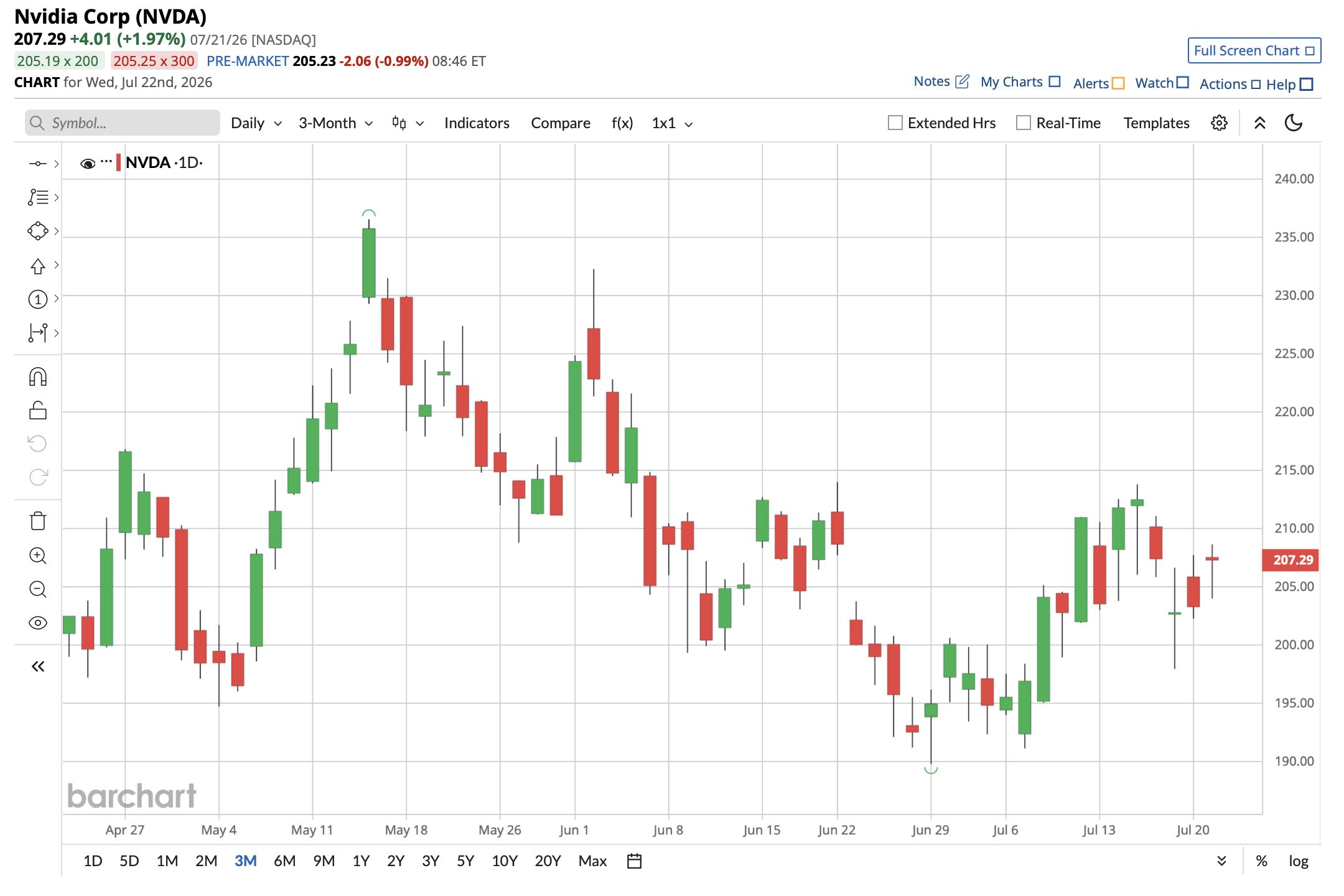
NVDA stock was trading sideways until March 2026. However, the stock grew rapidly in May, reaching a new 52-week high of $236.54. Recently, Nvidia saw a slight dip on concerns over reported delays for its next-generation chips. Over the last 12 months, the stock is up 22%, notably underperforming the iShares Semiconductor ETF (SOXX), which is up 128% over the same period. Despite underperforming SOXX, NVDA stock has still outperformed the S&P 500 Index ($SPX) for the past year.
 www.barchart.com
 Nvidia now has a market capitalization of more than $5 trillion, making it one of the world's most valuable companies. Yet NVDA stock still trades at a surprisingly modest multiple. The forward price-to-earnings (P/E) ratio of 23.5 times sits well below the five-year average, while the forward price-to-sales (P/S) ratio is 23.2 times. The valuation looks cheap for a business that is booming. Earnings are forecast to grow 92% in fiscal 2027, which is a massive jump for a company of this scale. The balance sheet also makes the valuation more attractive.
Launches like Spectrum-6 show the company moving beyond chips into networking, the wiring that ties AI factories together. The more of that system Nvidia owns, the more its customers will rely on it. The market has priced NVDA stock as if its best days are behind it, but the company’s own products suggest otherwise.
Nvidia’s Data Center Business Powers an 85% Revenue Jump
Nvidia reported its first-quarter fiscal 2027 earnings report on May 20. Revenue of $81.6 billion increased 85% year-over-year (YOY), while the GAAP gross margin was 74.9%, largely flat sequentially. Data Center segment revenue of $75 billion increased 92% YOY. Hyperscalers made up more than half of all data-center revenue, reaching $38 billion and increasing 12% quarter-over-quarter, while ACIE represented the other $37 billion portion of data-center revenue. The company stated that the revenue was driven by strong demand for its Blackwell architecture and continued acceleration in GB300 NVL72. CFO Colette Kress also said that the firm achieved strong performance across all key financial metrics. Free cash flow rose from $35 billion in Q4 2026 to a record $49 billion in Q1 2027.
Looking forward, Nvidia expects revenue of $91 billion, while gross margin is anticipated to be a healthy 75%. However, Nvidia excluded China data-center revenue due to ongoing U.S. export restrictions on advanced AI chips and related regulatory uncertainty. For full-year fiscal 2027, the company expects GAAP and non-GAAP tax rates to be between 16% and 18%. Moreover, the company expects OpEx growth somewhere in the upper 40% range for fiscal 2027.
What Do Analysts Expect for Nvidia Stock?
On July 14, Keybanc analyst John Vinh reiterated a “Buy” rating on Nvidia while increasing his price target from $310 to $330. Morgan Stanley, Bank of America Securities, and Citi have also kept positive ratings on NVDA stock, with BofA offering a price target of $350.
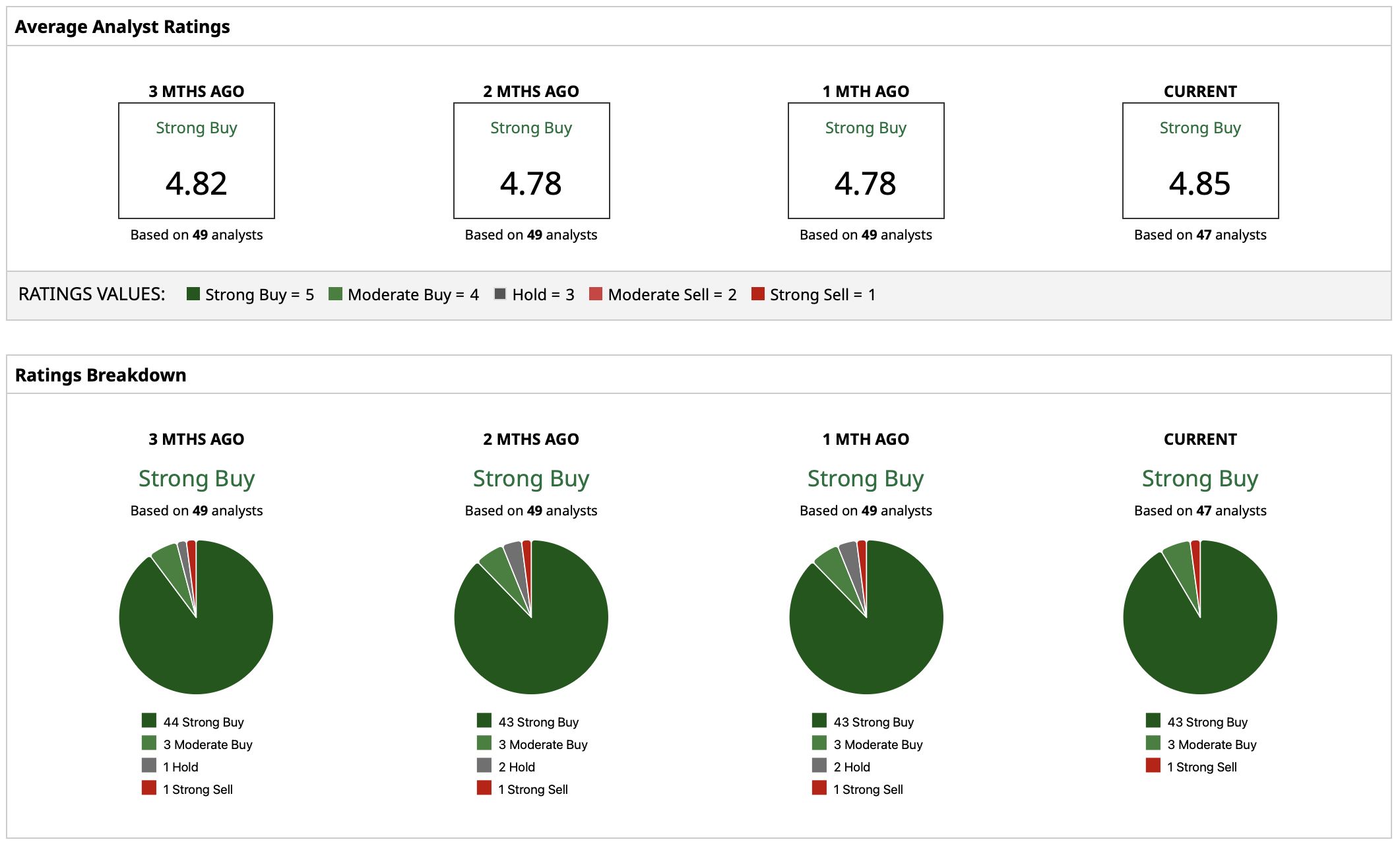
Based on 47 Wall Street analysts with coverage, Nvidia holds a consensus “Strong Buy” rating. The mean target price of $304.07 implies potential upside of 46% from current levels. The lowest price target is $180, while the high price target of $500 points to healthy upside expected. Overall, many analysts believe investors are undervaluing a company that has consistently beaten on revenue and earnings.
 www.barchart.com
 On the date of publication, Jabran Kundi did not have (either directly or indirectly) positions in any of the securities mentioned in this article. All information and data in this article is solely for informational purposes. For more information please view the Barchart Disclosure Policy here.
More news from Barchart
Texas Instruments Generates Strong Free Cash Flow - But TXN Stock Looks Cheap to Value Buyers Nvidia Just Launched a Product That Will Drive Future AI Factories. SpaceX and Tesla Already Want In. CoreWeave vs. Nebius Stock: Nvidia Backs Both, But Here’s the 1 You Should Buy Investors Keep Buying the DRAM ETF Despite the Selloff. They Might Be Right About Memory Stocks.