

Netflix’s (NFLX) stock fell close to its 52-week low immediately after the company reported its second-quarter results on July 16. However, the performance doesn’t quite explain the drop. Revenue rose about 13% from a year earlier. Earnings beat the Wall Street consensus. Margins also held steady. Yet the stock sold off sharply after the report and has stayed near the bottom of its range since.
The trigger was the outlook. Netflix guided to slightly slower revenue growth next quarter, and after a few quarters of cooling numbers, that was enough to worry investors. While the slowdown is real, the company is still growing revenue at a double-digit pace. The market pricing the stock as though something has broken could be an overreaction.
More Top Stocks Daily: Go behind Wall Street’s hottest headlines with Barchart’s Active Investor newsletter.
What the selloff misses is what Netflix is doing with the weakness. The company just carried out the largest share buyback in its history, spending billions buying its own shares while the price was falling. That is management betting on its own shares when the market would not. And subscribers are not canceling. Netflix holds on to them better than anyone else in streaming. The advertising business is still on track to roughly double this year. That is a lot of strength for a company trading near its 52-week low.
It is not difficult to figure out why the company is so confident in its own business. AI was supposed to disrupt its business, and judging by the investor sentiment and short-term weakness, it appears to be true. But investors are missing one thing. The ability of any media firm to create new content through AI has certainly improved, but no one has a distribution medium as strong as Netflix. So when operational efficiency gets enhanced many times because what used to take months to edit can now be done in days using AI, Netflix still has the advantage because it can make the same content on a bigger scale and distribute it at a much lower cost. The moat is still intact; it is just the market that is treating it like it's not there anymore.
 www.barchart.com
 The Market Priced In a Slowdown That Hasn’t Happened
Netflix’s valuation tells the same story as the selloff. The forward GAAP price-to-earnings (P/E) of 19.57x sits 46% below the company’s 5-year average of 36.06x. The forward price-to-sales (P/E) ratio of 5.70x is also 20% below its own average of 7.11x. Both measures say investors are paying far less for Netflix than they have been used to, which is unusual for a company still growing revenue at double digits. The EPS outlook does not explain the selloff either. Analysts expect growth of 42% in 2026, followed by a modest 6% in 2027, before improving again with a 20% surge in 2028. That is slower than Netflix’s best years, but it does not match the sharp reaction in the stock.
The balance sheet is decent. Netflix holds $9.13 billion in cash against $16.65 billion in debt. That leaves a small net debt position for a company worth close to $292 billion. This financial strength is what helped the company fund a record buyback last quarter. For investors who believe the selloff went too far, the cheap multiples present an attractive entry point.
About Netflix Stock
Netflix is a global entertainment company that provides streaming services. The company offers a wide range of content, including TV shows, documentaries, movies, and games. It also provides members the ability to receive streaming content through a host of internet-connected devices, including TVs, digital video players, and mobile devices. Founded in 1997, the company is headquartered in Los Gatos, California.
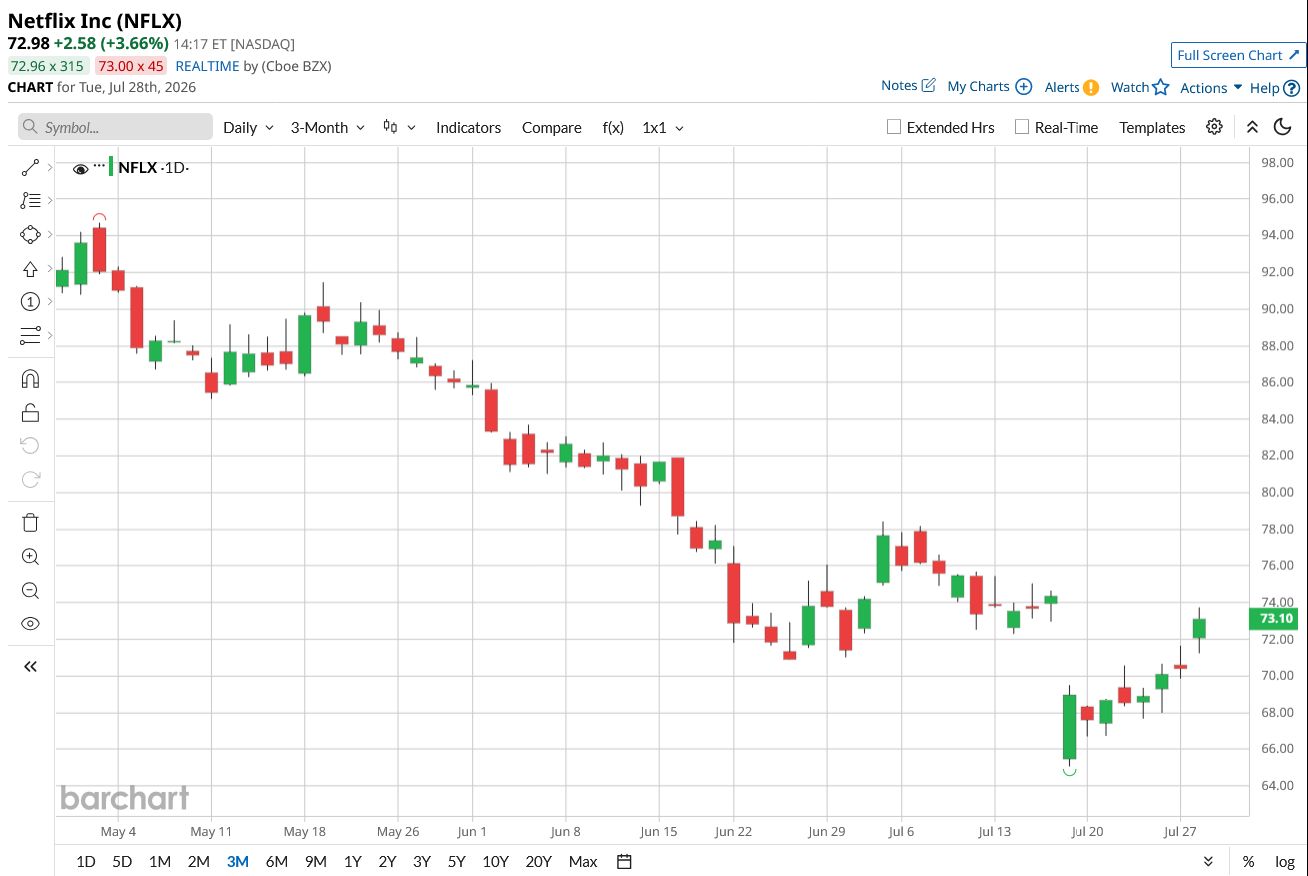
NFLX stock was listed at $107 on April 16, and since then, the stock has continued to decline. The stock is currently trading at about $70, near its 52-week low. Year-to-date (YTD), Netflix’s stock has declined by 22%, significantly underperforming the S&P 500’s ($SPX) 8.56% gain in the same period. The decline was driven by lower-than-consensus revenue. In addition, advertising revenue missed analyst expectations. Investors are concerned that the company’s future growth may not justify its premium valuation.
Solid Results, Cautious Outlook
Netflix reported its second-quarter fiscal 2026 earnings report on July 16. Revenue of $12.56 billion marginally missed the Wall Street consensus of $12.58 billion. The earnings per share came in at $0.80, up 1.27% from the $0.79 forecast. The company’s foreign exchange revenue grew 11% year-over-year (YoY). Net income for the second quarter was $3.40 billion, compared with $3.13 billion in the same period last year.
Going forward, for Q3 fiscal 2026, the company guided to 12% reported revenue growth and 11% FX-neutral growth. For the full year 2026, the company expects top-line growth of 13% to 14%, which would translate into roughly $6 billion of incremental revenue compared with last year. Moreover, the management highlighted that content spending is expected to rise about 10% in 2026, slower than revenue growth. This should help support margins over time.
What Do Analysts Expect for NFLX Stock?
Wall Street analysts remain divided on Netflix's outlook. On July 22, DBS analyst Sachin Mittal maintained a “Buy” rating on Netflix with a target price of $112. In contrast to DBS, Pivotal Research analyst Jeffrey Wlodarczak reiterated a “Hold” rating on the stock with a target price of $70. The analyst gave his “Hold” rating due to a combination of factors related to the company’s current performance and future outlook. He expressed his concerns about the company’s third-quarter outlook. The analyst cut his long-term subscriber forecasts, raised cost assumptions to address engagement challenges, and lowered his terminal EBITDA multiple. He also highlighted intensifying competition from short-form social media and free ad-supported streaming services.
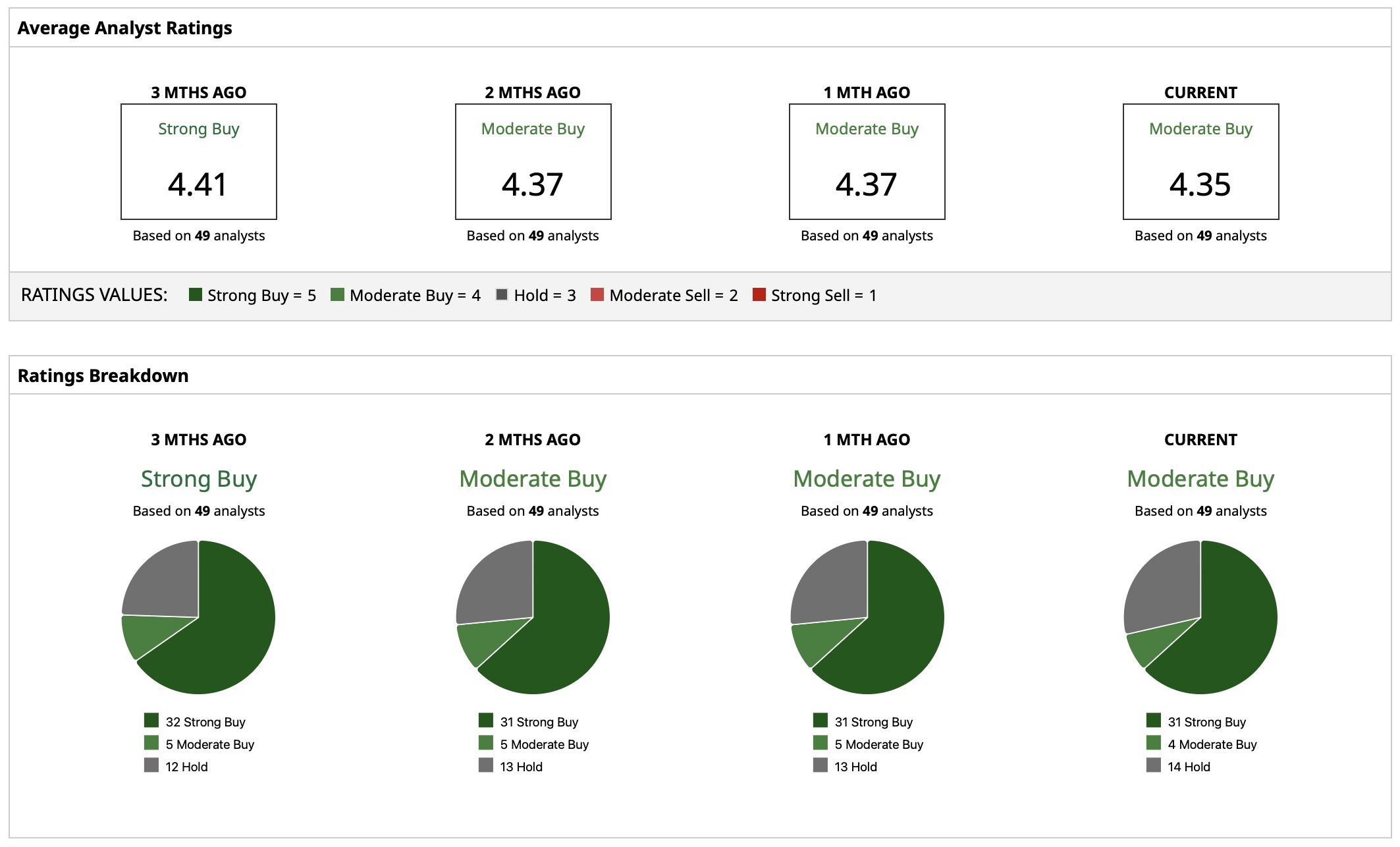
NFLX stock carries a consensus “Moderate Buy” rating from 49 Wall Street analysts covering it. Based on their estimates, the stock has a median price target of $95.48, which reflects a 31% upside from current levels. In addition to this, the highest price target of $135 reflects an impressive 85% upside from the current share price.
 www.barchart.com
 On the date of publication, Jabran Kundi did not have (either directly or indirectly) positions in any of the securities mentioned in this article. All information and data in this article is solely for informational purposes. For more information please view the Barchart Disclosure Policy here.
More news from Barchart
Netflix Is Betting Billions That AI Will Strengthen Its Business. Here’s What Wall Street Is Missing. Apple Just Knocked Nvidia Off Its $5 Trillion Throne. Here’s Why the Crown May Not Change Hands Again. Broadcom Secures Memory Chip Deal With Samsung. What This Means for AVGO Stock Investors. A $1 Billion Reason to Buy Naver Stock Now