


Goldman Sachs says global data center power use could climb by as much as 165% by the end of the decade, making fast power supply more important than ever. Bloom Energy (BE) has emerged as one of the clearest winners from rising AI power demand.
Their solid oxide fuel cells can deliver electricity in weeks or months, which gives it a strong edge when AI sites need power quickly. That strength showed up in its second quarter 2026 results, released after the close on July 28, when revenue passed $1 billion for the first time and reached $1.065 billion.
More Top Stocks Daily: Go behind Wall Street’s hottest headlines with Barchart’s Active Investor newsletter.
CEO KR Sridhar said every major U.S. hyperscaler and more than a dozen neoclouds, AI labs, and colocation operators have now tested and approved Bloom’s technology for their AI sites.
With demand still building and Bloom gaining more ground as a power supplier, the question now is simple. Is this post-earnings setup still a good chance to buy the stock?
Bloom Energy Earnings Snapshot
Bloom Energy builds on-site power systems with solid oxide fuel cells, giving data centers and industrial customers cleaner and more reliable electricity. The company is based in San Jose, California, and its market value is now $46.58 billion.
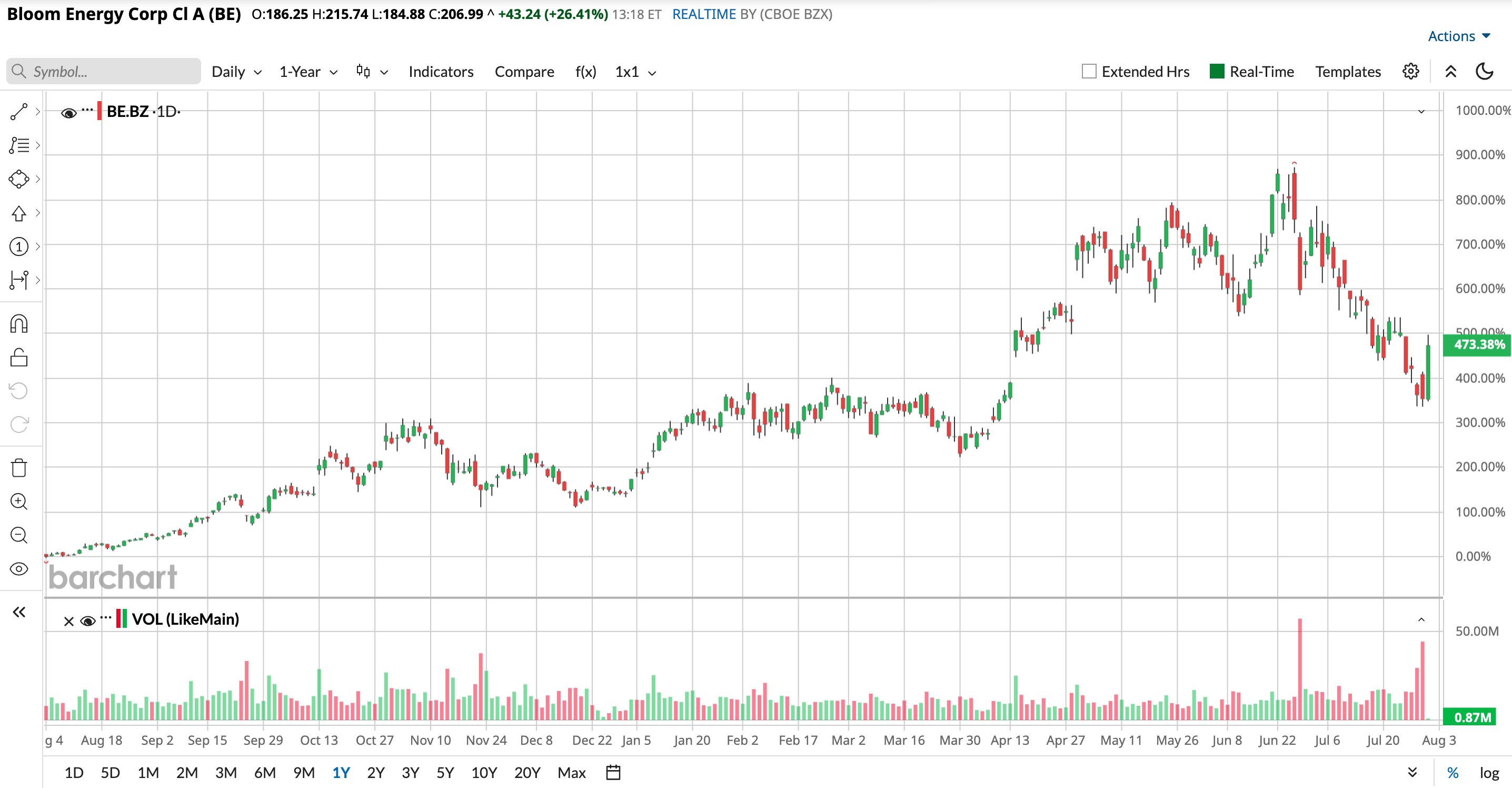
Its shares have a 52-week gain of 448.5% and a year-to-date (YTD) rise of 137.5%.
 www.barchart.com
Bloom has premium valuations of 79.64 times forward price-to-earnings, far above the sector median of 22.77 times, and at 11.71 times sales versus the sector median of 1.83 times.
Bloom reported second-quarter results on July 27, and the numbers were sharply better than a year earlier. Revenue reached $1.1 billion, up 165.5% from $401.2 million, while product revenue climbed 215.4% to $935.4 million from $296.6 million.
Their gross margin rose to 33.4% from 26.7%, and non-GAAP gross margin improved to 34.3% from 28.2%. This matters because stronger margins show Bloom is growing with better operating leverage, not just higher volume.
Bloom’s EPS came in at $0.62, up from a loss of $0.18, while non-GAAP EPS rose to $0.78 from $0.10. It also posted operating income of $182.2 million, compared with a $3.5 million operating loss a year earlier.
This shift was even clearer on a non-GAAP basis, where operating income reached $239.6 million versus $28.6 million. The company’s operating cash flow turned positive at $226.4 million, reversing a $213.1 million cash outflow last year.
These results strengthen the case that AI power demand is becoming a meaningful earnings driver.
Bloom’s Major AI Infrastructure Deals
Bloom Energy and Brookfield expanded their AI infrastructure partnership on June 30, raising the funding plan from $5 billion to $25 billion. That is a large step up from October 2025, and it points to steady demand for fast, reliable power from hyperscalers and AI data center builders.
Also, BE signed a $2.6 billion deal with Nebius Group (NBIS) for fuel cell capacity. The 10-year agreement covers the installation, operation, and maintenance of Bloom’s solid oxide fuel cell systems across Nebius’s growing AI and cloud data center network.
The company then added another $1.7 billion contract tied to Nebius’s AI buildout. Industrial Development Funding and Oaktree Capital are backing the meter power solutions for Nebius Group N.V.’s AI operations, which makes the scale of the opportunity even clearer.
Together, these deals show how closely Bloom is tied to rising power demand from AI infrastructure.
Bloom Energy Analyst Outlook and Targets
Bloom Energy is heading into its next earnings report with Wall Street expecting a big jump in profit. For the quarter ending September 2026, analysts see EPS at $0.36, up from a loss of $0.01 a year earlier, which works out to growth of about 3,700%.
The company also lifted its full-year outlook for revenue between $3.9 billion and $4.2 billion, which is above its earlier high-end target of $3.8 billion as demand from AI data centers and hyperscale operators keeps building.
UBS added more support to the stock by lifting its price target to $350 and keeping a “Buy” rating. That lines up with the idea that Bloom still has room to grow as demand for its power systems stays strong.
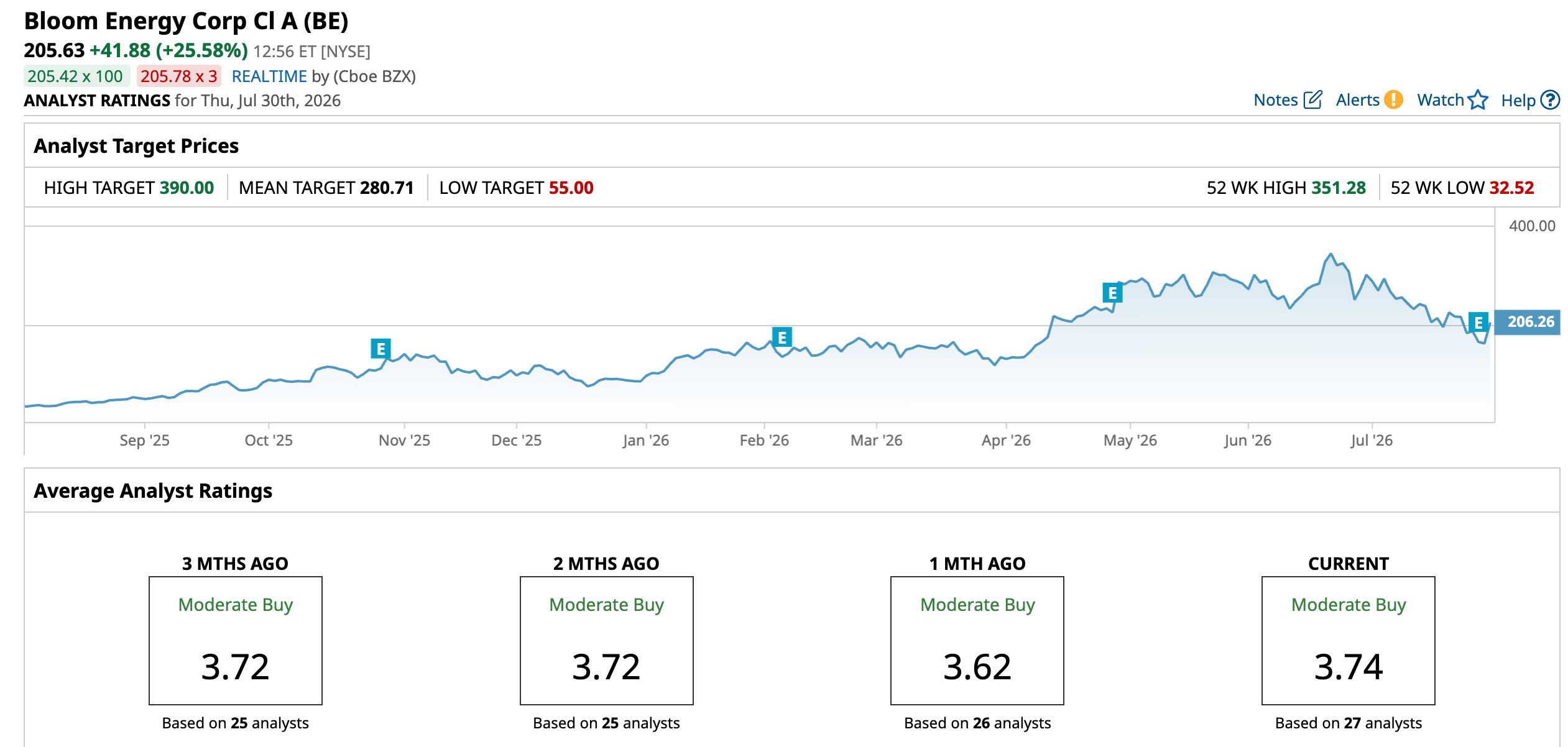
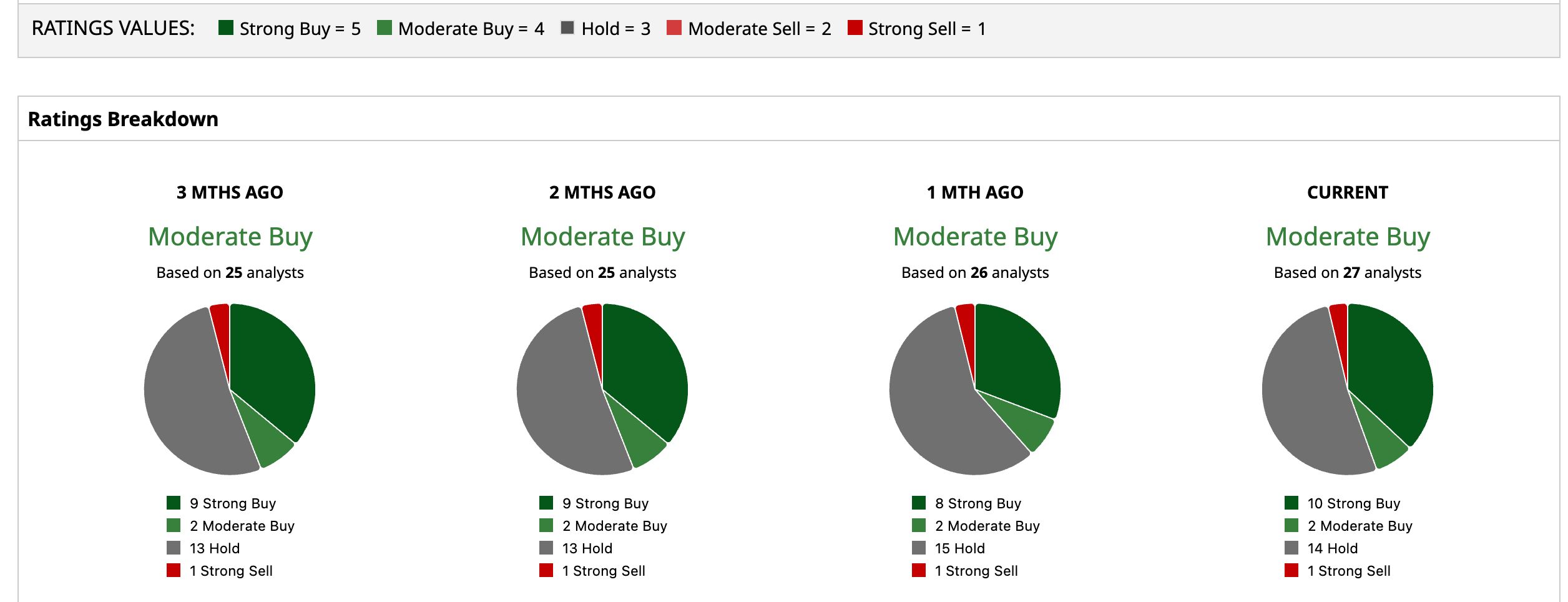
The wider analyst view is also positive. Out of 27 analysts, Bloom Energy has a consensus “Moderate Buy” rating, and the average price target is $280.71. That suggests about 36.5% upside from its current price.
 www.barchart.com
 www.barchart.com
Conclusion
Bloom Energy still looks worth a close look, but only for investors who are comfortable paying up for growth. The AI power story is still gaining strength, and the company keeps backing that up with bigger contracts and stronger guidance. Most likely, shares stay supported as long as data center demand keeps rising. In the near term, the stock could keep climbing, though pullbacks are still likely if growth expectations cool off.
On the date of publication, Ebube Jones did not have (either directly or indirectly) positions in any of the securities mentioned in this article. All information and data in this article is solely for informational purposes. For more information please view the Barchart Disclosure Policy here.
More news from Barchart
Bloom Energy Is Rising as AI Power Demand Strengthens. Only Buy BE Stock If You Can Stomach the Valuation. Why a New Core Scientific Deal Is a Big Win for AMD Stock CRWV Stock Alert: What to Know as CoreWeave Teams Up With Leidos Intel Just Posted Its Best Revenue Growth in 15 Years. Here’s What It Means for INTC Stock.