

While Tesla (TSLA) is having a tough time in 2026, traditional automakers are making merry. Both Ford (F) and General Motors (GM) raised their 2026 profit and cash flow guidance in their respective second-quarter earnings releases, with shares soaring after the reports. Tesla also raised its guidance, only not for earnings. The company raised its artificial intelligence (AI) capital expenditures guidance — a figure that's making markets increasingly wary.
While Ford and GM are raking in free cash flow (FCF) selling internal combustion engine (ICE) cars — which Tesla CEO Elon Musk has previously compared to “steam engines” and called a “passing fad” that would “look cool in a museum” — Tesla is expected to post negative FCF this year due to the burgeoning capex. Specifically, Tesla expects its AI capex to be more than $25 billion. CFO Vaibhav Taneja said during the Q2 earnings call that capex would only increase over the next couple of years on higher outlays toward Optimus, Robotaxi, AI infrastructure, and the upcoming semiconductor fab.
More Top Stocks Daily: Go behind Wall Street’s hottest headlines with Barchart’s Active Investor newsletter.
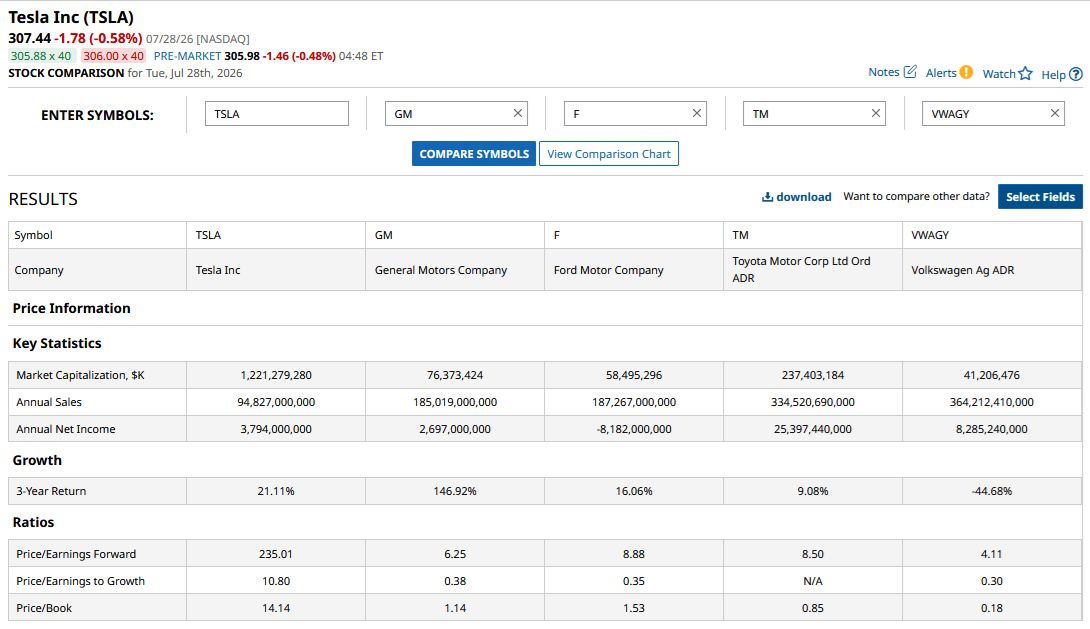
Comparing TSLA with legacy automakers might trigger Tesla bulls. Some of that is justified, as Tesla has never been merely an automaker — otherwise, its valuations wouldn’t be anywhere near where they are. For context, despite the recent selloff, Tesla is still worth $1.1 trillion by market capitalization. That's a number no legacy automaker has come remotely close to. Tesla is also valued more than the combined value of major legacy automakers, despite selling a fraction of the cars they sell.
 www.barchart.com
 Tesla Is an EV Success Story
The Tesla story was always about futuristic products. I would say even the early bet on electric vehicles (EVs) was quite ambitious, as not long ago, legacy automakers were quite dismissive of EVs. In 2014, for example, Sergio Marchionne — the late CEO of Fiat Chrysler Automobiles — famously said that he hoped customers would not buy the company’s electric Fiat 500e because it was losing $14,000 per vehicle. "I'm honest enough to tell you that," he emphasized.
But Tesla’s success in scaling EV volumes — and perhaps more importantly TSLA stock's soaring valuations — prompted a rethink among legacy automakers. Accordingly, they announced billions of dollars in investments to boost their own EV production. GM went so far as to say it won’t sell gas-powered cars after 2035. However, much of these investments have become sunk costs, and Detroit's “Big Three” have booked billions of dollars in charges, including in cash, as they dramatically cut their once-ambitious EV plans.
Legacy Automakers Continue to Lose Money on EVs
Even a decade after Marchionne’s statement, legacy automakers are still losing money on every electric car they sell. While through asset write-downs they have de facto admitted that the pivot has been disastrous, none have been especially forthcoming in acknowledging it.
Meanwhile, Tesla has been an EV success story. The company’s manufacturing prowess has also been remarkable, something with which even Musk’s critics would likely agree. But while Tesla proved critics wrong with EVs, its rise was aided by the fact that it literally had a home run, as not many took the category seriously a decade ago. This helped Tesla expand, including in China, laying out a red carpet for the company.
This time around, it is facing some serious competition, particularly from China. Given China’s backing of new-age companies in autonomous driving (AD) and robotics, and the strides that Chinese companies are making in advanced manufacturing, investors can expect some Chinese companies to give Tesla a run for its money in physical AI.
Tesla Needs to Execute Its AI Initiatives
While Tesla has put physical AI at the core of its business, the progress hasn’t been what markets would expect from a name that’s priced for perfection. The Robotaxi rollout has been much slower than expected, while Optimus has also missed ambitious production goals.
It did not help that Tesla’s Q2 shareholder letter omitted language from the previous Q1 letter that talked about “volume production” for Megapack 3 and Tesla Semi this year. Instead, the Q2 update noted that these initiatives remain “on schedule for production starting in 2026.” Meanwhile, for Cybercab, the Q2 update said that production has commenced while omitting the previous reference to volume production this year.
For years, Musk has been promising the moon to investors, only to miss self-declared deadlines and forecasts almost every time. However, there is some unease of late, and Tesla needs to buckle up on its new AI initiatives as markets are no longer buying Musk’s end-of-the-year promises. One thing that would work in Tesla's favor in ramping up its AI portfolio is support from suppliers. In its early days, many did not take the company seriously, and it faced supplier issues. But during the Q2 earnings call, Musk emphasized that Tesla's suppliers are investing billions of dollars alongside the company for its initiatives, including Optimus and Robotaxi. In particular, Musk thanked Micron Technology (MU) for allocating memory to the company, which he called “a very significant allocation on reasonable terms given the pretty insane pricing of memory these days.”
Unlike its initial EV days, this time around, not many suppliers would want to miss out on partnering with Tesla in its physical AI journey. However, the company still needs to execute, as mere promises are not moving TSLA stock anymore.
On the date of publication, Mohit Oberoi had a position in: TSLA , F , GM . All information and data in this article is solely for informational purposes. For more information please view the Barchart Disclosure Policy here.
More news from Barchart
Elon Musk Proved Critics Wrong on EVs, But Tesla Won’t Have a Home Run with AI Why Analysts Are Raising Their Seagate Stock Price Targets Left and Right Why SoFi Stock Is Falling on Earnings and How to Play Shares Here The $6 Billion Reason MarketAxess Stock Is Up Today