


Wall Street is placing a big bet against SpaceX (SPCX), and the size of that bet might surprise long-term bulls. In the weeks leading up to the company's first earnings report as a public company, traders have piled into bearish positions at a pace that now dwarfs the short bets against Tesla (TSLA), the other major public company run by Elon Musk.
Notably, two events are converging in early August, and both could shake up the stock in a big way.
More Top Stocks Daily: Go behind Wall Street’s hottest headlines with Barchart’s Active Investor newsletter.
 www.barchart.com
 SpaceX Stock Short Interest Spikes Ahead of Q2 Earnings
Short interest in SpaceX's stock stood at 219.3 million shares as of July 29, according to data from S3 Partners cited by Bloomberg. It works out to about 34% of all shares currently available for public trading, up sharply from 23.3 million shares when S3 began tracking the figure on June 16. In dollar terms, that bearish position is worth roughly $24.6 billion, more than the amount currently wagered against TSLA stock, Bloomberg reported.
Sam Pierson, director of research at S3, told Bloomberg that the real driver behind the trade is not the upcoming earnings report itself. Instead, traders are betting that nothing in the results will be strong enough to offset the wave of newly tradable shares about to hit the market.
Borrowing shares to bet against SpaceX has also gotten pricier as more traders pile in. Pierson noted there is some friction for short sellers looking to hold their positions through next week, though borrowing costs are expected to ease back to normal once the lockup event has passed.
SpaceX Earnings and Share Lockup Expiration Explained
According to Yahoo Finance:
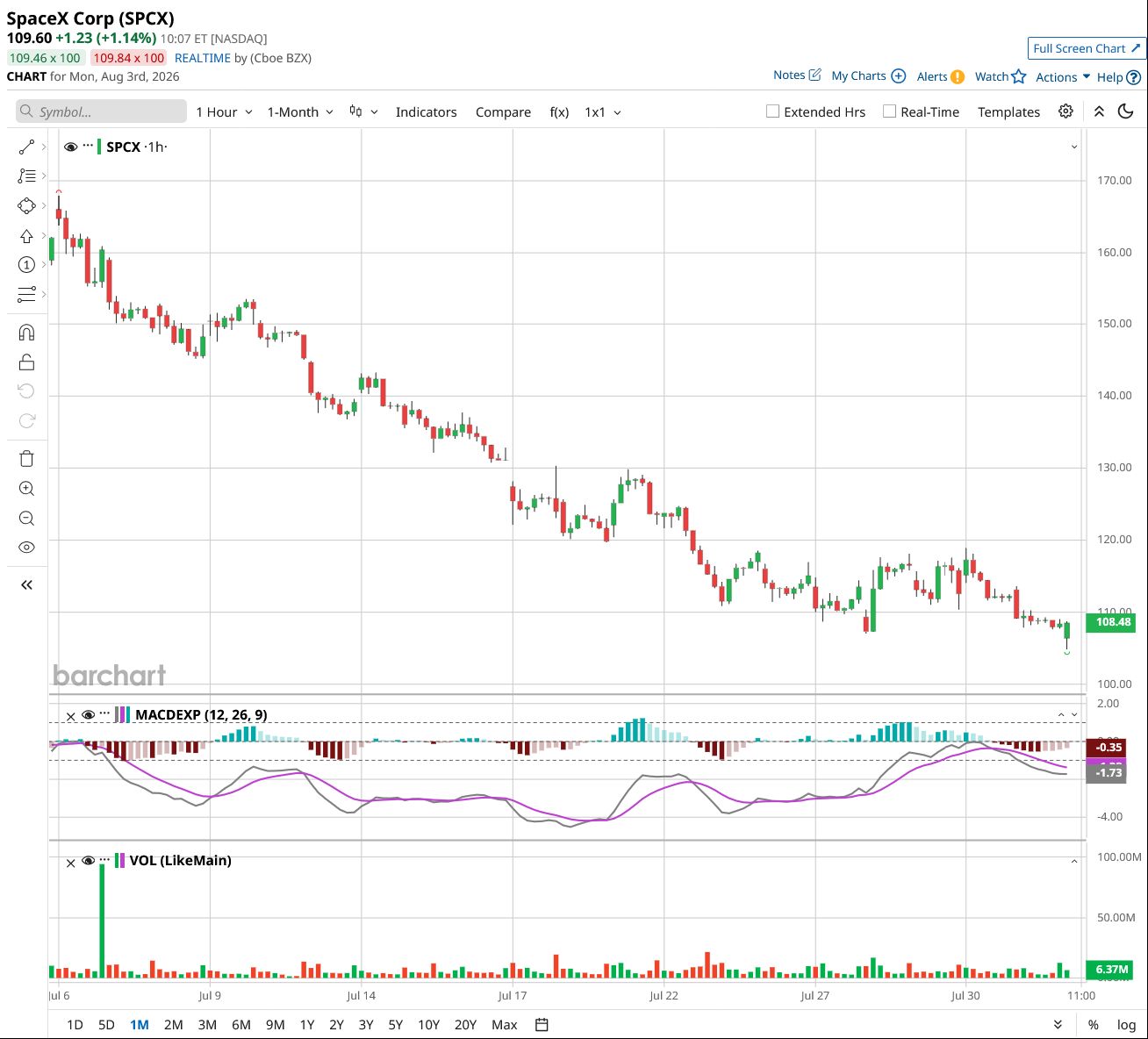
SpaceX is set to report its first quarterly results as a public company tomorrow, Aug. 4, less than two months after its blockbuster IPO. Just two days later, on Aug. 6, as many as 911.5 million shares could become eligible for trading under the company's staggered lockup schedule, a release that could free up as much as 20% of shares under the plan. Right now, only about 640 million shares, roughly 5% of total shares outstanding, are available to trade. Once the first lockup expires, that share count will more than double to around 12%. That is a lot of new supply for the market to absorb at once, which helps explain why traders are positioning for a possible pullback.SPCX stock trades around $108 at the time of writing, which is a drawdown of over 50% from all-time highs. Moreover, the IPO price for the space-tech giant stood at $135.
Adding to the uncertainty, The Wall Street Journal reported that Musk is still pushing for a potential merger between SpaceX and Tesla, with executives reportedly weighing what to do with Tesla's China business ahead of any deal.
Analysts note that a combination could raise scrutiny in Beijing, given SpaceX's role as a major defense contractor and concerns over data tied to Tesla's roughly 2 million Chinese vehicle owners.
Revenue Estimates Point to Fast Growth Despite Losses
Current Wall Street consensus estimates call for SpaceX to post revenue of $6.82 billion in Q2, based on a survey of 26 analysts. The revenue estimate is expected to jump to $12 billion in the September quarter. For the full 2026 year, analysts see revenue near $39.12 billion, climbing to $73.15 billion in 2027, a jump of almost 87%.
Profitability is expected to lag that revenue growth for now. Analysts currently project a non-GAAP loss of $0.29 per share for the current quarter, narrowing to a loss of $0.55 per share for all of 2026. By 2027, the average analyst estimate flips to a profit of $0.65, though forecasts vary widely, ranging from a loss of $0.78 to a gain of $1.74.
Longer-range forecasts compiled by TIKR.com paint an even bigger growth picture.
Revenue is projected to climb from $39.12 billion in 2026 to $364.80 billion by 2030, a compound annual growth rate of 74.7%. EBITDA is expected to grow even faster, from $16.99 billion to $266.30 billion over the same period, with margins expanding from 43.4% to 73%. Net income is projected to turn meaningfully positive along the way, going from $3.82 billion in 2026 to $149.18 billion by 2030. Normalized earnings per share are expected to climb from $0.20 to $10.80 over that stretch.These growth estimates explain why some investors remain bullish on SPCX stock long term, even as short sellers bet on near-term weakness tied to the lockup.
What Could Impact SPCX Stock?
Beyond the lockup, investors will be paying close attention to SpaceX's capital spending when results land next week. S&P Global Visible Alpha analyst Melissa Otto expects capital expenditures to climb from $48.7 billion this year to $118.4 billion by fiscal year 2028, according to Yahoo Finance. Total debt is projected to grow more than fivefold over the same stretch, from $41.7 billion to over $218 billion.
That kind of spending mirrors the pattern seen across other AI infrastructure heavyweights like Oracle (ORCL), Alphabet (GOOG) (GOOGL), and Meta (META), where the concern is whether massive capital outlays will eventually pay off.
Pierson told Bloomberg there are three catalysts worth tracking over the coming year.
The nearest is the lockup ladder itself. The second is potential entry into the S&P 500 ($SPX), which seasoning rules currently push out to at least mid-2027, though the market appears to already be pricing in the possibility. The third, and arguably the biggest wildcard, is a potential Tesla merger, which Pierson said could fast-track that S&P inclusion.
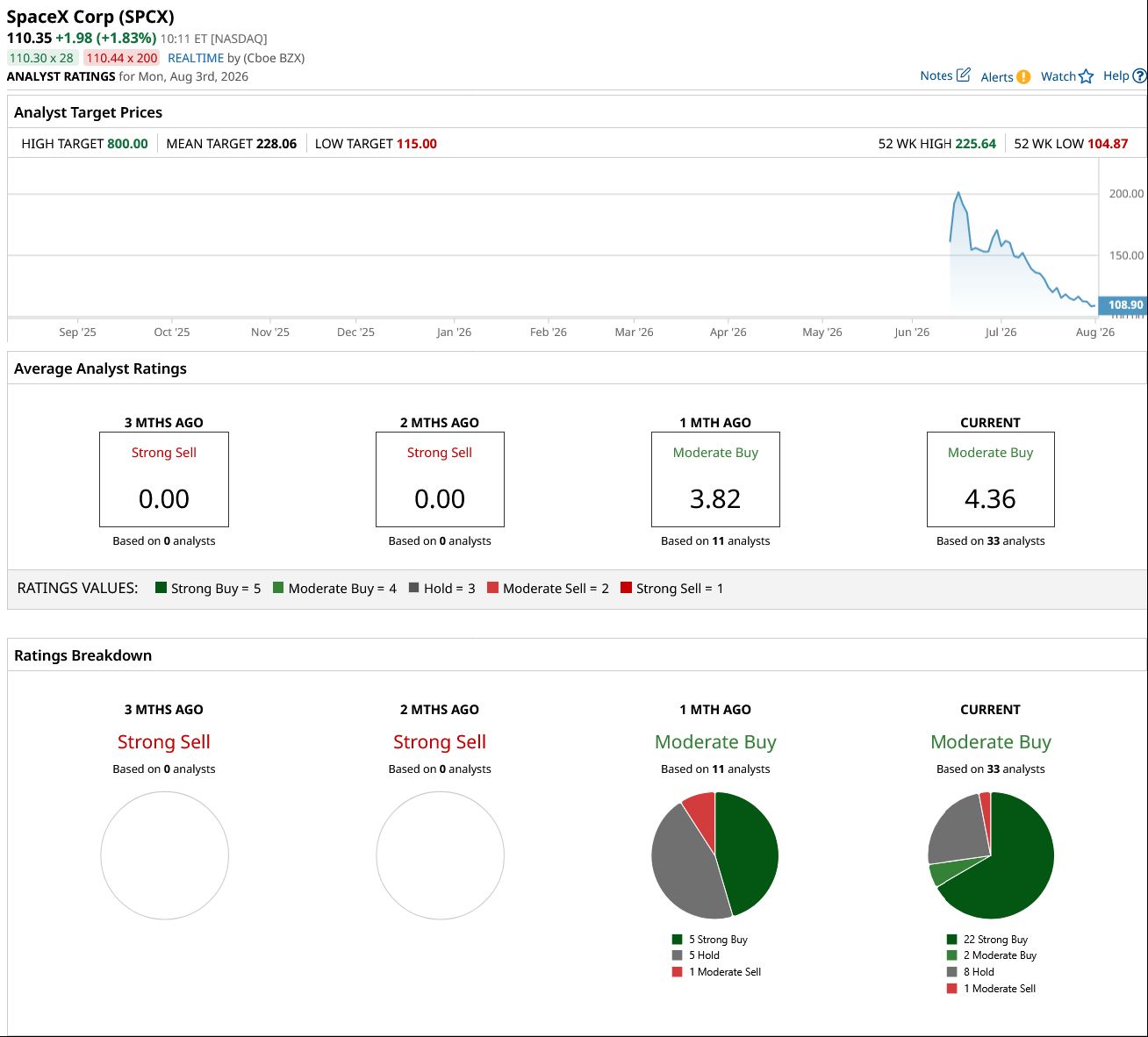
Out of the 33 analysts covering SPCX stock, 22 recommend “Strong Buy,” two recommend “Moderate Buy,” eight recommend “Hold,” and one recommends “Moderate Sell.” The average SPCX price target is $228, above the current price of $108.
For now, the message from the options and lending markets is clear. A large and growing group of traders believe SpaceX shares have further to fall before the dust settles on its first earnings report and its first major test of post-IPO share supply.
 www.barchart.com
 On the date of publication, Aditya Raghunath did not have (either directly or indirectly) positions in any of the securities mentioned in this article. All information and data in this article is solely for informational purposes. For more information please view the Barchart Disclosure Policy here.
More news from Barchart
A $1.6 Billion Reason to Buy SpaceX Stock Now The US Just Intervened in Japan’s Markets. Why Treasury Secretary Scott Bessent Says the Yen Crisis Might Not Be Over – ‘We Will Not Hesitate’ Surging Short Interest in SpaceX Stock Sends Strong Signal to Wall Street Circle’s Trust Charter Approval Sends a Key Signal to Wall Street