

SpaceX (SPCX) has just given investors another compelling reason to stay bullish. The private space giant recently secured a new $1.6 billion contract from the U.S. Space Force to carry out 18 Falcon 9 national security launches through 2027, deploying Pentagon satellites for airborne target detection and tracking while reinforcing its dominant position in the rapidly growing space defense market. The award not only strengthens long-term revenue visibility but also highlights the Pentagon’s continued reliance on SpaceX’s proven launch capabilities at a time when competitors are still scaling up.
This latest win adds to a string of major government contracts awarded to SpaceX this year, further cementing its role as a critical partner in U.S. national security and space infrastructure. Earlier this year, SpaceX landed a $4.16 billion contract to build a constellation of satellites for tracking airborne targets and a $2.29 billion contract to develop the Space Data Network Backbone, a secure satellite communications network supporting the Golden Dome missile defense initiative. Including the latest launch award, SpaceX has secured roughly $8 billion in Pentagon contracts this year alone.
More Top Stocks Daily: Go behind Wall Street’s hottest headlines with Barchart’s Active Investor newsletter.
With an expanding backlog spanning defense, satellite communications, commercial launches, and NASA missions, SpaceX continues to strengthen its long-term growth outlook. That gives investors another powerful reason to remain optimistic about the company’s future.
About SpaceX Stock
SpaceX is a leading aerospace, satellite communications, and space technology company founded by CEO Elon Musk. The company designs and launches rockets, operates the rapidly expanding Starlink satellite internet network, and provides launch services for commercial, government, and defense customers worldwide.
Headquartered in Starbase, Texas, SpaceX has emerged as a dominant force in the global space industry and recently became one of the world’s most valuable publicly traded companies following its historic initial public offering (IPO). SpaceX’s market capitalization is around $1.4 trillion, placing it among the largest companies by market value.
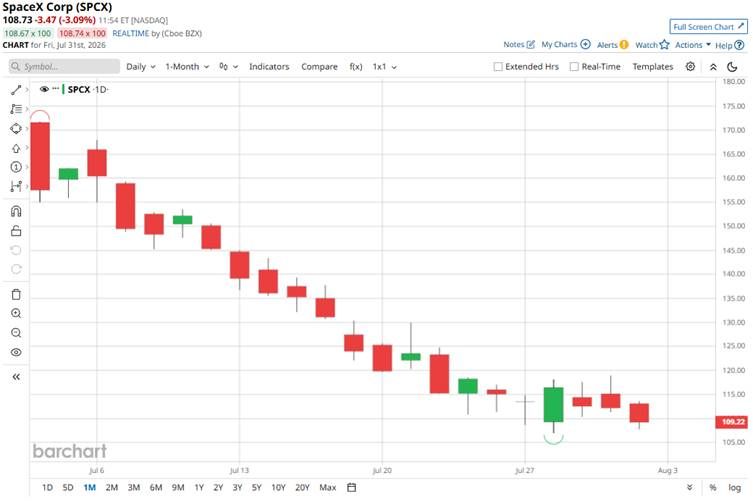
SpaceX has been one of the market’s most closely watched stocks since its blockbuster debut on June 12, 2026. The company priced its IPO at $135 per share. Investor demand proved overwhelming, with SPCX stock opening at $150 and climbing as high as $225.64 in the following days. The company’s valuation rose to more than $2 trillion at one point, making it one of the strongest public market debuts in history.
However, the post-IPO rally has given way to heightened volatility. SpaceX shares have come under pressure as investors have locked in profits and valuation concerns have intensified. SPCX stock is down 33% over the past month, closing the last session at $108.37, almost 20% below its $135 IPO price. That's despite the company continuing to win major government contracts, including its latest $1.6 billion U.S. Space Force launch award.
The recent pullback has sparked debate over whether the selloff presents a buying opportunity for long-term investors seeking exposure to SpaceX’s leadership in launch services, Starlink, and defense-related space infrastructure.
 www.barchart.com
 SpaceX also trades at an eye-catching 78.5 times sales. That valuation multiple far exceeds the sector median.
A Financial Snapshot
SpaceX has delivered strong top-line growth but remained unprofitable as the company continues investing aggressively in artificial intelligence (AI) infrastructure, Starlink expansion, and its next-generation Starship program. According to its U.S. Securities and Exchange Commission (SEC) filing, SpaceX generated first-quarter revenue of $4.7 billion, a more than 15% year-over-year (YOY) rise, while reporting an operating loss of $1.9 billion and adjusted EBITDA of $1.1 billion. The company posted a Q1 2026 loss per share of $1.27, compared with a loss of $0.18 per share in the prior-year period.
On an annual basis, the company generated $18.7 billion in revenue during 2025, up roughly 33% YOY from $14 billion in 2024, while adjusted EBITDA increased to $6.6 billion. However, SpaceX posted a 2025 operating loss of $2.6 billion. For 2025, net loss came in at $4.94 billion, or $1.69 per share, compared with 2024 net income of $791 million, or $0.01 per share.
The company’s financial performance has been driven primarily by its Connectivity segment, which includes Starlink. In 2025, the segment generated $11.4 billion in revenue, representing 50% YOY growth, while operating income surged 120% to $4.4 billion and adjusted EBITDA climbed 86% to $7.2 billion. During Q1 2026, the Connectivity business delivered $3.3 billion in revenue.
The Space segment, which includes launch services and Starship development, generated $4.1 billion of revenue in 2025. In Q1 2026, segment revenue totaled $619 million, with an operating loss of $662 million.
Meanwhile, SpaceX’s newly consolidated AI segment generated $3.2 billion of revenue in 2025 but posted an operating loss of $6.4 billion. In Q1 2026, AI revenue was $818 million while the operating loss widened to $2.5 billion. Capital expenditures for the AI segment totaled $12.7 billion in 2025 and an additional $7.7 billion in Q1 2026, reflecting massive investments in AI infrastructure and model development.
Importantly, SpaceX is gearing up to post its first official public Q2 2026 financial report after the market closes on Aug. 4. The consensus loss per share estimate is $0.26 for Q2 2026. Analysts also expect the company to post a loss per share of $0.64 in fiscal 2026 before improving by 198% to EPS of $0.63 in fiscal 2027.
What Do Analysts Expect for SPCX Stock?
Macquarie recently maintained an “Outperform” rating on SpaceX and reiterated its $250 price target, signaling continued confidence in the company’s long-term growth prospects despite the recent selloff. The firm framed the pullback as a normal post-IPO digestion phase rather than a fundamental shift. Bernstein also reiterated its “Outperform” rating on SPCX stock with a $239 price target, arguing that the recent selloff has created an attractive buying opportunity.
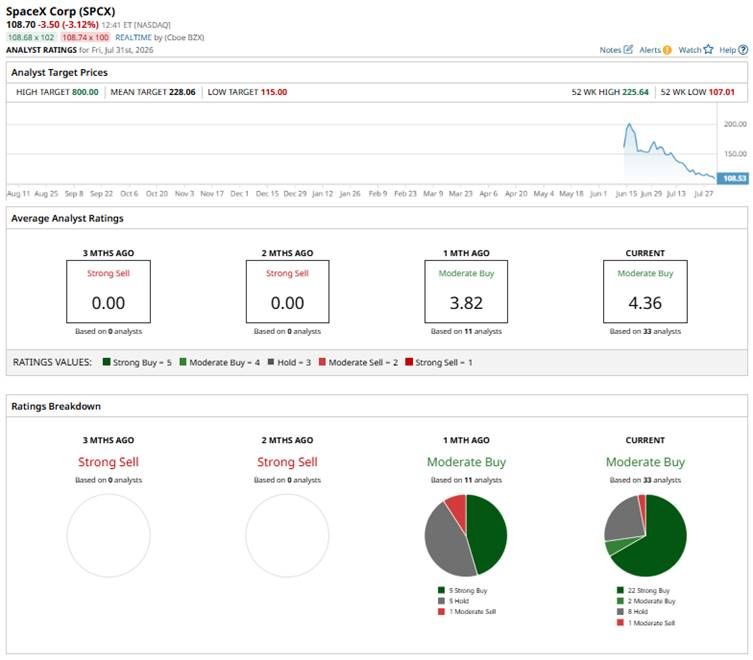
Overall, SpaceX has a consensus “Moderate Buy” rating. Of the 33 analysts covering the stock, 22 advise a “Strong Buy,” two recommend a “Moderate Buy,” eight suggest a “Hold" rating, and one analyst has a “Moderate Sell” rating. The average price target of $228.06 indicates potential upside of 105% from current levels, while the Street-high target price of $800 suggests as much as 619% potential upside from here.
 www.barchart.com
 On the date of publication, Subhasree Kar did not have (either directly or indirectly) positions in any of the securities mentioned in this article. All information and data in this article is solely for informational purposes. For more information please view the Barchart Disclosure Policy here.
More news from Barchart
A $1.6 Billion Reason to Buy SpaceX Stock Now The US Just Intervened in Japan’s Markets. Why Treasury Secretary Scott Bessent Says the Yen Crisis Might Not Be Over – ‘We Will Not Hesitate’ Surging Short Interest in SpaceX Stock Sends Strong Signal to Wall Street Circle’s Trust Charter Approval Sends a Key Signal to Wall Street