


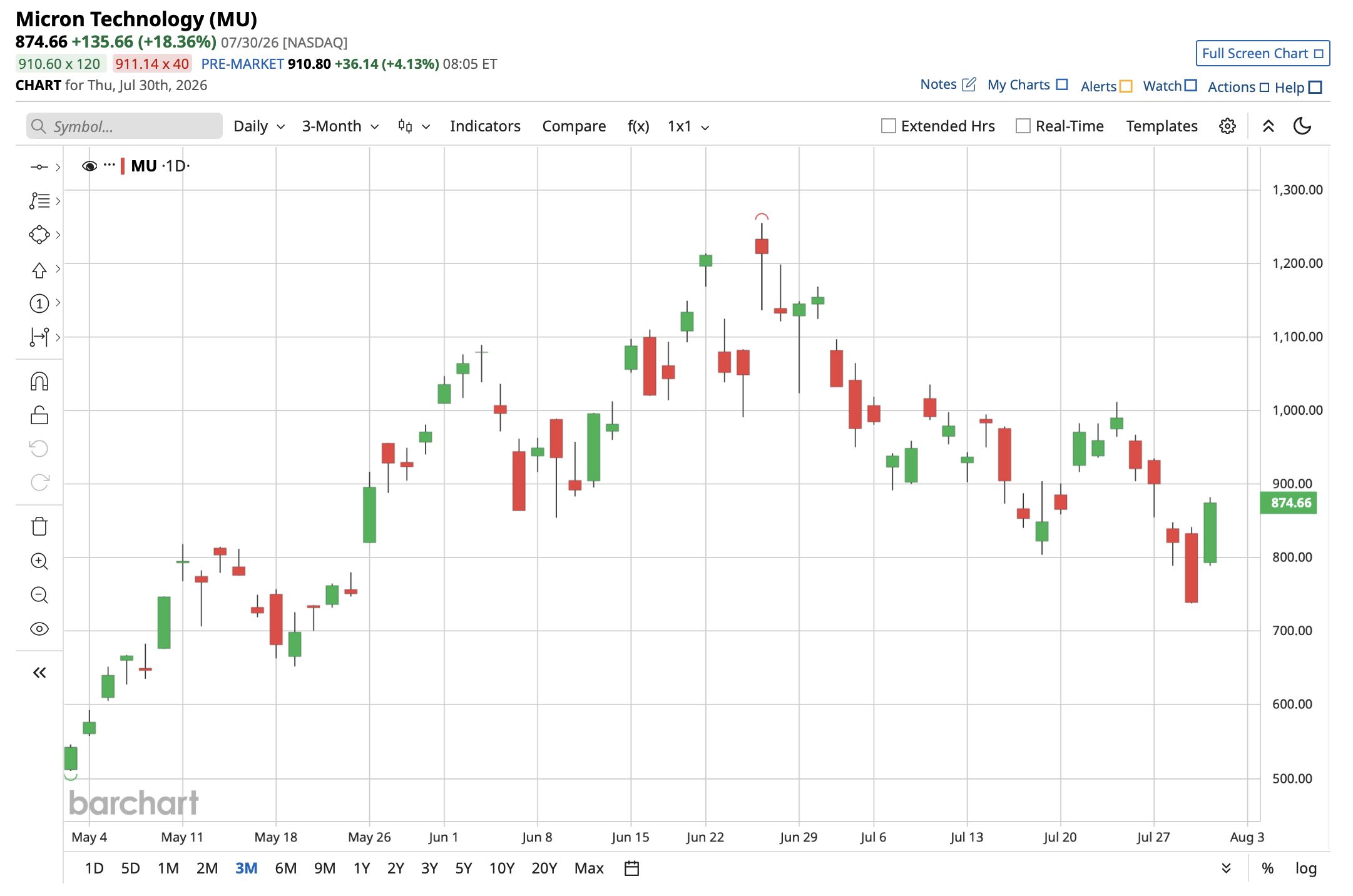
Michael Burry just disclosed a fresh short position again in Micron (MU) stock, claiming on social media that he added to his bearish bets on Micron and Nvidia (NVDA). Burry announced that he further shorted MU stock at $933.86.
In my previous coverage of Micron, I pointed out why MU stock was a sell strictly on the basis of risk control, not bad fundamentals. The stock has since been volatile and in a downward trend, but I also previously pointed out that the selloff won't last, precisely because the fundamentals are intact. However, it would be foolish to discount the market sentiment. Accordingly, I have continued to dig deeper as to what could possibly cause Micron to crash. In late July, I dismissed the UBS report that management could buy back nearly half the company, as that was an unrealistic expectation. Now, another thesis has emerged that could possibly prove short sellers like Burry right in the future.
More Top Stocks Daily: Go behind Wall Street’s hottest headlines with Barchart’s Active Investor newsletter.
To understand the bear thesis, one needs to know what a KV cache is. When chatting with an AI agent, you may have noticed that it tends to remember what it was told previously in the conversation. That knowledge is stored in a KV cache. Due to hardware limitations, this memory cannot simply be allowed to keep growing, which is why the AI agent often asks you to start a new chat or upgrade your membership. Any technological progress in improving this limitation is the actual Micron bear thesis. We don’t know if it will materialize — but we certainly know that if there is a technological limitation, some of the smartest brains in the world will stay up at night trying to find a solution. A Micron bull is essentially betting against those people, while Burry could possibly be betting on them.
Investors may remember the TurboQuant news. Alphabet's (GOOGL) Google was trying to solve exactly this problem, and successfully managed to enhance the KV cache without significant quality loss. Last month, Moonshot AI’s Kimi achieved a similar feat, cutting cache size by 75% using Kimi Delta Attention (KDA).
None of this has managed to hurt Micron yet because its high-bandwidth memory (HBM) supply is contractually sold out until the end of the year, irrespective of KV cache efficiency gains. But here’s what the bears are betting on. If these gains continue, eventually the memory bottleneck won’t be as severe, resulting in reduced memory demand in the long run despite no respite in the short term. Such a scenario will play right into the “memory is extremely cyclical” narrative, possibly resulting in investors fleeing to safety.
We don’t know whether this bear case will actually play out. But it is one way Michael Burry could eventually be proven correct.
About Micron Technology Stock
Micron is a manufacturer, developer, and seller of memory and storage chips. The company operates through multiple segments including the Core Data Center Business Unit, the Mobile and Client Business Unit, the Cloud Memory Business Unit, and the Automotive and Embedded Business Unit segments. Micron's products are widely used in cloud computing, consumer devices, AI systems, data centers, and automotive applications.
Over the past year, MU stock has significantly outperformed the broader semiconductor sector. Shares have surged 688% in the past 12 months, well above the iShares Semiconductor ETF's (SOXX) 113% gain during the same period. Growing demand for HBM used in AI servers has played a major role in MU stock’s strong performance.
 www.barchart.com
 Micron Technology Delivers Record DRAM Revenue
Micron reported its third-quarter fiscal 2026 earnings on June 24, posting record DRAM revenue of $31.3 billion. NAND revenue for Q3 came in at $9.9 billion. The company ended the quarter with a record level of cash and investments of $30.2 billion, while also reducing debt by $4.4 billion. During the quarter, operating cash flows reached $25.4 billion.
Going forward, Micron expects revenue and earnings to hit record levels. The company guided Q4 revenue of $49 billion to $51 billion, and forecast earnings at $31 per share, plus or minus $1. Gross margin is estimated to be 86% in Q4.
What Do Analysts Expect for Micron Stock?
Bernstein analyst Mark Li reaffirmed a “Buy” rating on MU stock with a $1,300 price target on July 27. In addition to Bernstein, Bank of America also recently reiterated a “Buy” rating and provided a $1,550 price target. Meanwhile, KeyBanc has a more bullish outlook on Micron, raising its price target from $1,600 to $1,750 while maintaining an “Overweight” rating on July 14.
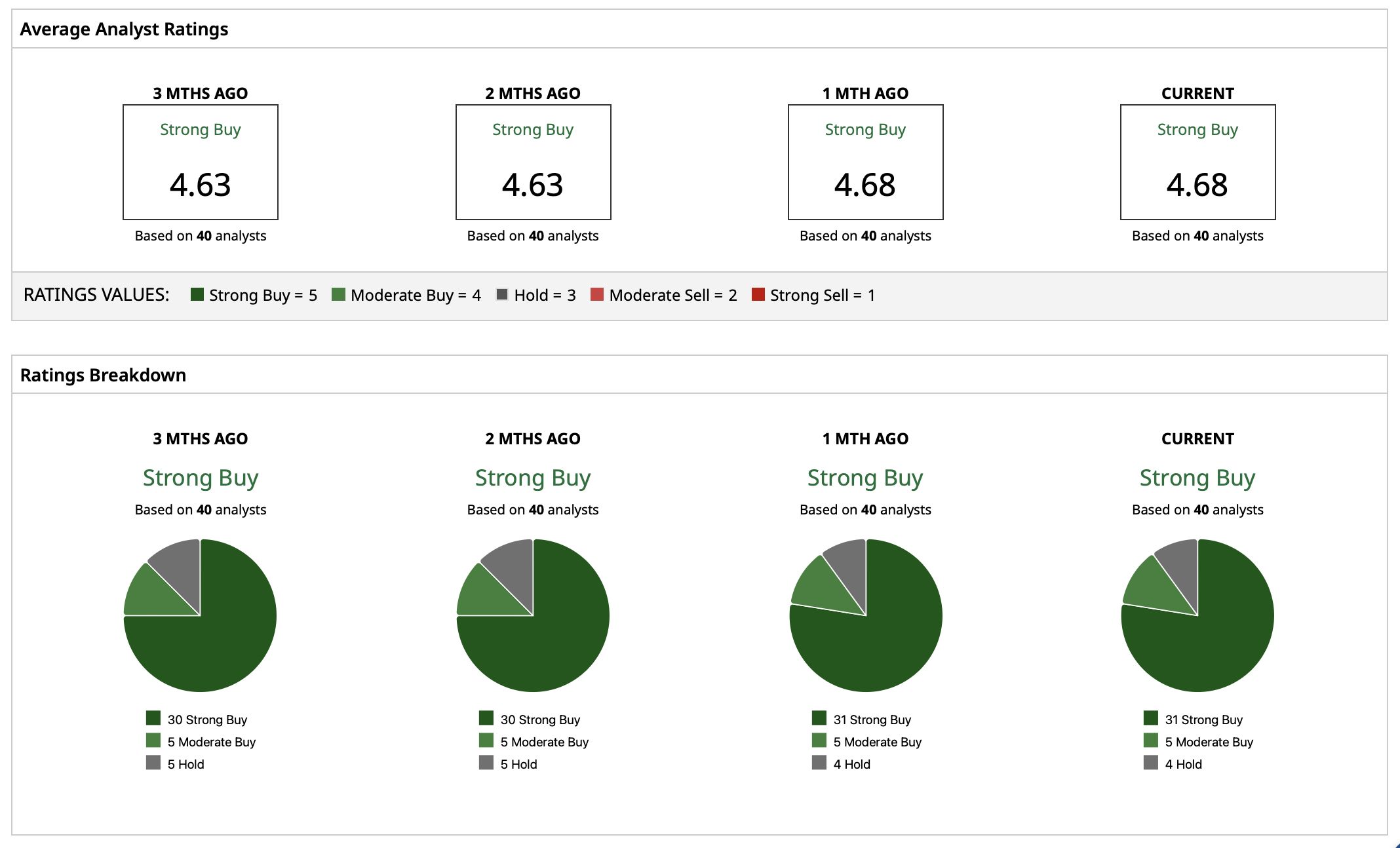
Micron stock is currently covered by 40 Wall Street analysts and has a consensus “Strong Buy” rating. The average price target of $1,487.03 reflects potential upside of 79% from current levels, while the highest price target of $2,000 suggests MU stock could climb 141% from here.
 www.barchart.com
 On the date of publication, Jabran Kundi did not have (either directly or indirectly) positions in any of the securities mentioned in this article. All information and data in this article is solely for informational purposes. For more information please view the Barchart Disclosure Policy here.
More news from Barchart
PLTR Stock Pops as Palantir Partners With Mercury on Defense Automation You Hit Micron’s Bear Thesis Every Time ChatGPT Says ‘Start a New Chat.’ Burry’s MU Short Might Be Onto the Same Thing. AMD Reports Q2 Earnings on Aug. 4. Here’s Why Analysts Remain Bullish. Microsoft and Amazon Are Spending Billions on AI. 1 Is Getting Far Better Returns.