

A Wall Street Journal report claiming that Elon Musk-led Tesla (TSLA) might shut or sell its operations in China has raised alarms among the analyst community. Although Tesla has refuted the possibility of such a development, Tom Narayan of RBC Capital Markets has opined that it would be a bad move for Tesla.
Narayan said, “Were Tesla forced to sell its China business, it would likely not receive fair value for it. A sale would generate only a fraction of that value since humanoids and robotaxi upside would be lost—a likely buyer such as BYD or SAIC would probably only want the automotive business and perhaps FSD.”
More Top Stocks Daily: Go behind Wall Street’s hottest headlines with Barchart’s Active Investor newsletter.
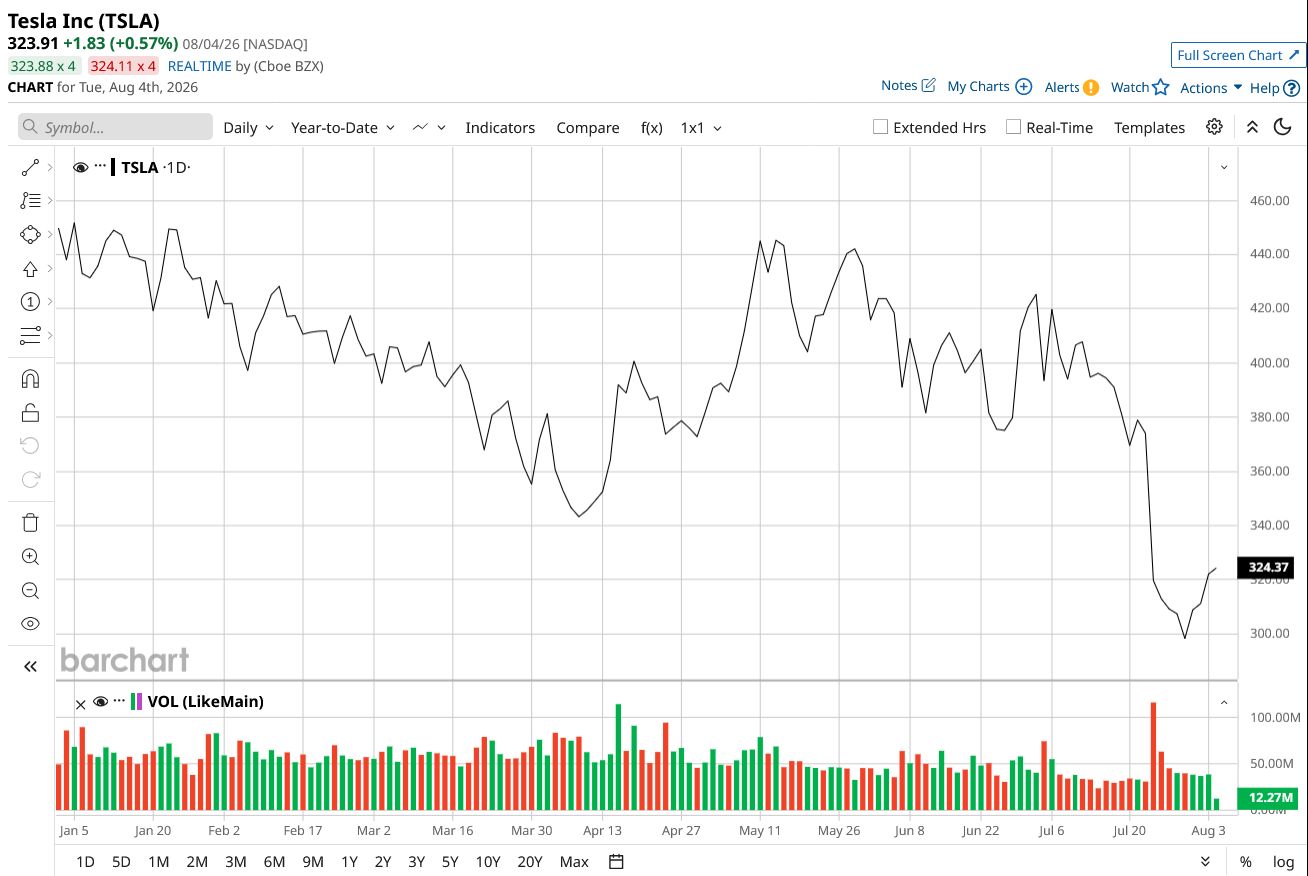
This could bring another bout of uncertainty for the $1.2 trillion market cap company, whose shares are already down 28% for the year.
Yet, it must be highlighted that China is a huge deal for Tesla, and if it ceases operations there, the impact would certainly not be immaterial.
 www.barchart.com
 China’s Importance to Tesla Cannot Be Overstated
Despite all the skirmishes between China and the U.S., Musk's closeness to the Trump administration, and competition from Chinese EV players, the country remains the second-biggest revenue contributor for Tesla. At about $9 billion, it represented about a fifth of the total revenues generated by Tesla this year.
China also houses the Tesla Gigafactory in Shanghai, and I think it is the most valuable piece of the puzzle there for the company, as it has become Tesla's largest manufacturing hub. Opened in 2019, it recorded many firsts. It was Tesla's first factory outside the United States and was the first wholly foreign-owned automobile plant in China, manufacturing the Model 3 and Model Y iterations of the company's vehicles. Notably, it has an annual capacity exceeding 950,000 vehicles.
Notably, the news also comes as Tesla has staged a steady comeback in the Chinese EV market. In May 2026, Tesla delivered 85,982 units across its Model 3 and Model Y. Not only was this an 8.2% increase from April (marking the sixth consecutive month of growth), but it also represents a jump of 39.4% from the previous year.
And not just vehicles. Just like the Gigafactory, Shanghai also hosts Tesla's Megafactory, which manufactures Megapack utility-scale battery systems for energy storage. That facility supports Tesla's rapidly growing energy generation and storage business and broadens its manufacturing footprint in China beyond passenger vehicles.
Overall, Tesla currently works with more than 400 Chinese suppliers, with over 60 of them exporting components to the company's factories worldwide, highlighting the country's significance in the company's supply chain.
Thus, exiting China would deal a severe blow to Tesla, especially when domestic Chinese players such as BYD (BYD) and XPeng (XPEV) are increasingly spreading their wings worldwide. However, the sale of the China business would bring in some much-needed capital to Tesla, or, eventually, SpaceX (SPCX). The company can then consider reallocating this capital towards what is increasingly becoming its main area of focus: data centers, enhancing compute capacity, developing its chips, and the overall AI buildout.
A Mixed Q2
Tesla posted total revenue of $28.2 billion in the second quarter, marking a 26% rise year-over-year (YoY) and beating estimates by more than $2.5 billion. Automotive revenue, the primary segment, increased 23% to $20.5 billion. Services revenue expanded 50% to $4.6 billion, while the energy segment advanced 13% to $3.1 billion.
Earnings per share decreased 18% to $0.33, falling short of the consensus forecast of $0.53. Gross margins narrowed slightly to 16.8% from 17.2% in the year-earlier period. Operating expenses climbed to $4.3 billion from $2.9 billion, largely reflecting a 50% YoY rise in research and development costs that could support future growth.
Operating cash flow totaled $4.7 billion, representing an 85% gain from the previous year. Free cash flow turned negative at $1.1 billion, which draws attention given Chief Financial Officer Vaibhav Taneja’s confirmation that capital expenditures will exceed $25 billion in 2026. The company closed the quarter with $43.5 billion in cash, well above its short-term debt of $1.4 billion.
Deliveries reached 480,126 vehicles, up 25% YoY and surpassing the consensus estimate of 406,000. Production rose 10% to 451,758 units, and Full Self-Driving subscriptions increased 56% to 1.48 million.
Energy storage deployment grew to 13.5 GWh from 9.6 GWh in the second quarter of 2025. Supercharger stations and connectors, core components of the energy network, rose 18% and 17%, respectively, to 8,704 stations and 82,357 connectors.
Even with these operational gains, TSLA stock remains at elevated valuation levels. The forward P/E ratio of 173.83 times, P/S multiple of 11.62 times, and P/CF multiple of 75.95 times all remain substantially higher than corresponding sector medians.
Analyst Opinion on TSLA Stock
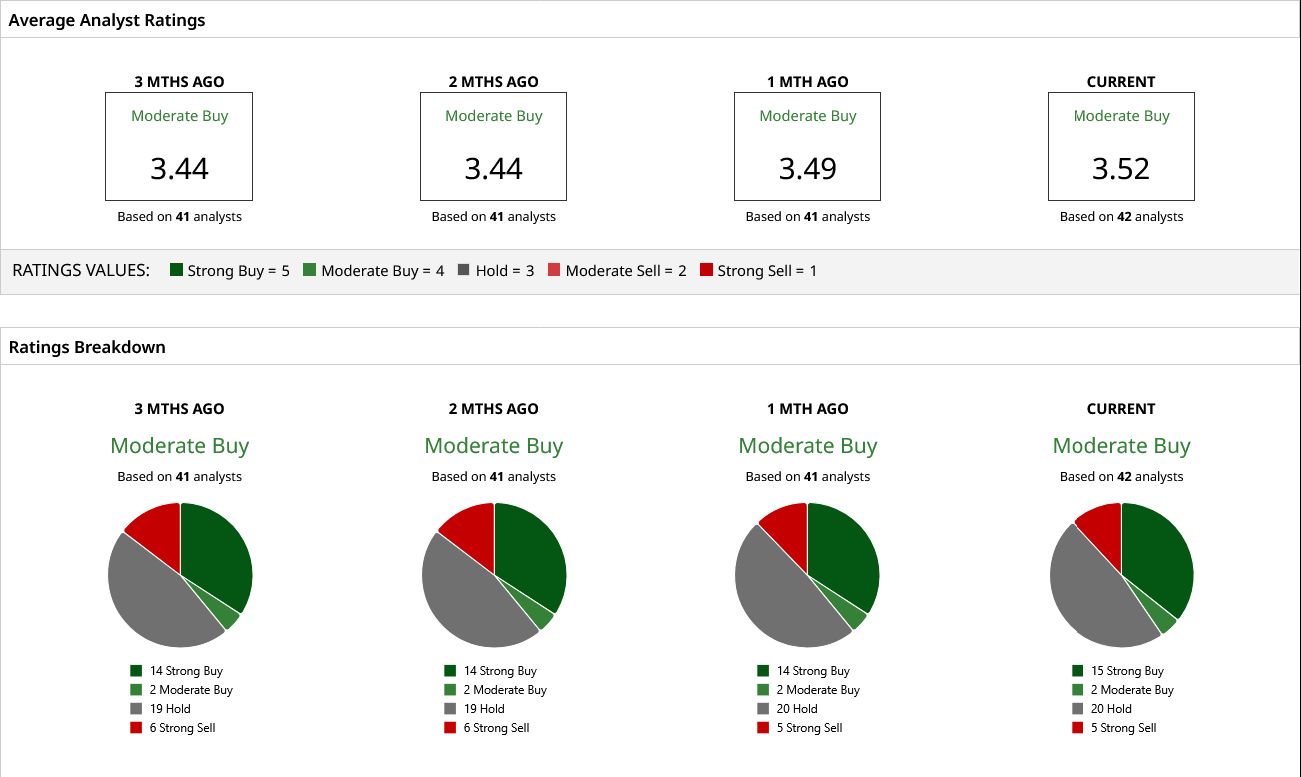
Overall, analysts have assigned a rating of “Moderate Buy” for TSLA stock. The mean target price of $401.29 suggests a potential upside of about 24% from current levels. Out of 42 analysts covering the stock, 15 have a “Strong Buy” rating, two have a “Moderate Buy” rating, 20 have a “Hold” rating, and five analysts have a “Strong Sell” rating.
 www.barchart.com
 On the date of publication, Pathikrit Bose did not have (either directly or indirectly) positions in any of the securities mentioned in this article. All information and data in this article is solely for informational purposes. For more information please view the Barchart Disclosure Policy here.
More news from Barchart
This Analyst Just Downgraded eBay Stock. Here's Why. Analysts That Selling Its China Business Could Be a Big Negative for Tesla Stock. Here’s Why. Apple’s New CEO Is Bringing a Familiar Face Back From Retirement. The Shift Is Happening. ArcelorMittal & Microsoft Deepen Partnership With Azure. How to Play MT Stock Here.