

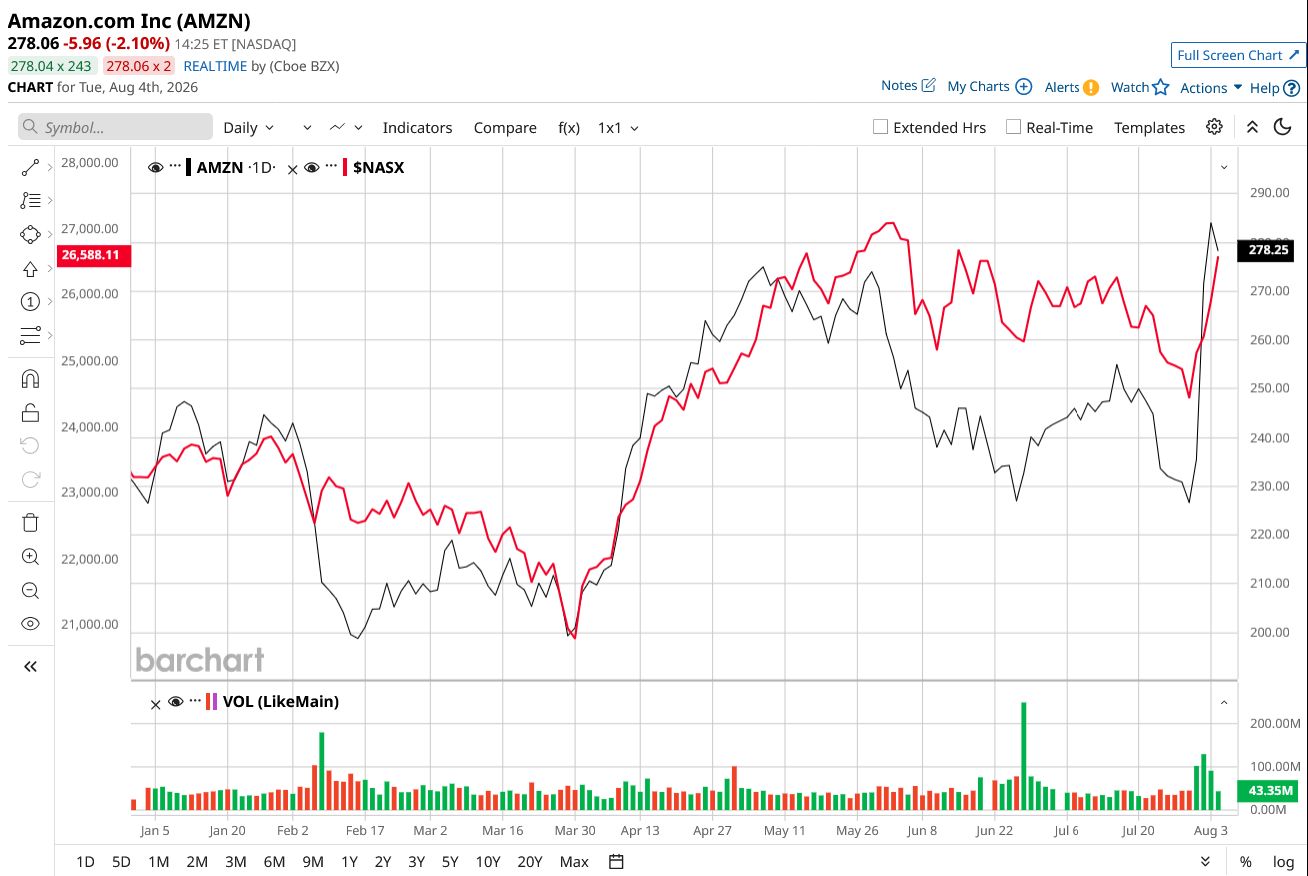
Artificial intelligence (AI) spending has been the most heated debate this year. Investors pulled out of AI stocks, worrying that the enormous AI spending was not yielding meaningful earnings growth. Amazon (AMZN) wasn’t spared either. However, one number in its recent Q2 print changed the story for the retail and cloud giant. Following its Q2 earnings release, AMZN stock has soared 21% over the past five days, touching a market cap of $3 trillion.
While the company revealed its plans of investing $220 billion in capital expenditures this year, it also laid out the plan for what this investment will generate. This one number in Amazon’s Q2 report shows why its AI spending may be far less risky than many investors assume.
More Top Stocks Daily: Go behind Wall Street’s hottest headlines with Barchart’s Active Investor newsletter.
 www.barchart.com
 The One Number Makes the AI Spending Look Far Less Risky
Amazon is spending an enormous $220 billion in capital expenditure at a time when the AI landscape has become extremely competitive. Microsoft (MSFT), Alphabet (GOOG) (GOOGL), Meta (META), Oracle (ORCL), and numerous AI infrastructure providers are all investing aggressively to capture enterprise AI workloads. Amazon specified that higher memory costs have led the company to increase its capex goals in 2026.
While the $220 billion is a staggering figure, so is Amazon’s massive AWS backlog of $496 billion, which has tripled year-over-year (YoY). This backlog is the future contracted revenue that Amazon has yet to recognize. In fact, management said that AWS doesn’t have enough infrastructure to meet the current demand in 2026. The company expects capacity constraints to continue into 2027 and added that the demand already visible for 2028 is “striking.” This implies that Amazon isn’t just spending heavily on the hope that customer demand will increase in the future. It is racing up to keep up with the present demand.
Importantly, Amazon isn’t hesitating to spend from $200 billion to $220 billion this year because its core business shows no sign of slowing. In the second quarter, revenue climbed 20% YoY to $200.6 billion, while earnings showed an eye-popping increase to $5.75 per share compared to $1.68 per share in the year-ago quarter. This highlights that Amazon is growing profits even as it dramatically increases capital spending. AWS led the way, with 36% YoY growth, marking the fifth consecutive quarter of accelerating growth. Amazon's advertising business also generated $19.8 billion in revenue, up 26% from the prior-year quarter.
Amazon Finally Explained the Math Behind Its $220 Billion AI Bet
The market has recently become wary because it treats huge AI infrastructure spending as a giant leap into the unknown. Amazon’s $220 billion capex would have ignited the same fear. However, Amazon made sure investors clearly understand where the money is going. In the Q2 earnings call, CEO Andy Jassy broke down the company's AI infrastructure into two very different assets: data centers and servers. Notably, servers are generally purchased a few months before deployment, giving Amazon strong visibility into customer demand before spending. This means if there is no demand, the company just doesn’t buy the equipment.
Furthermore, servers usually break even in less than three years, while most of Amazon’s AI capacity is contracted for at least five years. That means they continue generating revenue long after recovering their original cost, creating a meaningful boost to future free cash flow. The bigger long-term opportunity, however, lies in data centers. Unlike servers, AWS data centers are built to last more than 30 years. While building them demands a significant cost, it is primarily a one-time investment. Over time, Amazon may simply replace the servers at these facilities five or six times. As a result, each new generation of hardware has the potential to generate better returns.
As no investment is risk-free, Amazon made it clear that investors should expect free cash flow to remain under pressure in the near term while new data centers are still under construction. But note that these are risks that Amazon has accounted for before making such a huge capital commitment. Management believes once these facilities are operational, revenue growth should eventually outpace incremental capital spending. And when that happens, Amazon believes both free cash flow and return on invested capital will also improve significantly.
Analysts project Amazon’s 2026 earnings to increase by 69% YoY to $12.14 per share. AMZN stock currently trades at a 23x forward estimated earnings, lower than its five-year historical average. Investors buying the stock today are investing in a business trying to establish a stronger competitive position across cloud computing, AI, advertising, logistics, and enterprise software.
Is AMZN Stock a Buy Now?
Rather than just telling investors to trust that its AI investment will pay off, Amazon explained clearly how it believes these investments can generate strong long-term returns. Short server payback periods, multi-year customer contracts, decades-long data center lives, and demand that continues to exceed available capacity, all while operating a diversified business, strengthen Amazon’s long-term case. If investors can look beyond the near-term free cash flow pressure, Amazon remains the best AI stock to buy now at current levels.
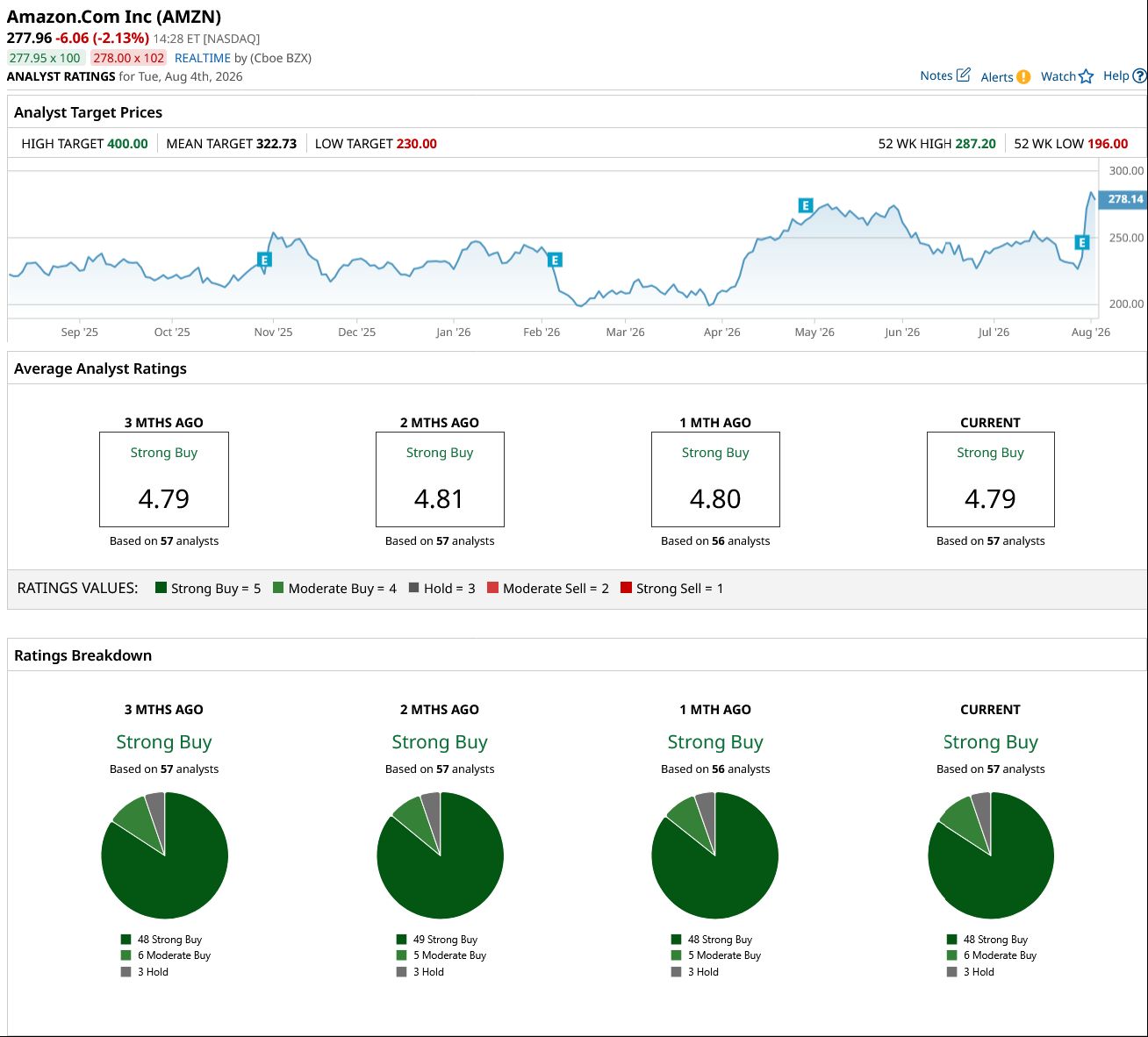
On Wall Street, AMZN stock holds a consensus “Strong Buy” rating. Of the 57 analysts covering the stock, 48 have a “Strong Buy,” six have a "Moderate Buy" rating, and three analysts rate the stock as a “Hold.” AMZN stock has climbed 21% year-to-date (YTD). But its mean target price of $322.73 implies a 16% potential upside from current levels. Plus, the high target price of $400 suggests that shares could climb as much as 44% over the next year.
 www.barchart.com
 On the date of publication, Sushree Mohanty did not have (either directly or indirectly) positions in any of the securities mentioned in this article. All information and data in this article is solely for informational purposes. For more information please view the Barchart Disclosure Policy here.
More news from Barchart
Amazon Stock: 1 Number Makes the AI Spending Look Far Less Risky JPMorgan Chase CEO Jamie Dimon Says AI 'Will Cure Cancers' — But How Should You Invest? Corcept Therapeutics Stock Shines at New All-Time Highs Despite Its Valuation Fossil Stock Jumps 19% on No News. It Could Be a High-Risk, High-Reward Bet for Speculators Willing to Take a Bite.