


The WisdomTree Quantum Computing Fund (WQTM), which debuted less than a year ago, is not the first quantum computing ETF. However, it is my favorite when I need a snapshot of where quantum computing stocks are headed.
Perhaps unsurprisingly, WQTM is AI-driven and has been to the moon and back in just the past few months.
More Yield, Less Trap: Sign up free to get Barchart’s daily Dividend Investor newsletter straight to your inbox.
 www.barchart.com
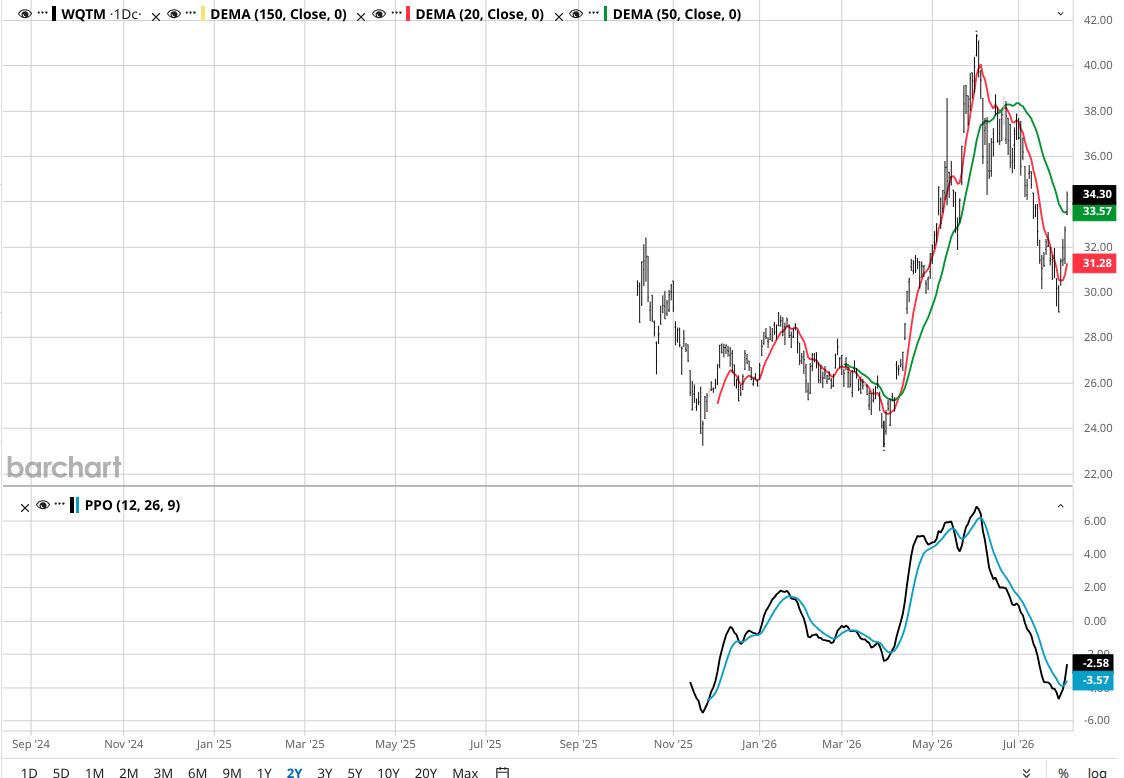
 Since its October 2025 debut, we’ve seen wild 20%-80% moves up followed by 15%-30% drawdowns that happen in weeks. WQTM is still more than 10% above its initial price, after all of that swinging around. But its percentage price oscillator (PPO) indicator at the bottom of the chart and the 20-day moving average shows signs of a trough. That said, these moves have been so much of a whipsaw, it is hard to trust them.
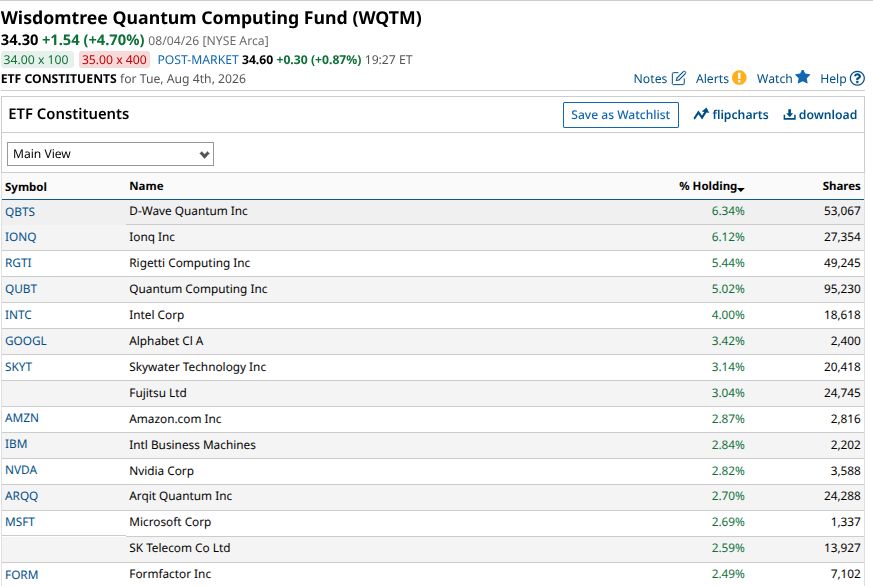
The fund has a foursome of core names at the top of its holdings list, and a supporting cast that includes a set of prominent mega-cap stocks. That combination has it primed for a potential parabolic move. But the risk is clearly high.
 www.barchart.com
 The Fundamentals Are Encouraging
WQTM uses a rules-based index codeveloped with quantum software firm Classiq. The fund blends pure-play hardware and software developers with large-cap technology enablers. So this is an ETF that eats its own cooking, so to speak.
The fundamental thesis for sustained upside rests on three core developments. First, there’s the commercialization via Quantum-as-a-Service (QaaS). End users are no longer buying physical quantum hardware; they are renting processing time over the cloud. Integration into cloud platforms run by Microsoft (Azure Quantum), Amazon (AWS Braket), and International Business Machines (IBM) allows pure-play quantum developers to generate recurring revenue without managing global distribution networks.
National defense and cybersecurity initiatives are accelerating capital deployment into quantum infrastructure. Government equity stakes, research grants, and post-quantum cryptography mandates provide non-dilutive funding to early stage sector leaders.
Quantum processing units (QPUs) are being paired directly with traditional graphics processing units (GPUs) inside enterprise data centers. This hybrid model allows high-performance computing tasks — such as molecular simulation, logistics optimization, and materials science — to adopt quantum acceleration faster than previously projected.
And there’s the fact that the pure-play constituents inside WQTM — such as D-Wave Quantum (QBTS), Rigetti Computing (RGTI), and IonQ (IONQ) — continue to run quarterly cash deficits. To fund hardware research and chip scaling, these companies frequently issue new shares or convertible debt, diluting early equity holders and creating price overhead.
So achieving true “quantum advantage,” the point where a quantum system solves practical commercial problems faster and cheaper than existing supercomputer clusters, remains an ongoing engineering challenge. Which explains the market’s flip-flopping on this ETF.
Carrying a price-earnings ratio above 65x, the ETF is sensitive to broader tech-sector discount rates. If long-term interest rates move higher, high-multiple growth vehicles like WQTM face valuation compression regardless of individual technology milestones.
The Takeaway
WQTM’s recent bounce reflects an attractive entry point following a deep price wash-out. However, sustained upside depends on pure-play constituents converting government contracts and cloud partnerships into cash flow.
Above all else, I think traders and investors have to realize that in the end, none of that fundamental narrative may matter. We are in a momentum-obsessed, liquidity-dominated economy. Until that ends, we will not know what is real value, and what is an extreme version of the Wall Street casino on full display.
Rob Isbitts is a semi-retired CIO, former fiduciary investment advisor, and Barchart columnist. Check out his other work at ETFYourself.com (featuring the Fresh Charts weekly trading post), and ROAR.PiTrade.com, helping investors to better-manage their own portfolios.
On the date of publication, Rob Isbitts did not have (either directly or indirectly) positions in any of the securities mentioned in this article. All information and data in this article is solely for informational purposes. For more information please view the Barchart Disclosure Policy here.
More news from Barchart
Why This ETF Might Be Ready to Make a Quantum Leap How Leveraged ETFs Turned South Korea’s Stock Market Into a Casino and Why the U.S. Might Be Next Silver Stocks Look Like They Could Bounce Back. Here’s How to Trade the SIL ETF Here. After SpaceX’s First Earnings Report, This Is My Favorite Space Exploration ETF