

On August 5, SanDisk (SNDK) posted the best quarter in its history. Revenue skyrocketed 372% from a year ago to $8.97 billion, gross margin hit a record 84.6%, and both revenue and earnings beat the Wall Street consensus. The company even added $14 billion to its buyback program. The performance looked extraordinary by almost every measure. Yet the stock, already well off its highs and volatile for weeks, fell 5.4% further after the release.
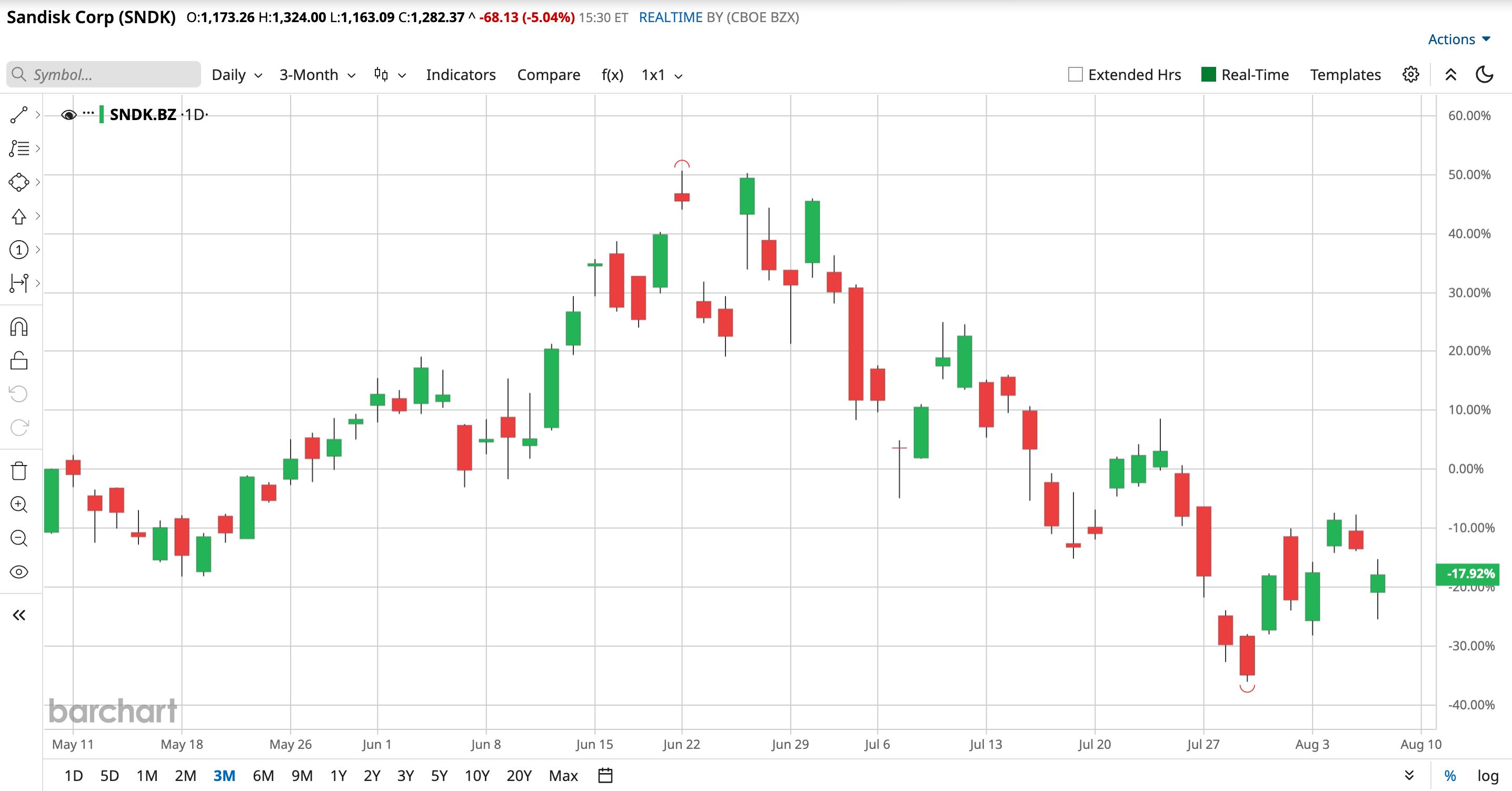
What spooked investors was not the quarter, but the outlook. SanDisk guided next quarter’s revenue to a midpoint of $10.55 billion, which reflects huge growth. But it still ended up being less than Wall Street’s estimates of around $10.8 billion. The stock has swung hard in the past year. From roughly $40 to its 52-week high of $2,354, then cut well over half before a slight recovery again in the past week. The expectations were still very high, and a lot of investors were ready to sell on any bad news. In such a case, missing guidance was enough to send it lower again.
More Top Stocks Daily: Go behind Wall Street’s hottest headlines with Barchart’s Active Investor newsletter.
The Cyclical Question
The deeper worry sits underneath that. SanDisk makes NAND flash memory, a business that has always been brutally cyclical. The prices boom when supply is tight and crash when it loosens. Many investors worry that SanDisk might have peaked or will soon do so, with gross margins no longer expected to continue getting better from the next quarter. CFO Luis Visoso tried to convince the market that this isn’t just a passing peak. While discussing the outlook, he said that the overall NAND market will exceed $300 billion in 2026 and $500 billion in 2027. Visoso also said that the demand continues to outpace SanDisk’s supply, and the output is expected to remain tight into 2028.
Other than the cyclical nature of the business, there is another concern that the market has. There is aggressive competition coming from Chinese memory makers. China’s biggest NAND company is expected to go public between late 2026 and mid-2027, which will likely reduce SanDisk’s pricing power further. So the question hanging over the stock is whether SanDisk can break past the boom-and-bust phase or whether it is nearing the end of its best stretch in the same old cycle. Its Investor Day on August 13 is the next chance to make that case. For now, investors remain cautious.
About SanDisk Stock
SanDisk operates as a developer and manufacturer of data storage devices and solutions based on NAND flash technology. The company’s offerings include solid-state drives, embedded products, removable cards, USB drives, and wafers and components, sold through consumer brands and global franchises. Its products serve smartphones, PCs, automotive, consumer electronics, IoT, industrial, and data center markets.
Since separating from Western Digital (WDC) in February 2025, SanDisk has significantly outperformed the broader semiconductor sector. During the past 52 weeks, the stock has surged 2,944.74% while the Semiconductor iShares ETF @SOXX (SOXX) has gained 126.5% over the same time period. Such a wide performance gap suggests the rally is being driven by more than a general recovery in semiconductor stocks. The trend has continued this year as well, with SanDisk delivering returns of 440% compared with 78.2% for the iShares Semiconductor ETF.
 www.barchart.com
After falling sharply from late June, SanDisk's stock now looks cheap, but it is cheap for a reason. The forward price-to-earnings ratio of 6.34 times and price-to-sales ratio of 4.01 times have no multi-year averages to compare against, since SanDisk only became a separate company in early 2025. The low multiples might make a company posting record growth seem undervalued.
However, this is common for companies seen as cyclical in nature. This is further backed by the EPS outlook. Analysts expect a growth of roughly 200% in 2027, slowing down sharply to 21% in 2028, and then turning negative, falling around 54% in 2029 and 45% in 2030. Analysts had expected a growth of 2,130% in 2026. These numbers suggest that the low multiples may not be as much of a bargain since the earnings are nearing the end of a peak.
The balance sheet, at least, is a genuine strength. SanDisk holds $3.74 billion in cash against just $207 million in debt, leaving it essentially debt-free. For investors, it comes down to one question. If SanDisk can hold these margins, the stock is cheap. If the cycle turns as the estimates suggest, the low multiple is a warning, not a bargain.
SanDisk Reports 372% Year-Over-Year (YOY) Revenue Growth
The company closed fiscal 2026 on a strong note, delivering fourth-quarter results that beat Wall Street expectations. Revenue rose 51% from the previous quarter and 372% YOY to $8.97 billion. Data Center generated $2.98 billion in revenue while the Edge segment contributed $5.43 billion. Consumer revenue came in at $556 million. On the earnings front, it reported Non-GAAP EPS of $39.25. During the quarter, SanDisk generated $5.04 billion in adjusted free cash flow and repurchased $4.5 billion of its shares.
Going forward, the company projects first-quarter fiscal 2027 revenue of $10.3 billion to $10.8 billion. Non-GAAP earnings are expected to range between $44 and $46, based on approximately 155 million fully diluted shares. As stated earlier, management expects the NAND market to exceed $300 billion in revenue in 2026 and reach $500 billion in 2027. SanDisk believes NAND supply constraints will persist beyond 2027. As a result, it intends to keep higher inventory levels to meet customer demand.
What Do Analysts Expect for SanDisk Stock?
Following the company’s earnings report, Mizuho Securities analyst Vijay Rakesh lowered the firm’s price target from $2200 to $1900. However, the analyst maintained a “Buy” rating on the shares. Earlier, on July 21, Aaron Rakers from Wells Fargo raised his price target on the stock from $1,250 to $1,620 while keeping a "Hold" rating.
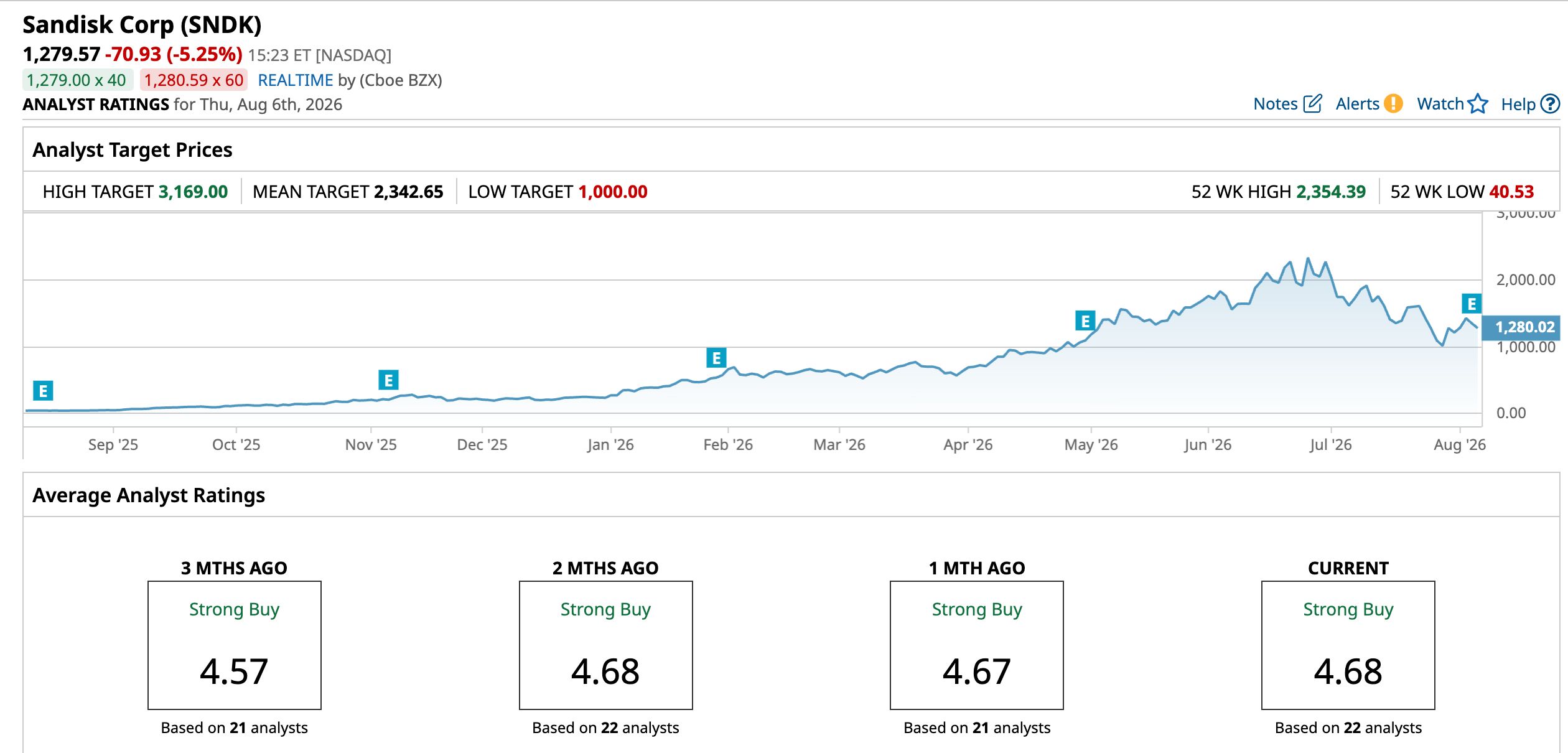
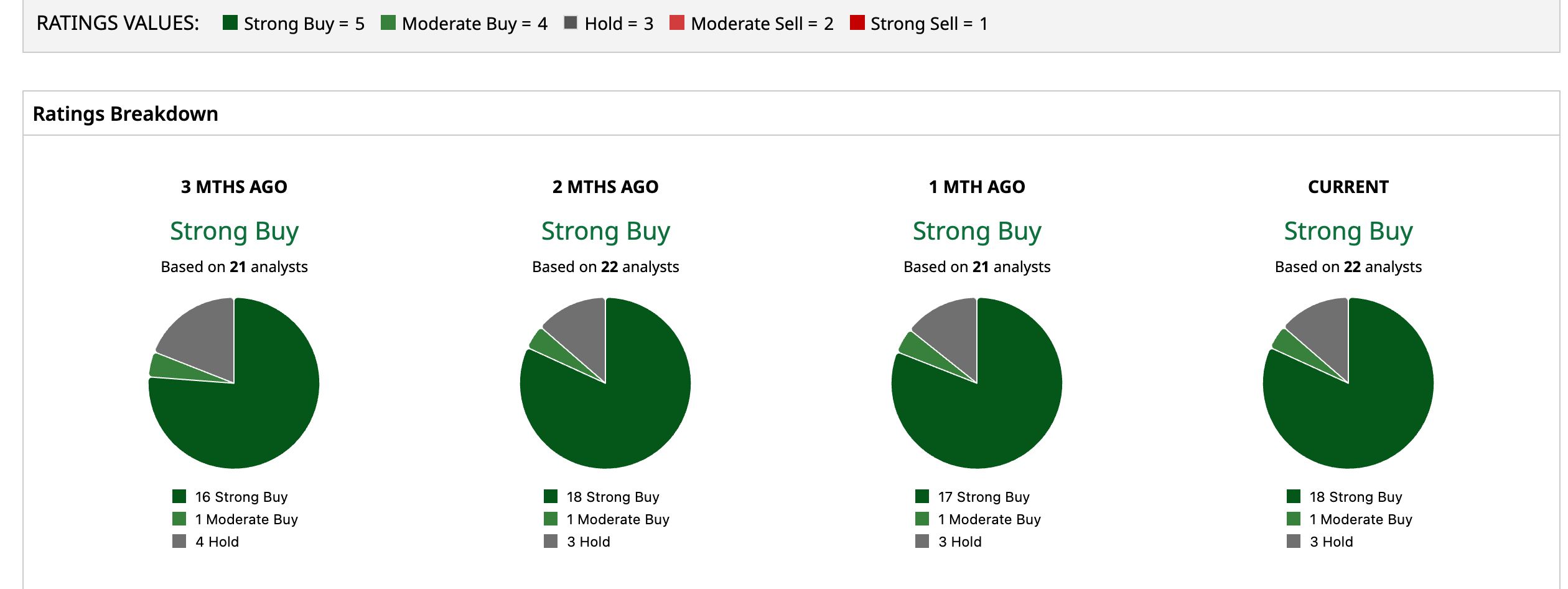
SanDisk enjoys a consensus “Strong Buy” rating from 22 Wall Street analysts covering it. According to their estimates, the stock has an average price target of $2,342.65, offering an additional 83.1% upside from the current share price. In addition, the highest price target of $3,169 suggests that the stock could gain as much as 147.7% from here.
 www.barchart.com
 www.barchart.com
 On the date of publication, Jabran Kundi did not have (either directly or indirectly) positions in any of the securities mentioned in this article. All information and data in this article is solely for informational purposes. For more information please view the Barchart Disclosure Policy here.
More news from Barchart
Wall Street Can't Agree on Palantir. Here's What Investors Should Do Next Dear SanDisk Stock Fans, Mark Your Calendars for a Fresh Catalyst on August 13 AMD Tops Q2 Estimates, but Investors Still Hit the Sell Button. What's Next for AMD Stock. Why This ETF Might Be Ready to Make a Quantum Leap