


With a year-to-date (YTD) loss of around 10%, Meta Platforms (META) is the second-worst-performing Magnificent 7 stock this year. Only Tesla (TSLA) has fared worse this year, and all other Mag 7 constituents are in the green. Meanwhile, Meta seems to be facing a perfect storm. While its core digital advertising business is doing quite well, the company is battling some serious headwinds over child safety even as investors question the company's artificial intelligence (AI) strategy, or the lack of it.
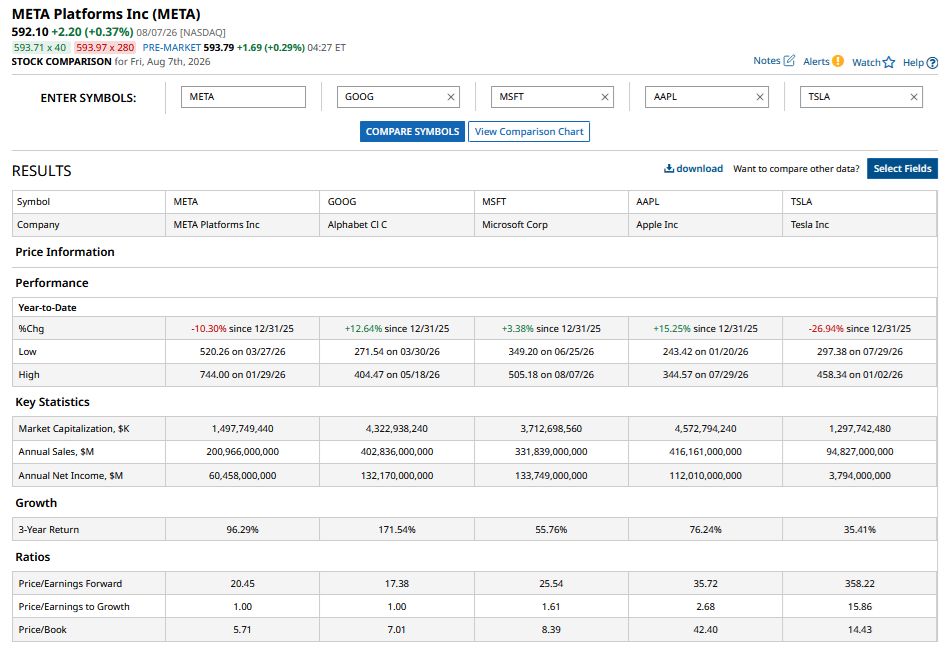 www.barchart.com
 In March, a Los Angeles jury found that Meta and YouTube were negligent in protecting children on their platforms—and deliberately structured their platforms to make them addictive. Now, a New Mexico judge, Bryan Biedscheid, has ordered Meta to pay $567 million into an abatement fund after ruling that the company failed to protect children on its platform. The sum is over and above the $375 million that Meta was forced to pay in civil penalties earlier this year after it was found to have repeatedly violated the state’s Unfair Practices Act as its algorithm “steered” teens towards harmful content.
More Top Stocks Daily: Go behind Wall Street’s hottest headlines with Barchart’s Active Investor newsletter.
Meta Is Facing Scrutiny Over Child Safety
Meanwhile, while the total fine—which is now approaching $1 billion—barely moves the needle for Meta, which generated over $60 billion in revenues in Q2 2026, it is the judge’s observation and its implications for many more such trials that should concern investors.
While Judge Biedscheid ruled that Meta wasn’t alone in causing such harm, he said, “its social media platforms are a significant contributing factor to the current mental health crisis among New Mexico’s youth established by the substantial evidence in this case.” He observed that the harmful effects of Meta’s social media platforms on children are similar to how "noxious pollution produced by the factory can harm the common public right to reasonably clean air".
Notably, almost three dozen U.S. states are suing Meta over child privacy laws, collectively seeking over $1.4 trillion from the company, which, for context, is only a tad below its current market cap. The company is cognizant of these risks, and during the Q2 2026 earnings call, CFO Susan Li said, “We continue to see scrutiny on youth-related issues in several markets and have a number of youth-related trials scheduled for this year in the US, which may ultimately result in a material loss.” The company has made similar observations in the past, highlighting the importance of these lawsuits.
Incidentally, there is a global clamor to ban social media for kids, and many countries are taking steps to at least limit teens' social media activity, if not ban it altogether. On a similar note, in its preliminary report last month, the EU Commission concluded that Meta was in violation of the Digital Services Act due to the “addictive” features on Facebook and Instagram. While the Trump administration has vowed to defend U.S. tech giants from the “digital tax” several countries are looking to impose, the flurry of teen safety cases in the U.S. would lower the legroom to take on other countries contemplating similar measures.
Meta’s AI Strategy
Talking of AI, Meta expects to spend up to $145 billion on capex this year. While in absolute terms, Amazon’s (AMZN) 2026 capex budget is the highest among Mag 7 peers, Meta is expected to spend over 57% of its expected revenues on capex this year, by far the highest. It was also among the most aggressive in hiring AI talent at eye-popping compensation and plans to put “superintelligence” into every user’s hand.
However, it has failed to convince markets that it actually has an AI strategy. It does not help that Meta does not have cloud operations, even as during the Q2 call, CEO Mark Zuckerberg touted the possibility of selling excess compute capacity and said the company is “getting a lot of offers for compute at a significant premium.”
Meta has announced a flurry of initiatives to monetize its AI capex, but the company’s monetization timeline is quite hazy, unlike other hyperscalers whose cloud businesses are currently reaping the reward from AI capex.
During the recent earnings call, Microsoft (MSFT) was able to shed the perception that it is losing out in the AI race and showed strong growth in Copilot numbers while also maintaining its 2026 capex guidance. As for Meta, the earnings call left markets with more questions than answers and only added to the gloom around the stock.
From a valuation perspective, META trades at a forward price-to-earnings (P/E) multiple of around 20.4x, which is quite balanced. However, scrutiny over teen safety issues and mounting concerns over its AI strategy might keep a lid on the stock unless the company addresses them.
On the date of publication, Mohit Oberoi had a position in: META , MSFT , TSLA , AMZN . All information and data in this article is solely for informational purposes. For more information please view the Barchart Disclosure Policy here.
More news from Barchart
Why SpaceX Stock Plunged Despite a Strong Q2 Earnings Beat The Biggest AI Power Opportunity May Be Hiding in Constellation Energy Meta Is Facing a Perfect Storm as Child Safety and AI Strategy Concerns Pull Down META Stock Redwire Takes Off on Solid Q2 Results. How to Play RDW Stock Here.