

SpaceX Corporation’s (SPCX) first quarterly earnings report as a public company delivered the kind of headline numbers investors typically celebrate. Revenue surged past Wall Street’s expectations, losses narrowed significantly, and management reaffirmed its long-term ambitions across its space, satellite, and artificial intelligence (AI) businesses.
Yet the market focused on a different story.
More Top Stocks Daily: Go behind Wall Street’s hottest headlines with Barchart’s Active Investor newsletter.
SpaceX shares plunged 13.61% on Aug. 5 as investors looked past better-than-expected Q2 results and focused instead on its aggressive AI spending plans. Capital expenditures soared sixfold year-over-year (YOY) to $18.4 billion in the second quarter, well above analysts’ expectations, with most of the spending directed toward expanding AI infrastructure.
While management argued the investments would generate a payback period of less than one year and accelerate its push to become a major AI cloud provider, concerns remain that the enormous upfront costs would delay profitability and strain cash flow. The stock’s decline was compounded by concerns over insider lockup expiration.
About SpaceX Stock
SpaceX, formally known as Space Exploration Technologies Corporation, is a leading aerospace, satellite communications, and space technology company founded by Elon Musk. The company designs and launches reusable rockets, operates the rapidly expanding Starlink satellite internet network, and provides launch services for commercial, government, and defense customers worldwide.
Headquartered in Starbase, Texas, SpaceX has emerged as a dominant force in the global space industry and recently became one of the world’s most valuable publicly traded companies following its historic IPO. Currently, SpaceX’s market cap is $1.74 trillion, placing it among the largest companies by market value.
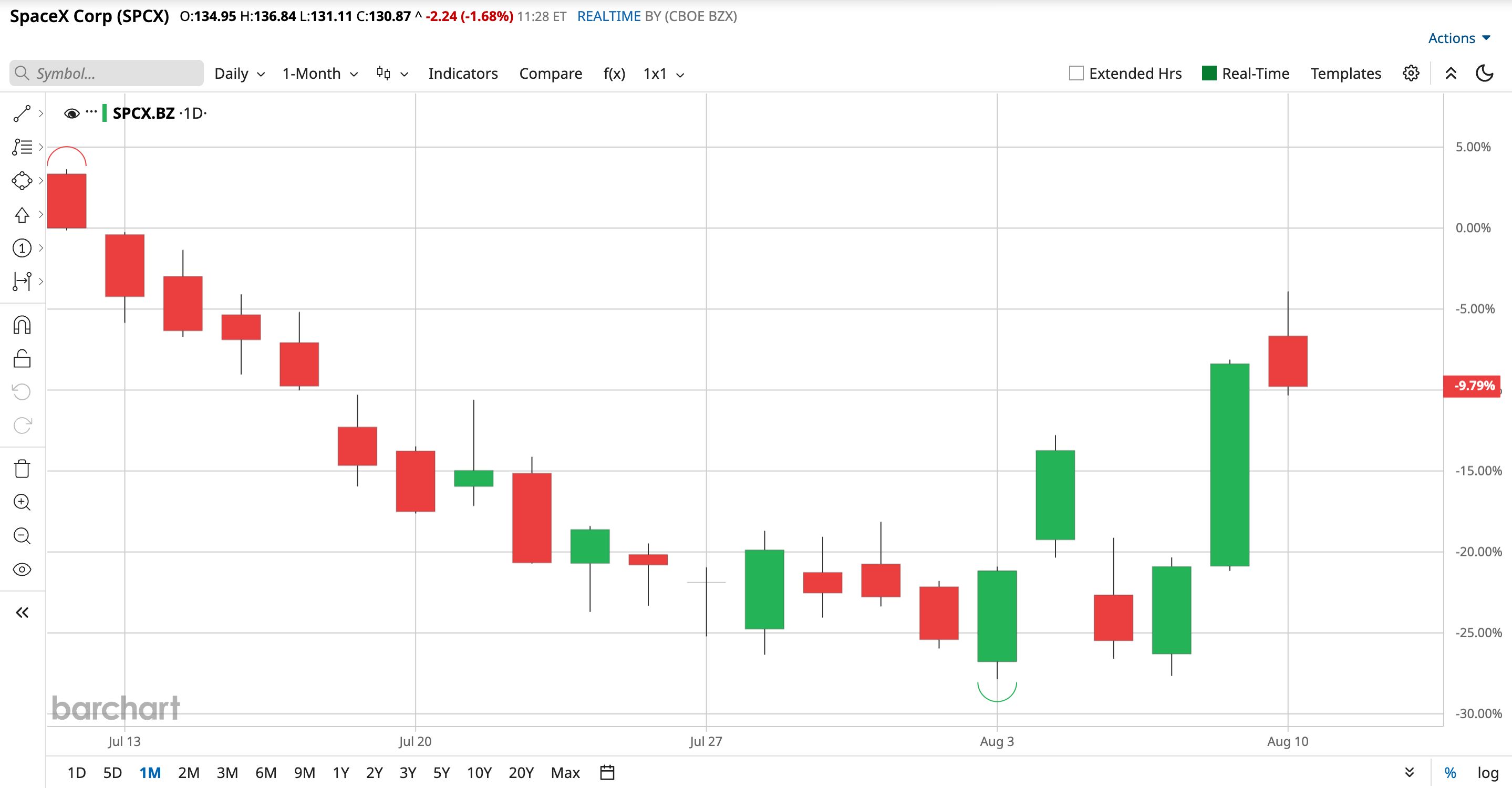
SpaceX had a blockbuster Nasdaq debut on June 12, 2026. The company priced its IPO at $135 per share, while the stock opened at $150, climbed as high as $176.52 intraday, and finished its first trading session at $160.95. However, it has experienced sharp volatility since its public debut, as investors locked in profits and valuation concerns intensified.
Over the past month, the stock has fallen 6.76%, although it remains up 18.29% over the past five trading days. The biggest move came on Aug. 5, when shares plunged 13.61% despite the company reporting better-than-expected second-quarter results. Instead, investors focused on its $18.4 billion quarterly capital expenditure, most of it earmarked for AI infrastructure and concerns over the insider lockup expiration.
However, bargain hunters stepped in the following session, lifting the stock 6.14% on Aug. 6 and 15.83% on Aug. 7 as investors viewed the post-earnings sell-off as overdone and the lockup event passed without the wave of selling many had feared.
Even after the rebound, SPCX remains well below its $135 IPO price, underscoring continued investor caution over the pace of AI spending, its impact on near-term profitability and valuation.
 www.barchart.com
 SpaceX trades at an eye-catching 80.47 times sales, a valuation multiple that far exceeds the sector median.
Robust Q2 Growth
SpaceX reported its second-quarter 2026 results on Aug. 4 after the market close, delivering a broad earnings beat driven by strong growth across its Space, Connectivity, and AI businesses. Revenue surged 92% YOY to $7.81 billion from $4.1 billion, above expectations, while the net loss narrowed to $541 million from a loss of about $1.0 billion in the prior-year quarter. It reported a Q2 2026 loss per share of $0.09, beating expectations. Adjusted EBITDA climbed 191% YOY to $3.5 billion from $1.2 billion.
The Connectivity segment remained the company’s profit engine, with revenue increasing 66% YOY and operating income rising 79%, supported by a doubling of Starlink subscribers. The AI business was the fastest-growing segment, with revenue jumping 247% YOY to $2.6 billion, fueled by new cloud services agreements and Grok subscriptions, while the Space segment generated $962 million in revenue, up 29% YOY.
Despite the strong operating performance, investors were unsettled by the company’s aggressive investment plans. Capital expenditures increased to $18.4 billion during the quarter, including $15.8 billion directed toward AI infrastructure and compute capacity expansion. Management emphasized that demand for its AI cloud platform remains robust, highlighting $14.1 billion in new cloud services agreements signed during the quarter and ending the period with $47.5 billion in backlog and $100 billion in cash, cash equivalents, and marketable securities.
Further, the company expects to achieve a $100 billion annualized revenue run rate by the end of 2026 and pulled forward its target of reaching $1 trillion in annual revenue to 2030 from 2031.
On the other hand, analysts expect the company to post a loss per share of $0.11 for 2026, but improve 1,491% to an EPS of $1.53 in 2027.
What Do Analysts Expect for SpaceX Stock?
Most recently, Argus Research upgraded SpaceX from “Hold” to “Buy” and assigned a $160 price target, citing growing confidence that the company’s aggressive artificial intelligence investments will generate attractive returns.
Also, JPMorgan reiterated its “Overweight” rating on SpaceX and raised its price target to $240 from $225 following the company’s second-quarter earnings report. The firm acknowledged that SpaceX’s AI-driven capital expenditures were substantially higher than expected but argued that the market is underestimating the long-term value of the company’s extreme vertical integration across launch services, satellites, AI infrastructure, and cloud computing.
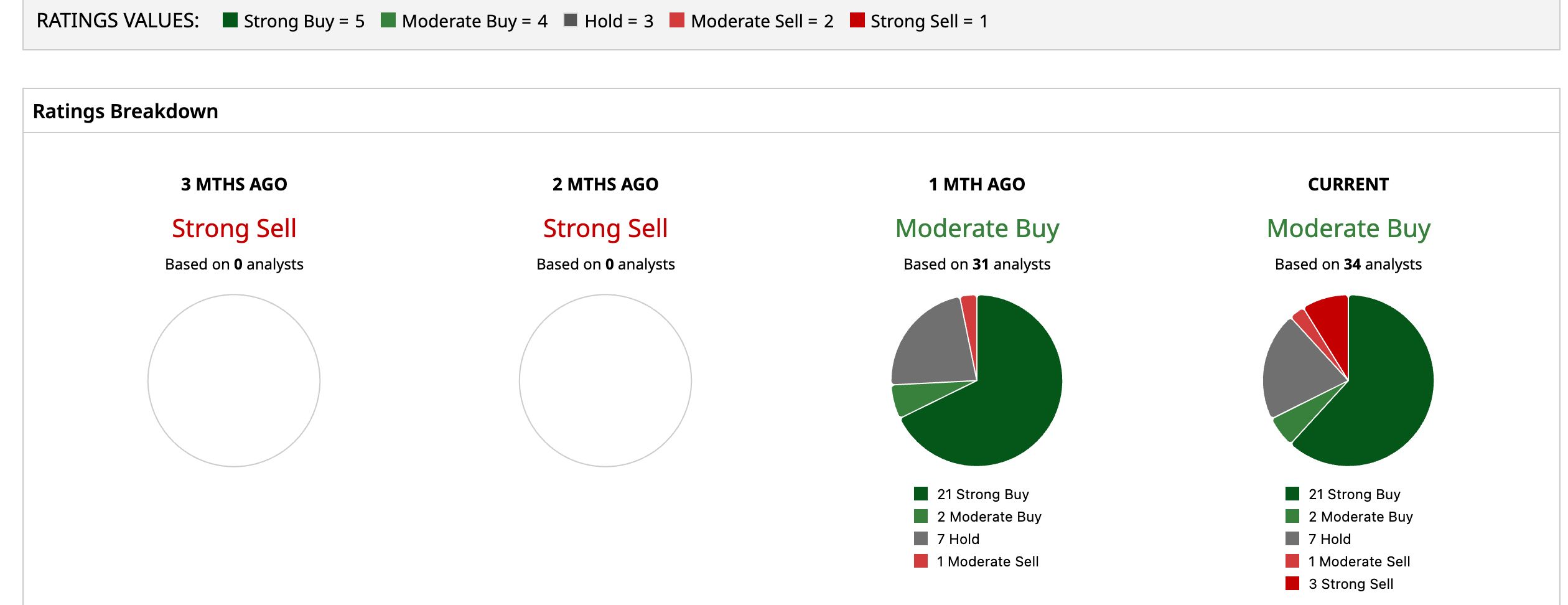
Overall, SpaceX has a consensus “Moderate Buy” rating. Of the 34 analysts covering the stock, 21 advise a “Strong Buy,” two recommend a “Moderate Buy,” seven suggest a “Hold,” one gives a “Moderate Sell” rating and three “Strong Sell.”
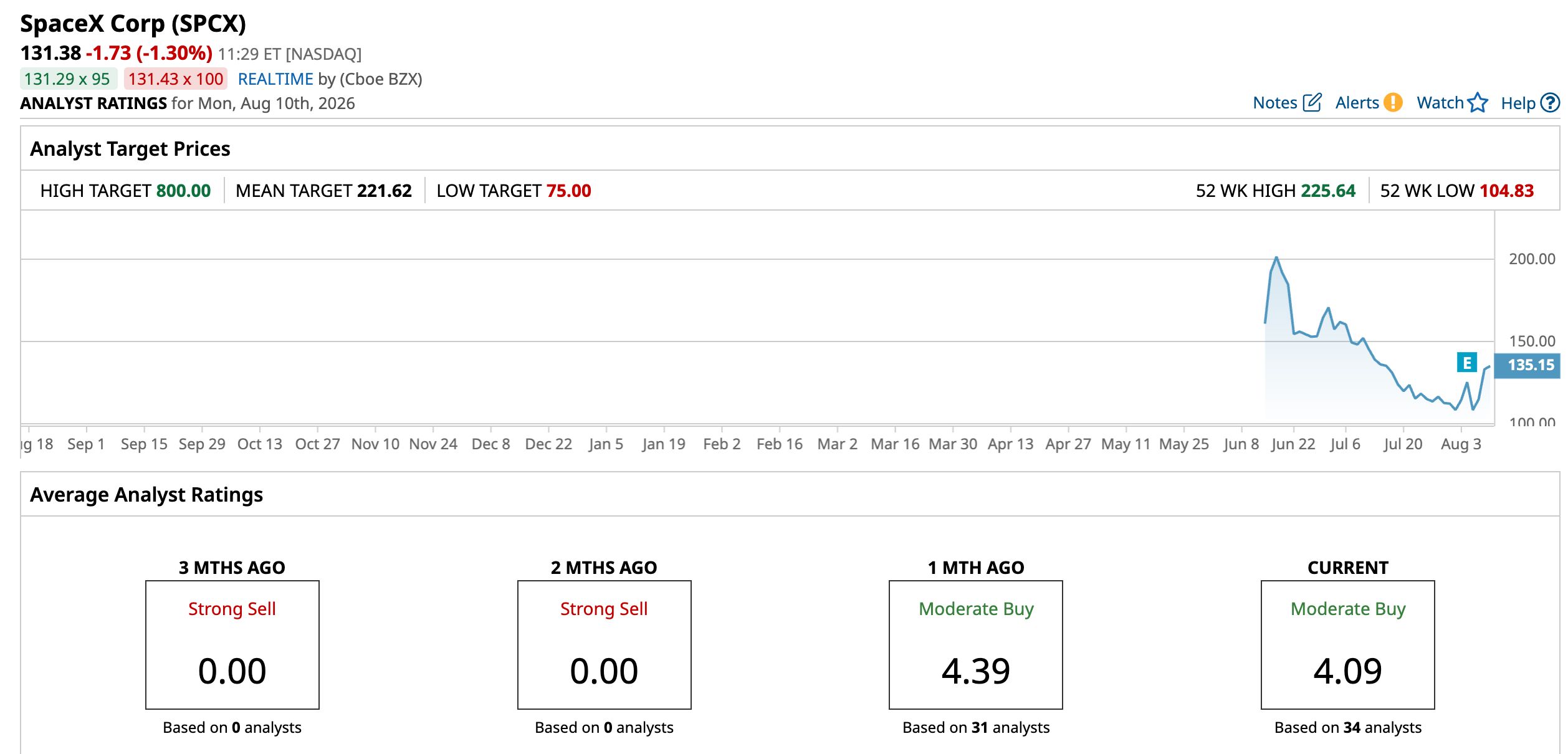
SPCX’s average analyst price target of $221.62 indicates an upside of 68.7%, while the Street-high target price of $800 suggests the stock can surge as much as 508.9%.
 www.barchart.com
  www.barchart.com
 On the date of publication, Subhasree Kar did not have (either directly or indirectly) positions in any of the securities mentioned in this article. All information and data in this article is solely for informational purposes. For more information please view the Barchart Disclosure Policy here.
More news from Barchart
Why SpaceX Stock Plunged Despite a Strong Q2 Earnings Beat The Biggest AI Power Opportunity May Be Hiding in Constellation Energy Meta Is Facing a Perfect Storm as Child Safety and AI Strategy Concerns Pull Down META Stock Redwire Takes Off on Solid Q2 Results. How to Play RDW Stock Here.