

Biotech stocks had already been gaining ground before this week’s news. In June, the iShares Nasdaq Biotechnology ETF (IBB) traded just 1.47% below its 52-week high after moving sideways since November.
Then, Moderna (MRNA) surged more than 176%, while Merck (MRK) gained over 12%, after their personalized mRNA cancer vaccine reduced melanoma recurrence in a late-stage trial. The INTerpath-001 study included 1,137 high-risk melanoma patients and delivered the first successful Phase 3 result for an individualized mRNA neoantigen therapy.
More Top Stocks Daily: Go behind Wall Street’s hottest headlines with Barchart’s Active Investor newsletter.
The news lifted the wider group. The SPDR S&P Biotech ETF (XBI) had already risen nearly 72% over the prior 52 weeks, and the follow-on rally pushed biotech shares to a post-pandemic high.
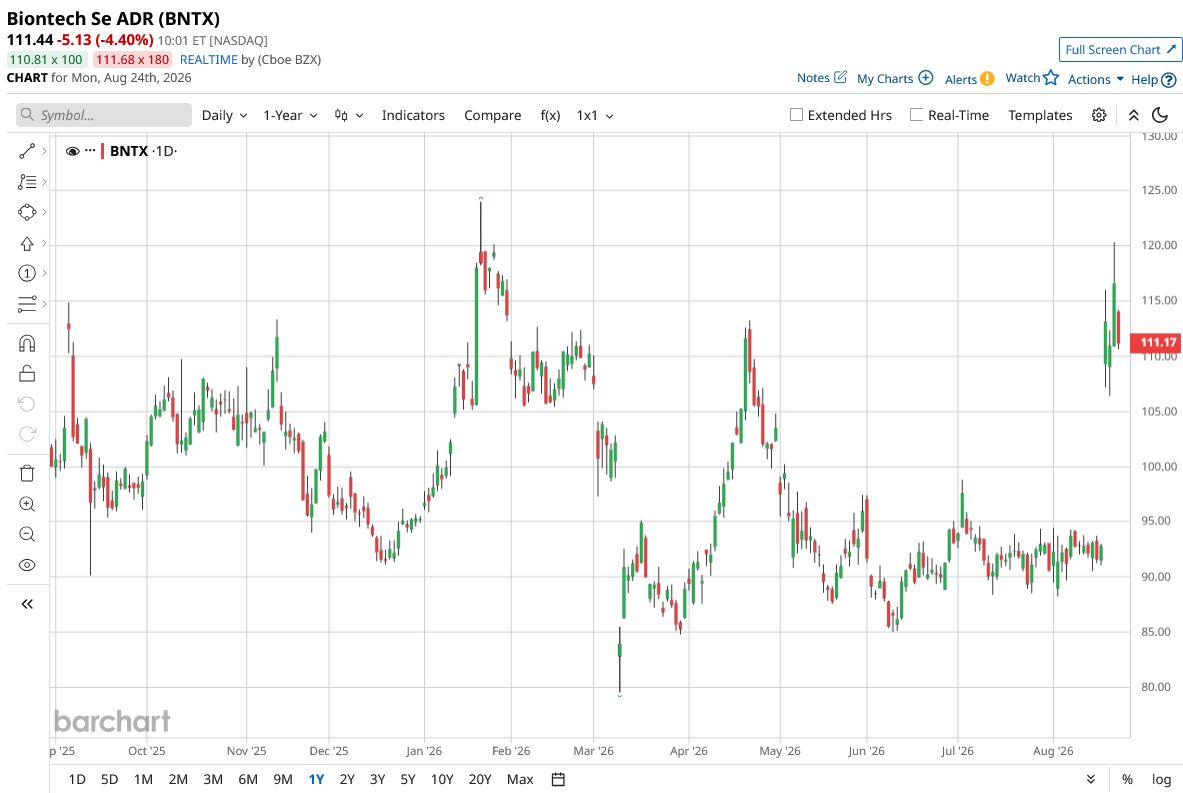
BioNTech (BNTX), a close mRNA peer of Moderna, was among the biggest gainers despite reporting no new clinical data of its own. BioNTech fell to a 52-week low of $79.52 in March and remains below its January high of $124. In other words, a stock that spent most of 2026 grinding lower just repriced in a single session on someone else's clinical win.
So does BioNTech's own pipeline, cash position, and valuation actually support this re-rating? Let's find out.
BioNTech’s Post-Covid Financial Reality
BioNTech (BNTX) is best known for its mRNA work and its Covid-19 vaccine partnership with Pfizer (PFE). But the company is now trying to build its next business around cancer treatments. BNTX is up 17% so far this year but up only 0.21% over the past 52 weeks.
 www.barchart.com
 Second-quarter revenue fell to €105.6 million from €260.8 million a year ago. First-half revenue also dropped to €223.7 million from €443.6 million as Covid-19 vaccine demand slowed. At the same time, R&D spending rose to €551.0 million from €509.1 million, or €477.1 million on an adjusted basis. BioNTech is spending more on its cancer programs, including pumitamig and gotistobart, while also taking on costs tied to CureVac.
SG&A expense increased to €197.8 million from €137.4 million as the company prepared for possible launches, integrated CureVac, and upgraded its operations. The result was a Q2 net loss of €820.8 million, up from €386.6 million, with a diluted loss per share of €3.24 versus €1.60.
First-half losses reached €1.35 billion, or €5.34 per share, while pipeline-prioritization charges pushed other operating expenses to €207.9 million. BioNTech still had €16.63 billion in cash and security investments at the end of June, giving it plenty of room to fund its cancer pipeline while vaccine sales remain weak.
Pipeline Progress Could Redefine BNTX
BioNTech and Pfizer (PFE) received European Commission approval for their 2026-2027 Covid-19 vaccine, updated for the XFG variant, for people aged six months and older. The approval covers all 27 EU countries, plus Iceland, Liechtenstein, and Norway. It followed the European Medicines Agency’s July 23 recommendation. The companies have already started production before the respiratory season. Their submitted data showed strong immune responses against XFG and several other circulating variants, including XFG.1.1, NB.1.8.1, PQ.17, and PQ.2.8.1.
The bigger opportunity is BioNTech’s pumitamig partnership with Bristol Myers Squibb (BMY). The companies started five pivotal trials in the first half of 2026, covering triple-negative breast cancer, colorectal cancer, gastric cancer, and two non-small-cell lung cancer settings. That brings the ROSETTA program to seven pivotal trials. BioNTech expects to book €613 million in collaboration revenue from Bristol Myers Squibb in Q3, far above the €105.6 million it reported as total Q2 revenue. In first-line lung cancer, Phase 2 data showed confirmed response rates of 57.1% in non-squamous NSCLC and 68.4% in squamous NSCLC, with a 100% disease-control rate in both groups.
BioNTech also partnered with Boehringer Ingelheim to study pumitamig with its DLL3/CD3 T-cell engager in extensive-stage small-cell lung cancer. Meanwhile, gotistobart, which BioNTech is developing with OncoC4, posted a 0.46 hazard ratio against chemotherapy in squamous lung cancer at the European Lung Cancer Congress in March. A Phase 3 interim update is expected later this year.
Analyst Views and the Road Ahead
BioNTech is set to report earnings on Nov. 2, 2026. Analysts expect $0.64 per share for the current quarter, compared with a loss of $0.14 per share a year earlier. That works out to 557.14% year-over-year (YoY) growth, though estimates still point to a full-year 2026 loss of $6.33 per share, wider than the $0.54 loss reported in 2025.
Still, some analysts are focused more on BioNTech’s cancer pipeline than its near-term losses. UBS analyst David Dai upgraded BioNTech to “Buy” from “Neutral” on May 27 and lifted his price target to $135 from $117. He cited growing confidence in pumitamig, which UBS sees as a possible best-in-class treatment for several solid tumors.
Canaccord Genuity analyst John Newman kept a “Buy” rating and set a $142 price target on Aug. 5, even after BioNTech reported weak Q2 results and cut its outlook.
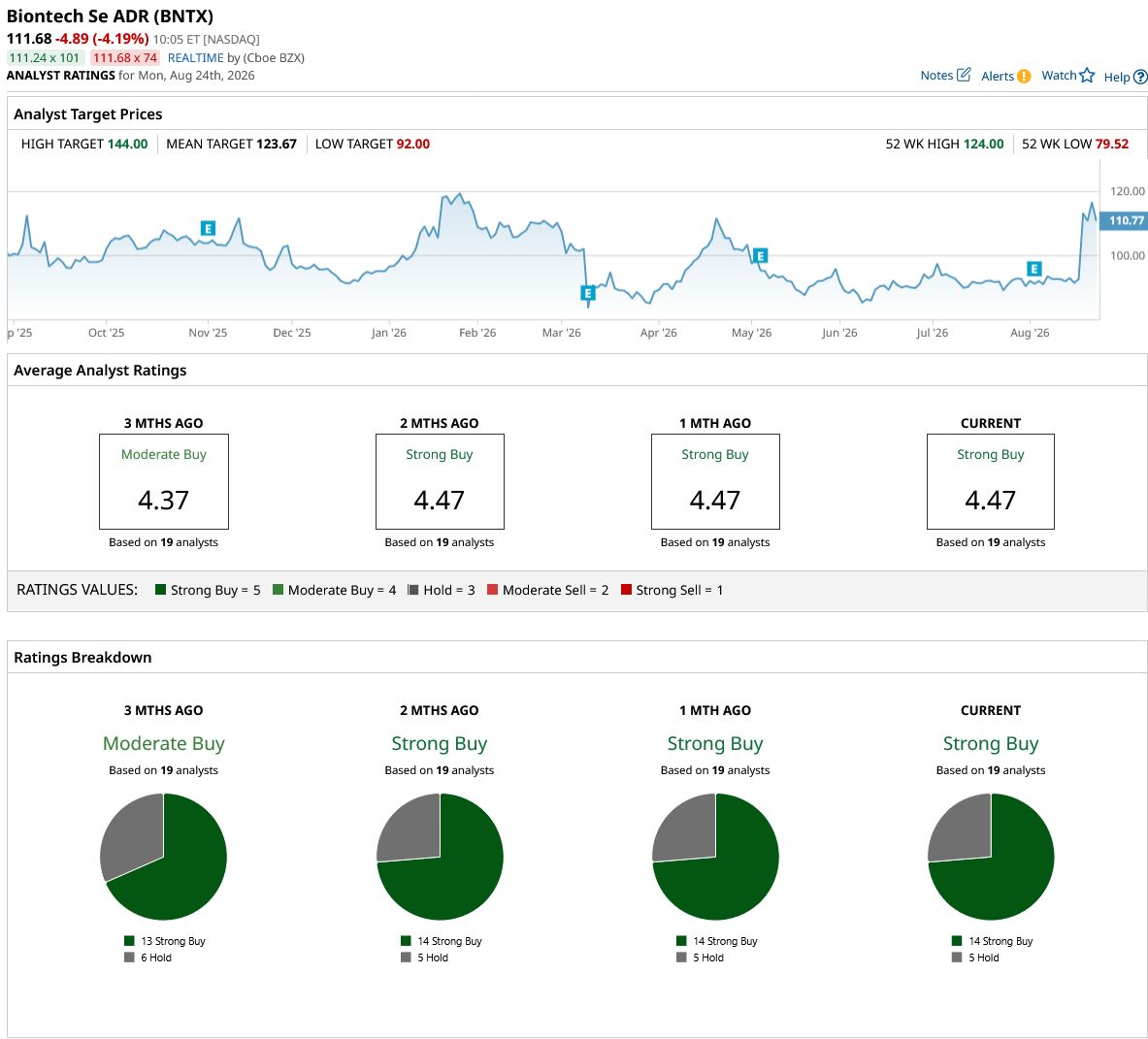
The 19 analysts covering BNTX rate it a consensus “Strong Buy,” with an average target price of $123.67. That points to about 10% upside from the current share price.
 www.barchart.com
 Conclusion
BioNTech’s rally has a credible foundation, but it is not yet fully supported by its current financial results. The company still faces falling Covid-19 revenue, rising operating costs, and substantial losses, while the recent sector move was sparked by Moderna and Merck’s clinical success rather than BioNTech data. Still, BNTX has €16.63 billion in liquidity, a meaningful oncology runway, and nearer-term catalysts around pumitamig and gotistobart. Shares are most likely to remain volatile, but the direction should tilt higher if upcoming pivotal data validate the pipeline and collaboration revenue begins to narrow the gap left by Covid sales.
On the date of publication, Ebube Jones did not have (either directly or indirectly) positions in any of the securities mentioned in this article. All information and data in this article is solely for informational purposes. For more information please view the Barchart Disclosure Policy here.
More news from Barchart
BioNTech Moved Higher as the Broader Biotech Sector Hit a Post-Pandemic Peak, but BNTX Stock Needs Stronger Fundamentals to Keep Climbing Better Than Nvidia: 3 AI Dividend Stocks Leaving It in the Dust Why the China-Led Weakness in NXP Semiconductors Stock Could Open Doors for Speculators Intel Stock Has Soared 140% YTD. The Next Catalyst May Be Hiding in GPU Prices.