

Alibaba (BABA) stock is under renewed pressure after Michael Burry exited his position and shifted his money toward Chinese rival JD.com (JD). The famed “Big Short” investor said he no longer plans to buy Alibaba back unless the stock falls by roughly half, raising fresh questions about valuation, dilution, and the company’s aggressive artificial intelligence spending.
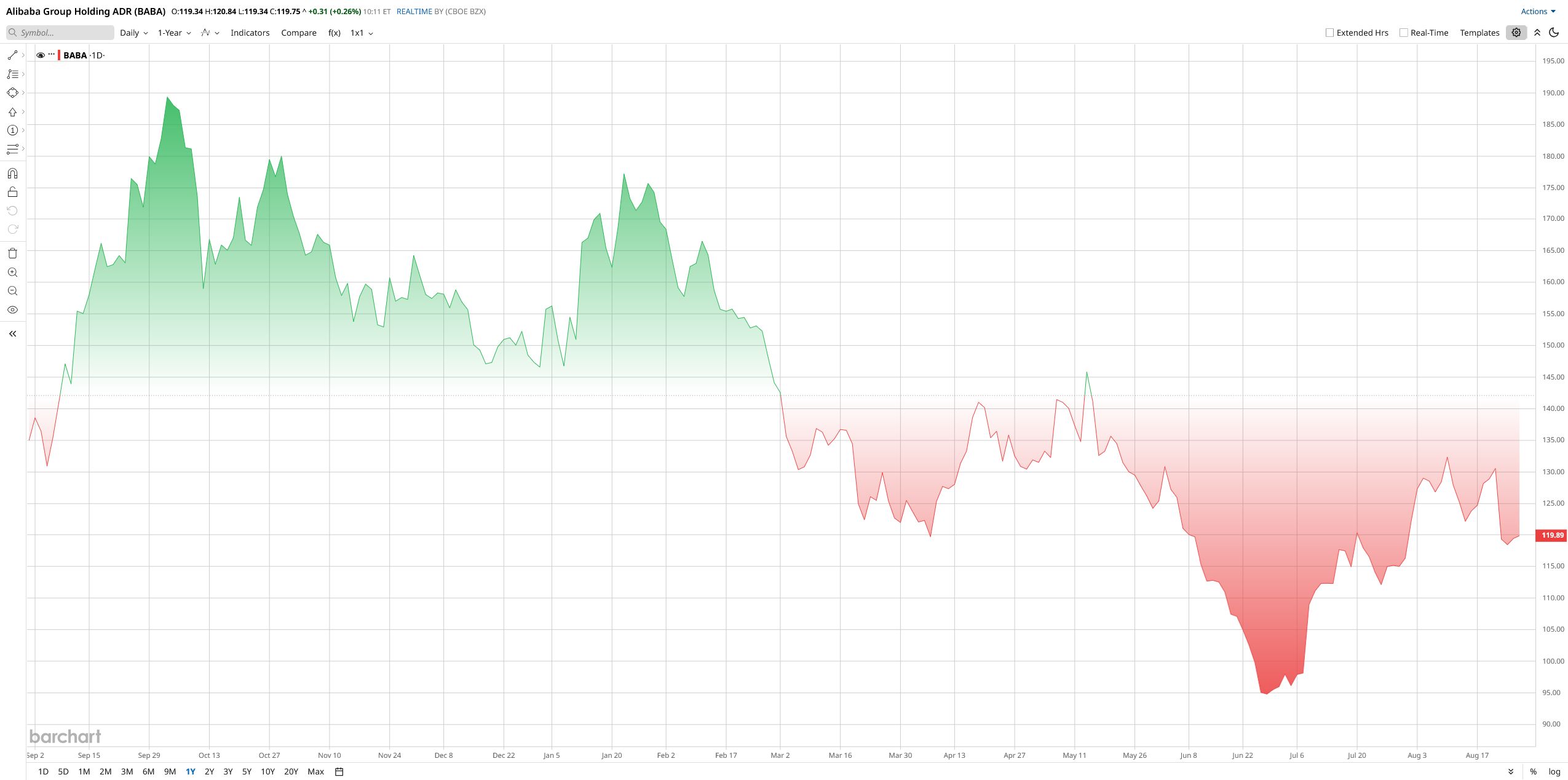
BABA stock closed at $119.44 on Tuesday after plunging 8.5% in a single session following Alibaba’s latest financing announcement. The shares are down sharply by about 18% in 2026 and remain well below their 52-week high of $192.67, which shows growing investor concerns over profitability and the cost of the company’s AI expansion.
More Top Stocks Daily: Go behind Wall Street’s hottest headlines with Barchart’s Active Investor newsletter.
Alibaba Stock Faces Growing Pressure in 2026
Alibaba’s weak stock performance reflects several competing forces. The company is spending heavily to build its AI infrastructure, while China’s e-commerce market remains intensely competitive.
The latest blow came on Aug. 24, when Alibaba announced an HK$80 billion ($10.2 billion) share placement to finance AI investments. The offering involves 710 million new shares priced at an 8.4% discount to the previous close, creating immediate dilution concerns for existing shareholders. Alibaba shares in Hong Kong fell more than 8% following the announcement.
That helps explain why Burry’s exit matters. His criticism is not simply about near-term earnings. It highlights the risk that Alibaba may need to keep raising capital while returns from its AI investments remain uncertain.
 www.barchart.com
 BABA Valuation Looks Cheaper on Forward Earnings
Alibaba’s valuation is where the bullish and bearish arguments collide.
At around $119, BABA trades at roughly 27.2 times trailing earnings, according to current valuation data. However, its forward P/E is only about 14.6 times.
That lower forward multiple suggests the market is already pricing in a meaningful recovery in earnings. In other words, Alibaba does not necessarily look expensive based on future profits. The concern is whether those future profits actually materialize as AI spending continues to pressure margins and free cash flow.
Burry appears to be betting that investors are underestimating that risk. His decision to walk away also puts the spotlight on Alibaba’s declining return on invested capital and its increasingly capital-intensive growth strategy.
AI Spending Is Crushing Profits for Now
Alibaba’s latest quarterly results show exactly why investors are divided.
For its fiscal first quarter ended June, revenue rose 9% year-over-year (YoY) to 268.95 billion yuan, beating expectations. But net income plunged roughly 75% to 10.54 billion yuan as capital expenditures jumped 75% to 67.68 billion yuan. Free cash flow also moved deeper into negative territory.
The biggest bright spot was Alibaba Cloud. Cloud and AI-related revenue climbed 45% to 48.44 billion yuan, with AI-related product sales continuing to post triple-digit growth.
Alibaba is also investing beyond its traditional e-commerce operations. It is committing about 380 billion yuan to AI and cloud infrastructure over three years, expanding data center capacity and developing its Qwen family of AI models. The company is also working on its own chips and has moved to streamline operations, including plans involving its semiconductor arm, T-Head.
Wall Street Still Sees Big Upside for BABA Stock
Despite Burry’s bearish move, Wall Street remains overwhelmingly bullish on BABA stock.
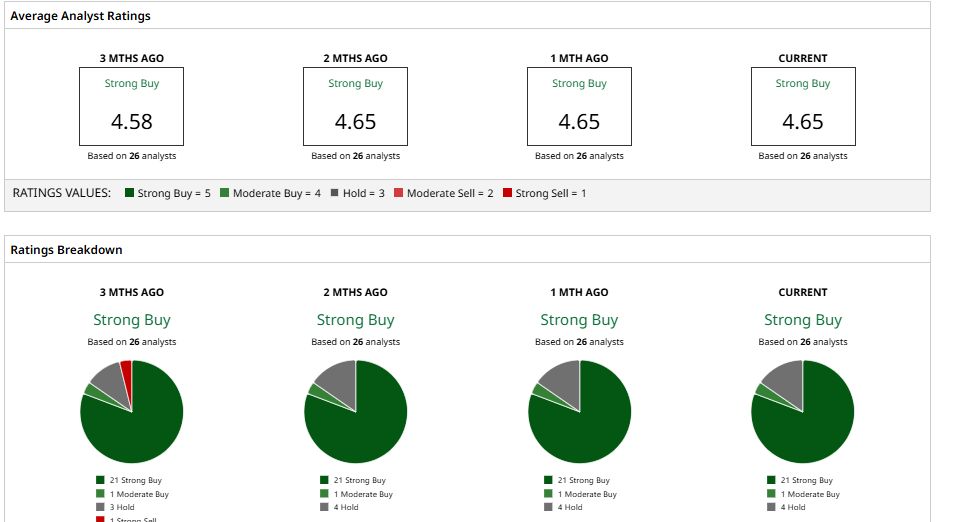
Barchart currently shows a “Strong Buy” consensus based on 26 analysts; 21 of those analysts give it a “Strong Buy,” and there are no sells. The 12-month mean price target is $182.29, implying roughly 52% upside from the stock’s recent levels, while the highest target reached $220, or close to 84% potential upside.
That bullish stance still implies confidence that Alibaba’s AI and cloud investments can eventually translate into stronger margins, cash flow, and earnings growth.
The key question for BABA investors is therefore not whether Burry is concerned. He clearly is. The bigger question is whether Alibaba can turn its massive AI spending into high-return growth before dilution and weaker near-term profitability become a bigger problem. For now, Wall Street is betting that it can.
 www.barchart.com
 On the date of publication, Nauman Khan did not have (either directly or indirectly) positions in any of the securities mentioned in this article. All information and data in this article is solely for informational purposes. For more information please view the Barchart Disclosure Policy here.
More news from Barchart
Ahead of Affirm Earnings, Here's What Barchart Data Says Comes Next for AFRM Stock Every $1,000 Bitcoin Move Now Swings Strategy’s Fortune by $840 Million Elon Musk Says We’re ‘1000% Going to Go Bankrupt’ Without Al and Robots — ‘We’re Totally Screwed’ as Interest on National Debt Tops $1 Trillion DICK’S Sporting Goods Stock Slumps 30.7%: Why Investors Shouldn’t Rush to Buy DKS.