


Quantum computing stocks rallied on Tuesday as the U.S. Department of Commerce finalized $100 million CHIPS and Science Act awards to each of three pure-play quantum firms — D-Wave Quantum (QBTS), Rigetti Computing (RGTI), and Quantinuum (QNT) — totaling $300 million in combined federal investment.
In exchange for the funding, the Commerce Department will acquire minority, non-controlling equity stakes in Rigetti and D-Wave, a structure designed to provide potential upside for U.S. taxpayers while avoiding interference with corporate governance.
More Yield, Less Trap: Sign up free to get Barchart’s daily Dividend Investor newsletter straight to your inbox.
The catalyst sent D-Wave shares up roughly 6%, Rigetti up 3%, and Quantinuum up approximately 1%, all outperforming a broadly declining market weighed down by rising oil prices and new Canadian retaliatory tariffs.
How the Quantum Funds Will be Deployed
D-Wave intends to deploy its $100 million toward developing a 100,000-qubit annealing system and a 10,000-qubit gate-model quantum computer capable of 100 logical qubits, targeting applications in optimization, materials simulation, and quantum AI.
Rigetti's award funds three specific hardware initiatives: miniaturized readout electronics, expanded cryogenic infrastructure, and high-connectivity quantum chip fabrication, all aimed at overcoming key bottlenecks in scaling superconducting quantum systems.
Quantinuum will use its allocation to advance trapped-ion quantum technology in collaboration with GlobalFoundries (GFS) on next-generation ion traps manufactured on 300mm wafers. GlobalFoundries itself secured the largest individual award at $375 million, underscoring the federal government's parallel emphasis on strengthening the broader quantum supply chain.
Quantum Stock Performance in Context
Despite the day's gains, the year-to-date performance of these stocks remains deeply negative, with Rigetti down 29% and D-Wave down 33% for 2026, meaning Tuesday's pop only recovered a small fraction of losses accumulated throughout the year.
Both companies still carry substantial cash reserves — each roughly $540–$546 million at the end of the second quarter — but revenue generation remains minimal, with Rigetti reporting just $5.1 million and D-Wave approximately $3.1 million in Q2 revenue.
The government equity stakes also introduce dilution risk; D-Wave's SEC filing revealed a planned issuance of about 7.1 million shares at $14.09 per share to the Commerce Department, with an initial $53.55 million tranche available shortly after the award date.
Is Government Funding a Reason to Buy These Quantum Stocks?
The federal government's willingness to invest directly and take equity positions in quantum companies signals Washington's conviction that quantum computing is both a national security imperative and a commercial opportunity, but investors should weigh the multi-year research timelines and persistent operating losses against the validation these awards represent.
Notably, some major technology players have opted out of the Commerce Department's equity-for-funding model entirely. A Google (GOOG) (GOOGL) Quantum AI executive confirmed in June that Google declined the deal due to restrictive conditions, while IBM (IBM) is pursuing its own $2 billion quantum foundry initiative with a separate $1 billion Commerce Department commitment.
1 Way to Invest in Quantum Stocks Without Picking Winners
Investors looking to take part in longer-term upside can screen Barchart’s Quantum Computing Stocks Watchlist, or consider the Defiance Quantum ETF (QTUM).
As columnist Rick Orford has noted, QTUM offers a basket approach that dilutes the impact of any one company's volatility – making it well-suited for investors seeking diversified exposure to quantum computing without taking concentrated single-stock risk in these highly speculative, pre-revenue companies.
QTUM is up only about 1% on the session, reflecting the reality that the CHIPS Act catalyst was concentrated in the two publicly traded recipients rather than spread across the broader quantum ecosystem. On a year-to-date basis, however, the quantum ETF has outperformed both RGTI and QBTS, as well as QNT's post-spinoff returns.
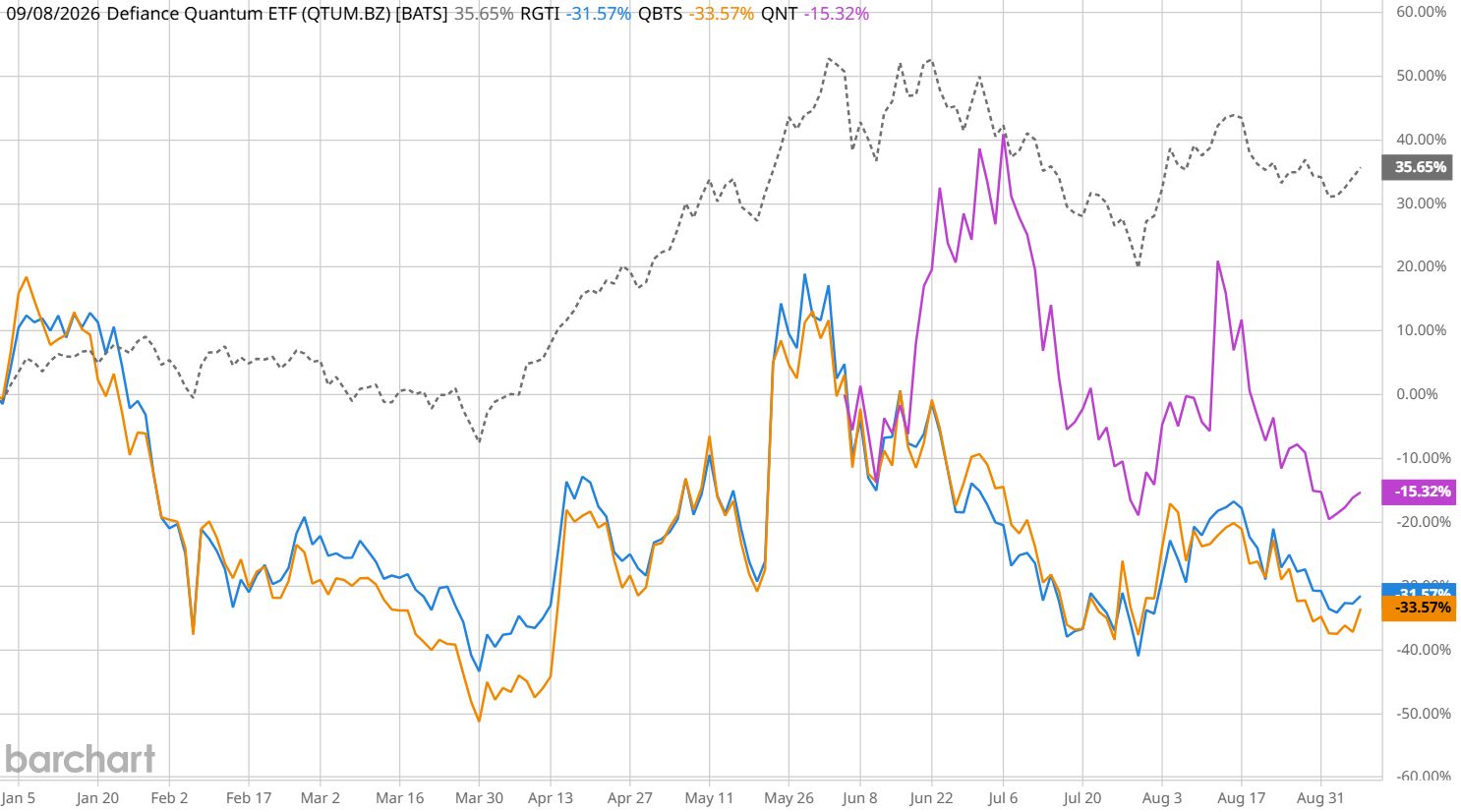 QTUM vs. individual quantum stocks YTD.
This article was created with the support of automated content tools from our partners at Sigma.AI. Together, our financial data and AI solutions help us to deliver more informed market headline analysis to readers faster than ever.
On the date of publication, Sarah Holzmann did not have (either directly or indirectly) positions in any of the securities mentioned in this article. All information and data in this article is solely for informational purposes. For more information please view the Barchart Disclosure Policy here.
More news from Barchart
Quantum Stocks Are Climbing Today as CHIPS Act Cash Pours In. Here’s One Way to Invest. 2 ETFs You Can Use to Trade a Dangerous Market as S&P 500 Short Interest Reaches Decade Highs 1 Momentum Signal Suggests the Software Apocalypse Is Over. Don’t Rush to Buy Just Yet. The VIX Is Playing Tricks: Why Stocks Are Volatile, But the Fear Gauge Is Sleeping