

Meta Platforms (META) is making another push to prove it can compete at the front of the artificial intelligence (AI) race.
On Sept. 2, Meta released Muse Spark 1.3, an updated model focused on coding and agentic workflows. The timing matters. Investors have been questioning whether Meta’s enormous AI spending will translate into real business gains.
More Top Stocks Daily: Go behind Wall Street’s hottest headlines with Barchart’s Active Investor newsletter.
Muse Spark 1.3 is designed to handle longer tasks, use tools, manage several workflows, and correct its own plans. That moves Meta closer to the kind of AI agents that can work with limited human supervision. Meta says the model also delivers better performance in real-world coding use cases.
That could become important for Meta’s broader AI strategy. The company is not simply trying to build another chatbot. It wants AI to sit inside Facebook, Instagram, and WhatsApp while also opening new opportunities beyond its core advertising business.
Meta Platforms Stock Has Had a Rough 2026
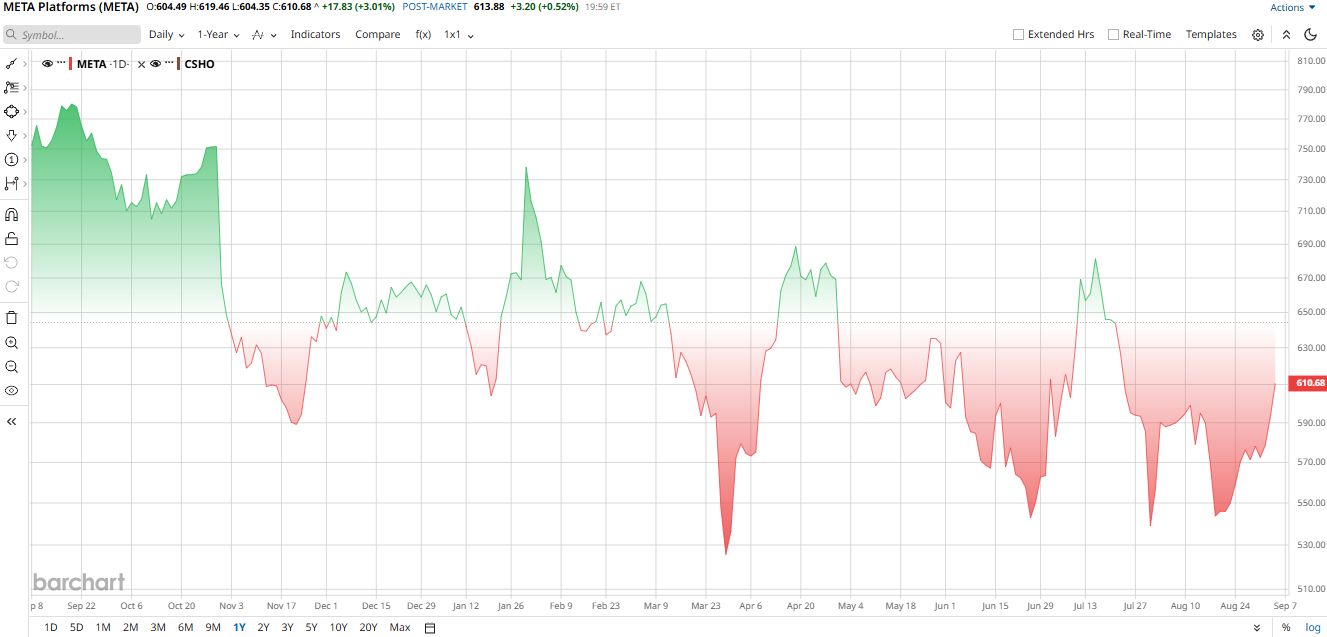
Meta Platforms stock is still down about 18% over the past year. Shares are also down roughly 6% year-to-date (YTD) while other "Magnificent Seven" members have gained by double digits. The biggest issue has been spending. Meta’s second-quarter capital expenditures reached $31.08 billion, while free cash flow dropped sharply.
Investors are worried that AI infrastructure costs may rise faster than profits. At the same time, advertising remains strong and recent AI momentum has helped sentiment. The Muse Spark launch also gave shares another lift as META stock climbed more than 2% on Sept 2.
In terms of valuation, Meta does not look especially expensive compared with major technology businesses. Its trailing price-to-earnings (P/E) ratio is around 20.8 times, which is below the information technology sector median near 33 times.
That suggests investors are not paying an extreme premium despite Meta’s AI ambitions. But the catch is clear. Earnings growth must eventually catch up with the spending spree.
 www.barchart.com
 Muse Spark Could Strengthen Meta’s AI Case
The biggest opportunity from Muse Spark 1.3 is not the model itself. It is what Meta can build on top of it.
The new model is aimed at longer-horizon agentic work. That matters because Meta has been working toward more capable personal AI agents. The company has also been developing a highly personalized assistant designed to handle everyday tasks for users. Muse Spark 1.3 fits neatly into that effort.
Meta Chief AI Officer Alexandr Wang said the update is competitive with frontier models, and said its usability improvements could help with personal agents that work around the clock.
That is potentially valuable for META stock. Better AI could raise engagement across its apps, improve ad targeting, and eventually create entirely new products. Meta is also seeing developers use its lower-cost contributor tier, which could help expand adoption and improve its models through broader feedback.
Q2 Revenue Soared, But Costs Are the Problem
Meta’s latest quarter showed why investors remain divided. Revenue jumped 28% year-over-year (YOY) to $60.8 billion. Family of Apps generated $60.37 billion in revenue, while Reality Labs contributed $431 million.
The problem was spending. Costs and expenses surged 55% YOY to $42.03 billion. Operating income fell 8% to $18.78 billion. Net income dropped almost 14% to $15.85 billion. Diluted EPS was $6.18, down more than 13% from $7.14 a year earlier. Meta does not report a separate adjusted EPS figure in its quarterly release.
Free cash flow fell to just $784 million from $8.55 billion. Cash, cash equivalents, and marketable securities totaled $90.26 billion at the end of June, while capital expenditures hit $31.08 billion.
Still, CEO Mark Zuckerberg sounded confident. “AI is accelerating our core business today, powering our next generation of products, and opening the door to entirely new enterprise opportunities,” he noted in the Q2 report.
For Q3, Meta Platforms expects revenue of $61 billion to $64 billion. Full-year expenses are expected at $165 billion to $169 billion, while 2026 capital spending is expected to remain elevated. Analysts estimate full-year revenue near $254 billion and EPS of around $31 per share.
What Do Wall Street Think of META Stock?
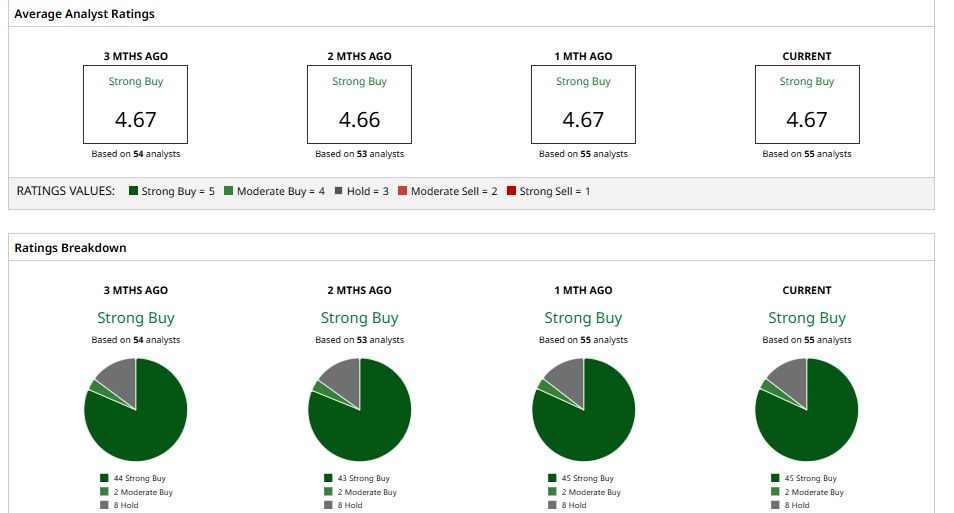
Wall Street remains constructive on META stock. Barchart currently shows a consensus “Strong Buy” rating based on 55 analysts with coverage. The average price target is around $751.08, implying roughly 22% potential upside from current levels.
Recent targets underline that optimism. Bernstein recently kept its target at $800, while BofA Securities kept its target at $810. KeyBanc's target sits at $780, while UBS has a price target of $715 per share.
The important part is the reasoning. Analysts continue to point to strong advertising, growing AI engagement, and Meta’s ability to turn heavy AI investment into higher revenue over time. Muse Spark 1.3 gives them another reason to watch that story closely.
 www.barchart.com
 On the date of publication, Nauman Khan did not have (either directly or indirectly) positions in any of the securities mentioned in this article. All information and data in this article is solely for informational purposes. For more information please view the Barchart Disclosure Policy here.
More news from Barchart
Meta Unleashes a New AI Weapon. Wall Street Sees Huge Upside for META Stock SpaceX Stock Just Scored a New 'Buy' Rating. What to Know. Dear Nvidia Stock Fans, Mark Your Calendars for September 10 Quantum Stocks Are Climbing Today as CHIPS Act Cash Pours In. Here’s One Way to Invest.