


When Cathie Wood makes a move, Wall Street tends to pay attention. Her trades have become something of a market signal, especially when they involve the high-growth themes she has consistently backed. And in September, that shopping list included a little bit of everything — space, fintech, crypto and biotechnology — while ARK Investment Management trimmed several large technology and healthcare positions.
In fintech, ARK Innovation ETF (ARKK) has been steadily adding to its Robinhood Markets (HOOD) bet. On Sept. 4, the fund bought 28,589 HOOD shares worth roughly $3.5 million, just a day after the stock jumped 16.6%. ARK then returned to the checkout counter on Sept. 8, purchasing another $3.3 million worth of Robinhood’s shares. The buying reflects growing optimism around Robinhood’s prediction markets, banking, and crypto businesses. The additions have also pushed HOOD into ARKK’s top 10 holdings, with a 4.17% portfolio weight.
More Top Stocks Daily: Go behind Wall Street’s hottest headlines with Barchart’s Active Investor newsletter.
Robinhood has evolved far beyond its commission-free trading roots, expanding into stocks, options, crypto, retirement accounts and subscription-based financial services. Its prediction-markets business has also become a serious growth engine. In Q2 2026, event-contract revenue surpassed crypto revenue for the first time, while over 13.6 billion event contracts were traded.
HOOD may have stumbled a bit in 2026, but Robinhood has not exactly hit the brakes. The company keeps expanding across crypto, retirement, and wealth management, while ARKK continues to add to its position. With analysts warming up and the stock recovering, could Wood be betting on a bigger comeback than Wall Street expects?
About Robinhood Stock
Founded in 2013, Robinhood Markets has come a long way from its original mission of making investing more accessible. Headquartered in Menlo Park, Calif., the fintech company helped shake up Wall Street with commission-free trading, bringing stocks and investing closer to everyday retail investors.
Fast-forward to today, and Robinhood is more than just a trading app. Its platform now spans stocks, ETFs, options, futures, and cryptocurrencies, along with retirement accounts, wealth management, digital banking, and credit cards. The company has also stepped into prediction markets and is expanding internationally, including in the U.K.
That broader ecosystem is a big part of Robinhood’s growth story. Its easy-to-use platform has attracted millions of customers and turned the company into a major digital financial platform. With a market capitalization of roughly $105.5 billion, Robinhood has clearly grown beyond its disruptive beginnings.
Robinhood is already a meaningful bet for Wood’s ARK, and it is not limited to the ARK Innovation ETF. The stock also holds a 6.3% weight in the ARK Fintech Innovation ETF (ARKF), making HOOD one of the fund’s notable fintech positions.
A Rollercoaster Stock Ride
That confidence, however, has not translated into a smooth ride for the stock this year. HOOD struggled to maintain the momentum it built previously, particularly after its first-quarter earnings report in April. Softer options and cryptocurrency trading activity weighed on transaction-based revenue, while weakness in Bitcoin (BTCUSD) added another headwind, given the historical link between crypto activity and Robinhood’s trading volumes.
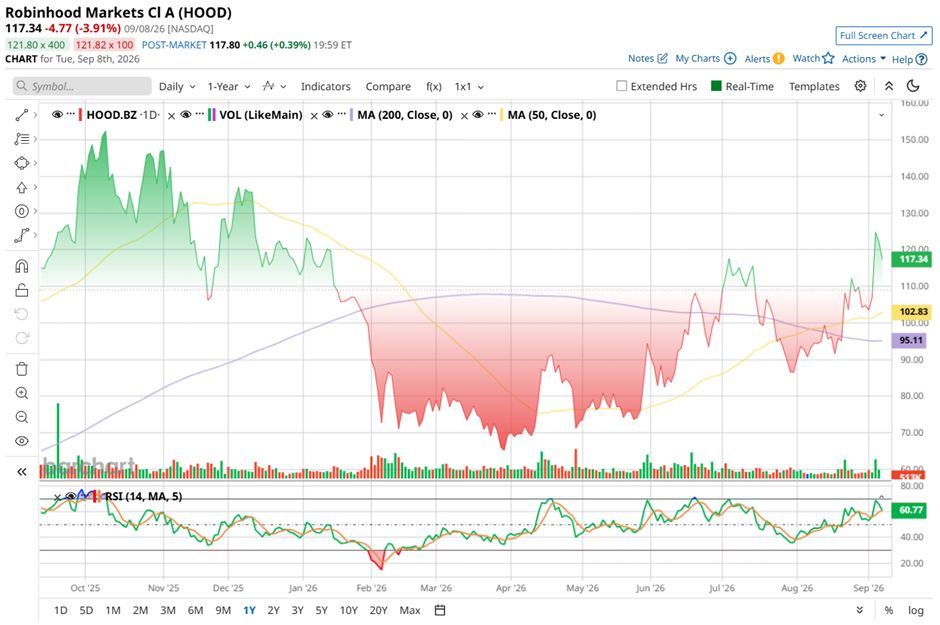
But lately, the story has started to turn. Although HOOD remains almost flat over the past 52 weeks and is still 23.7% below its 52-week high of $153.86, the shorter-term numbers tell a very different story. After hitting a $63.51 low in March, shares have surged 84.7% from that bottom. HOOD is up 52.2% over six months, 38% over three months, and 25.8% over the past month. Even over the last five trading sessions, the stock has climbed another 12%.
The latest rally has several moving parts. Strong second-quarter results, U.K. regulatory approval for cryptocurrency services, expansion into prediction markets, and new crypto partnerships have all strengthened the growth story. Then, on Sept. 3, HOOD jumped nearly 17%, becoming the S&P 500’s ($SPX) best-performing stock that day as both equities and cryptocurrencies rallied. Bitcoin was also nearing its highest level since May, providing an additional tailwind.
Wall Street has been warming up, too, with Morgan Stanley upgrading the stock, Scotiabank initiating coverage on HOOD, and Piper Sandler raising its price target.
The technical picture is backing up the comeback. HOOD’s 14-day RSI is around 61, while shares have remained above both the 50-day and 200-day moving averages since mid-August.
So, while Robinhood still has plenty to prove, the stock’s recent action suggests investors are once again willing to bet on its expanding financial ecosystem.
 www.barchart.com
 Yet HOOD stock is not exactly cheap. At a 48.47x forward non-GAAP P/E and 21.17x forward P/S, the stock trades at a hefty premium to both its sector and historical averages. But investors are not paying today’s price for yesterday’s earnings. They’re betting on the next leg of growth — from gold and crypto to options, banking, and newer products.
A Snapshot of Robinhood’s Q2 Results
Robinhood’s second-quarter numbers came in with plenty to talk about, showing that the fintech platform is still finding ways to grow even as some parts of its business hit a rough patch. In July, Robinhood reported $1.3 billion in revenue for the quarter ended June 2026, up 32% year-over-year (YOY), while EPS climbed to $0.62, up 48% from the year-ago result. That said, the quarter was not without its speed bumps. Weaker crypto trading activity and higher operating expenses weighed on the results.
Still, the customer story looked encouraging. Funded customers increased 7% YOY to 28.4 million, including about 300,000 customers added through the WonderFi acquisition, while investment accounts rose 9% to 29.9 million. Plus, Robinhood Gold continued to gain traction. Gold subscribers jumped 39% YOY and 11% sequentially to 4.84 million, with Gold adoption reaching 17% of funded customers in Q2. About 40% of new funded customers signed up for Gold during the quarter, pushing annualized Gold subscription revenue to $216 million.
Meanwhile, total platform assets rose 32% to $369 billion, helped by net deposits and higher equity valuations, although lower crypto valuations took some shine off the number. Average platform assets per funded customer reached about $13,000.
On the revenue front, transaction-based revenue was the standout, jumping 44% to $776 million as options, equities, and event-contract activity benefited from heightened market volatility. Options revenue rose 29% to $342 million, while equities revenue nearly doubled, climbing 95% to $129 million. Crypto, however, remained the weak link, with transaction-based cryptocurrency revenue falling 38% to $100 million.
Net interest revenue increased 9% to $389 million, supported by higher platform assets and Gold growth. Meanwhile, Robinhood Strategies crossed 300,000 funded customers and nearly $2 billion in assets under management, while Robinhood Banking ended June with more than $3 billion in deposits.
Robinhood is also keeping shareholders in the picture, repurchasing $414 million of Class A shares during Q2. Since launching its buyback program in Q3 2024, the company has repurchased $1.3 billion, or 27 million shares.
The launch of Trump Accounts on July 4 marked another major milestone for Robinhood, with the program already surpassing 7 million sign-ups and attracting nearly $1.5 billion in deposits.
Looking ahead, management actually tightened its 2026 adjusted operating expense and share-based compensation outlook to $2.675 billion-$2.775 billion, down from $2.7 billion-$2.825 billion previously. The lower range reflects efficiency gains while absorbing costs tied to Rothera and WonderFi.
Analysts expect the company to post third-quarter revenue of $1.36 billion, with a profit of $0.53 per share. Looking beyond the quarter, the outlook tells an interesting story. EPS is projected to rise 3.4% YOY to $2.12 in fiscal 2026 and then bounce in a big way, climbing another 34.9% annually to an estimated $2.86 in fiscal 2027.
What Do Analysts Expect for Robinhood Stock?
Goldman Sachs is getting more bullish on HOOD, recently raising its price target to $142 from $124 while keeping a “Buy” rating. Analyst James Yaro pointed to Rothera — Robinhood’s prediction-market joint venture — which has ranked among the world’s top three to five exchanges by trading volume since launching in May. Rothera generated about $150 million in annualized revenue in its first quarter of operation.
Goldman Sachs expects $307 million in 2027 revenue in its base case, with bull-case estimates reaching $359 million to $906 million, and bear-case estimates at $91 million to $242 million. It also sees prediction-markets revenue reaching $943 million in 2027 and $1.15 billion in 2028, above consensus by 10% and 14%, respectively.
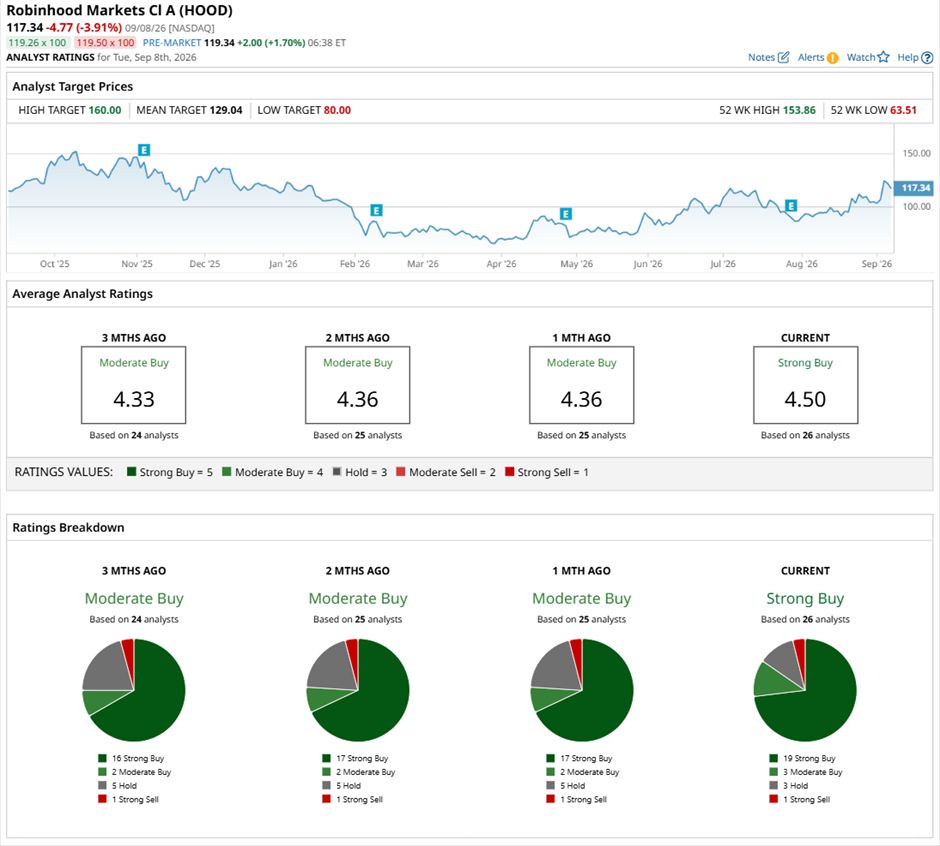
Despite this year’s stock-price swings, Wall Street remains optimistic about Robinhood’s long-term prospects. Analysts have a positive outlook on HOOD, giving it a consensus rating of “Strong Buy,” and that’s an upgrade from the “Moderate Buy” rating a month ago. Based on the 26 analyst ratings on the stock, 19 suggest a “Strong Buy,” three advise a “Moderate Buy,” three analysts are playing it safe with a “Hold," and one analyst has a “Strong Sell” rating.
While the average price target of $129.04 points to 10% upside potential from current levels, the Street-high target of $160 suggests Robinhood’s shares could rally as much as 36.4%.
 www.barchart.com
 On the date of publication, Sristi Suman Jayaswal did not have (either directly or indirectly) positions in any of the securities mentioned in this article. All information and data in this article is solely for informational purposes. For more information please view the Barchart Disclosure Policy here.
More news from Barchart
Cathie Wood Is Doubling Down on Robinhood Stock Morgan Stanley Just Upped Its Price Target on 'Top Pick' Dell Stock Time to Buy: Wall Street Says Dell Stock Could Climb 38% in a Year SHOP Stock Alert: What to Know as Shopify Acquires Tailwind Labs