


L3Harris Technologies, Inc. (LHX) was formed in 2019 through the merger of L3 Technologies and Harris Corporation and has since established itself as a leading provider of aerospace and defense technologies. Headquartered in Melbourne, Florida, the company develops mission-critical solutions serving government, military, and commercial customers worldwide.
Its capabilities span air, land, sea, space, and cyber domains, with a portfolio that includes advanced communication systems, tactical radios, missile defense technologies, space payloads, and intelligence, surveillance, and reconnaissance solutions. Through these offerings, L3Harris supports national security initiatives and the development of next-generation defense capabilities. With an approximate market capitalization of $46.6 billion, the company is firmly positioned within the “large-cap” segment of the aerospace and defense industry.
More Top Stocks Daily: Go behind Wall Street’s hottest headlines with Barchart’s Active Investor newsletter.
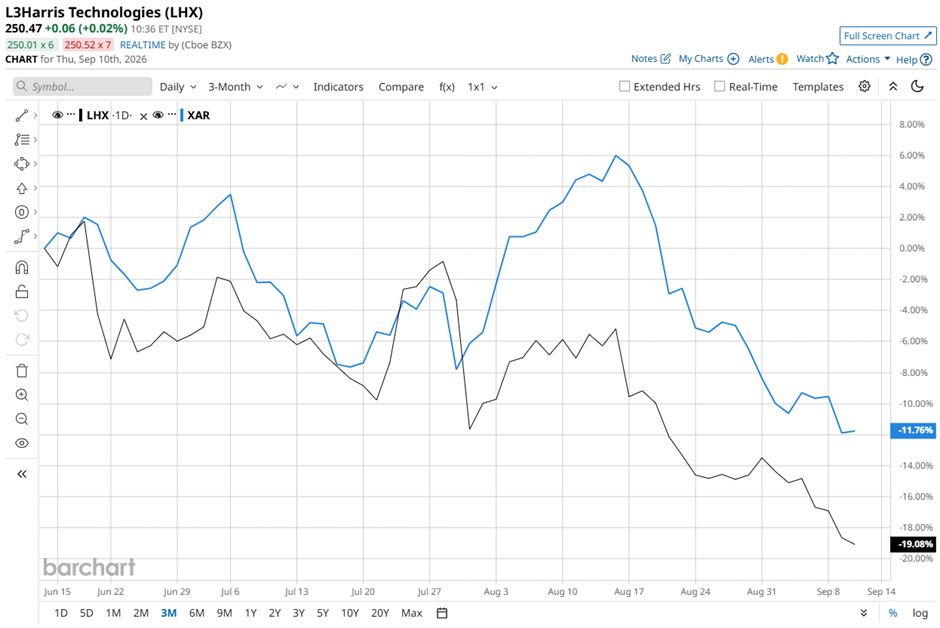
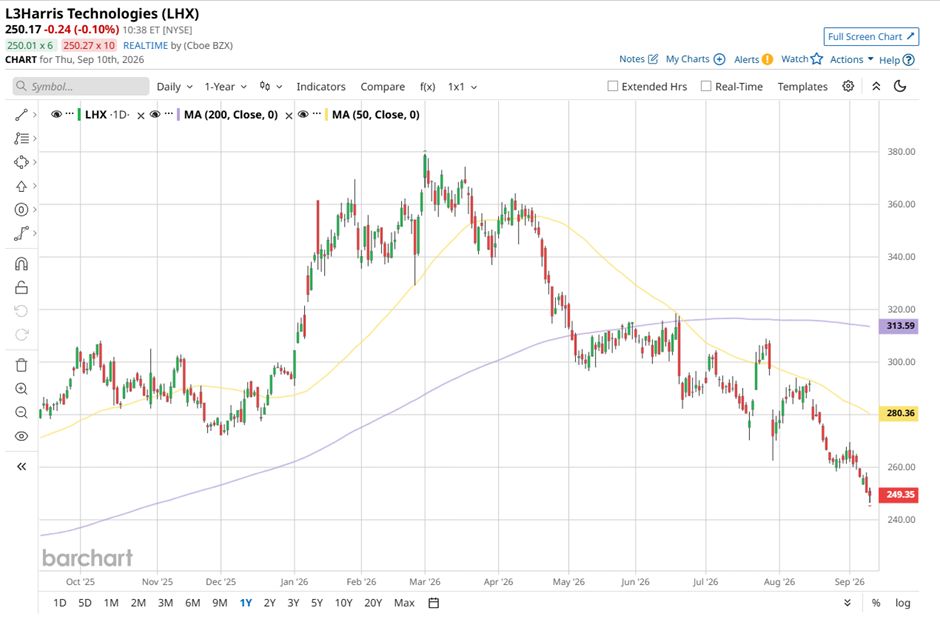
But for all its scale and importance in defense and aerospace, LHX stock has hit a rough patch on Wall Street. After climbing to a 52-week high of $379.23 in early March, the stock has since given back 34.2%. The slide has picked up steam recently, and weakness becomes even more noticeable when compared with the SPDR S&P Aerospace & Defense ETF (XAR). Shares of L3Harris are down about 17.7% over the past three months, while the ETF has declined 7.1% over the same time frame. LHX has faced considerably steeper selling pressure than the broader group.
 www.barchart.com
 The gap becomes even harder to ignore on a broader timeline. LHX stock is down 15.1% so far in 2026, while XAR has gained 2.8% on a year-to-date (YTD) basis. Over the past 52 weeks, the stock has slipped 9.5%, even as the ETF has delivered a 13.5% gain.
And technically, the picture remains under pressure, with shares trading below both their 50-day and 200-day moving averages – a sign that the bears still have the upper hand for now.
 www.barchart.com
 What makes the recent selloff in LHX a little tricky is that the business itself has not suddenly fallen apart. The bigger issue has been uncertainty around the story. The abrupt removal of Chairman and CEO Christopher Kubasik over a code-of-conduct violation created a governance shock, even though the company kept its financial outlook intact. At the same time, investors have been dealing with delays in government contracts, continuing resolutions and broader federal budget uncertainty. The delayed IPO of its missile business, heavy capital spending needs and concerns around its debt load have added to the pressure.
That said, the underlying numbers tell a somewhat better story. In Q2 FY2026, revenue climbed 8.4% year over year (YOY) to $5.9 billion, while EPS jumped 28.3% annually to $3.13. Free cash flow also rose 37.4% to $771 million, and orders reached $7.3 billion, lifting backlog to a record $42 billion. So, the market’s concern appears to be more about execution, leadership and timing than a collapse in demand.
And that becomes clearer when LHX is placed beside rival Lockheed Martin Corporation (LMT). LHX has trailed its larger defense peer in 2026, falling while Lockheed Martin has gained 8.7% YTD. The longer-term gap is just as noticeable, with Lockheed Martin up 13.3% over the past year.
The recent weakness in LHX stock has not completely changed Wall Street’s view of the company. If anything, analysts appear to be looking past the near-term turbulence and focusing on its longer-term potential. LHX currently carries a consensus “Moderate Buy” rating, based on the 20 analysts covering the stock. Plus, the stock has an average price target of $362.74, which suggests roughly 44.9% upside from current levels.
On the date of publication, Sristi Jayaswal did not have (either directly or indirectly) positions in any of the securities mentioned in this article. All information and data in this article is solely for informational purposes. For more information please view the Barchart Disclosure Policy here.
More news from Barchart
Dear Super Micro Stock Fans, Here's What August's Rally Means for SMCI Why Barchart Data Says You Shouldn’t Chase Cloudflare Stock Here Despite Strong Technical Momentum 2 Reasons to Buy Super Micro Stock — And 1 Reason to Be Cautious Scott Bessent Thinks Norway May Trade Treasuries for Assets Like Fannie Mae. What That Actually Means for FNMA Stock.