


Hon Hai Precision Industry (FITGF), better known globally as Foxconn, is the world’s largest electronics contract manufacturer. While the Taiwanese giant is best known for assembling Apple’s (AAPL) iPhones, its role in the artificial intelligence (AI) revolution is becoming increasingly important. Foxconn is also a major manufacturer of the servers and rack-scale systems that house the powerful chips driving today’s AI data centers. That growing exposure to AI infrastructure also brings Foxconn increasingly closer to chip giant Nvidia Corporation (NVDA).
Foxconn has been manufacturing Nvidia-based AI systems for years and today plays a key role in producing some of Nvidia’s most advanced AI server platforms. And now, Foxconn is sending another potentially bullish signal for Nvidia. The company’s latest numbers point to red-hot demand for AI infrastructure. Foxconn reported August revenue of NT$921.8 billion ($29.1 billion), up a whopping 52% year-over-year (YoY), making it the company’s second-best monthly sales performance on record. The surge was driven in part by accelerating AI demand, with the manufacturer specifically highlighting strong momentum in its cloud and networking business.
More Top Stocks Daily: Go behind Wall Street’s hottest headlines with Barchart’s Active Investor newsletter.
The strength wasn’t limited to August. Foxconn’s consolidated revenue for the first eight months of the year reached NT$6.5 trillion, representing roughly 40% YoY growth. August’s performance came just behind July, when revenue hit NT$946.5 billion ($29.9 billion), up 54% YoY. For Nvidia, this is an important supply-chain read-through. Foxconn is not simply another electronics manufacturer. The company is helping Nvidia turn its GPUs and networking technologies into complete AI servers and rack-scale systems.
Therefore, strong growth in Foxconn’s cloud and networking business suggests that customers are continuing to spend heavily on AI infrastructure, potentially supporting demand for Nvidia’s latest-generation systems. Of course, Foxconn’s revenue is not a direct proxy for Nvidia’s sales, given its broad customer base and exposure to smartphones, PCs, and other electronics. But when a major Nvidia manufacturing partner reports accelerating AI-driven demand and surging cloud and networking sales, it provides another piece of evidence that the AI infrastructure spending boom remains intact. So, with that in mind, here's a closer look at NVDA.
About Nvidia Stock
Few companies have benefited more from the artificial intelligence revolution than Nvidia. Founded in 1993 by Jensen Huang, Chris Malachowsky, and Curtis Priem, Nvidia is headquartered in Santa Clara, California, and began as a pioneer in computer graphics and gaming. The company’s breakthrough came with the development of the graphics processing unit (GPU), which transformed how computers handle complex visual workloads.
What Nvidia could not have known at the time was that the same technology would eventually become the backbone of the modern AI revolution. Fast-forward to today, and Nvidia is far more than a graphics chip maker. The company designs GPUs, CPUs, networking equipment, AI systems, and software that power some of the world's most demanding computing workloads. Its chips are used by leading cloud providers, technology companies, and AI developers to train and run increasingly sophisticated AI models.
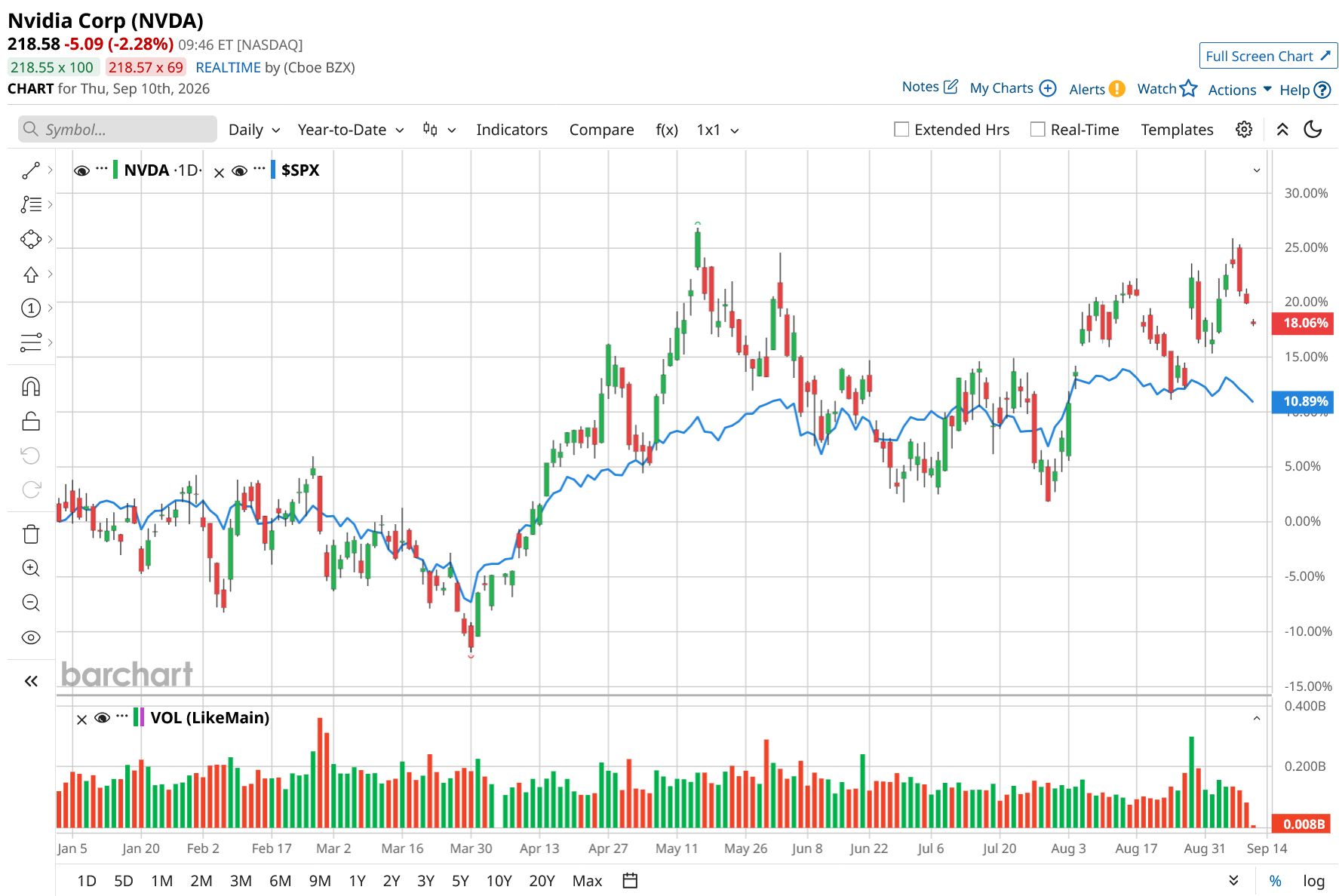
With a staggering $5.45 trillion market capitalization, NVDA has firmly cemented its place among the world’s most valuable companies. But the stock’s remarkable AI-fueled run is far from over. Despite some cooling in investor enthusiasm following its explosive gains in recent years, Nvidia continues to leave the broader market in the dust. Shares have climbed 24% over the past year and 18% so far in 2026, comfortably ahead of the S&P 500 Index’s ($SPX) 17% one-year gain and 12% advance in 2026.
Now, Nvidia’s momentum is heating up again. Renewed demand for AI infrastructure, coupled with easing concerns about how the world’s largest hyperscalers will fund their enormous AI investments, has helped reignite investor interest in the chip giant. The stock is now trading just 4.9% below its all-time high of $236.54, reached on May 14, putting Nvidia within striking distance of another record.
 www.barchart.com
 Inside Nvidia’s Q2 Earnings Report
Nvidia’s latest earnings report didn’t just beat expectations. It showed why the AI spending cycle still has enormous momentum behind it. Released in late August, the company’s fiscal 2027 second-quarter results delivered another quarter of extraordinary growth, with revenue more than doubling from a year earlier. Nvidia generated $96.22 billion in revenue, up 106% YoY from $46.74 billion, easily surpassing Wall Street’s $92.17 billion estimate.
Even more striking, GAAP net income jumped 126% to $59.69 billion, while non-GAAP EPS reached $2.22, ahead of the $2.10 analyst estimate. At the same time, non-GAAP gross margin expanded by 2.5 percentage points to 75%, showing that Nvidia is managing to combine rapid growth with exceptional profitability. The sheer scale of the Data Center business explains much of that performance.
The segment generated an enormous $89 billion in revenue, representing more than 92% of Nvidia’s total revenue, and grew 117% YoY. Behind that surge is continued heavy spending by hyperscalers and rising enterprise adoption of accelerated computing clusters. Nvidia is also moving its product roadmap forward, with the quarter benefiting from the initial volume rollout of its next-generation Vera Rubin architecture. And Blackwell systems continued in full-scale production across major cloud partners such as Azure, Google Cloud, and OCI.
Yet Nvidia’s opportunity is gradually extending beyond the massive hyperscale buildout. Edge Computing revenue reached $7.2 billion, up 27% YoY, reflecting growing commercial adoption of AI running directly on devices. At the same time, Nvidia’s enormous cash generation is giving it room to return significant capital to investors. The company returned approximately $26 billion to shareholders through share repurchases and cash dividends during the quarter and still had approximately $99 billion remaining under its share repurchase authorization at quarter-end.
Perhaps the biggest message from the report, however, came from Nvidia’s forward outlook. The company expects fiscal 2027 third-quarter revenue of $108 billion, plus or minus 2%, signaling that it expects its extraordinary growth trajectory to continue. Importantly, that forecast assumes no Data Center compute revenue from China. Nvidia also expects both GAAP and non-GAAP gross margins to reach 74%, plus or minus 50 basis points.
What Do Analysts Think About NVDA Stock?
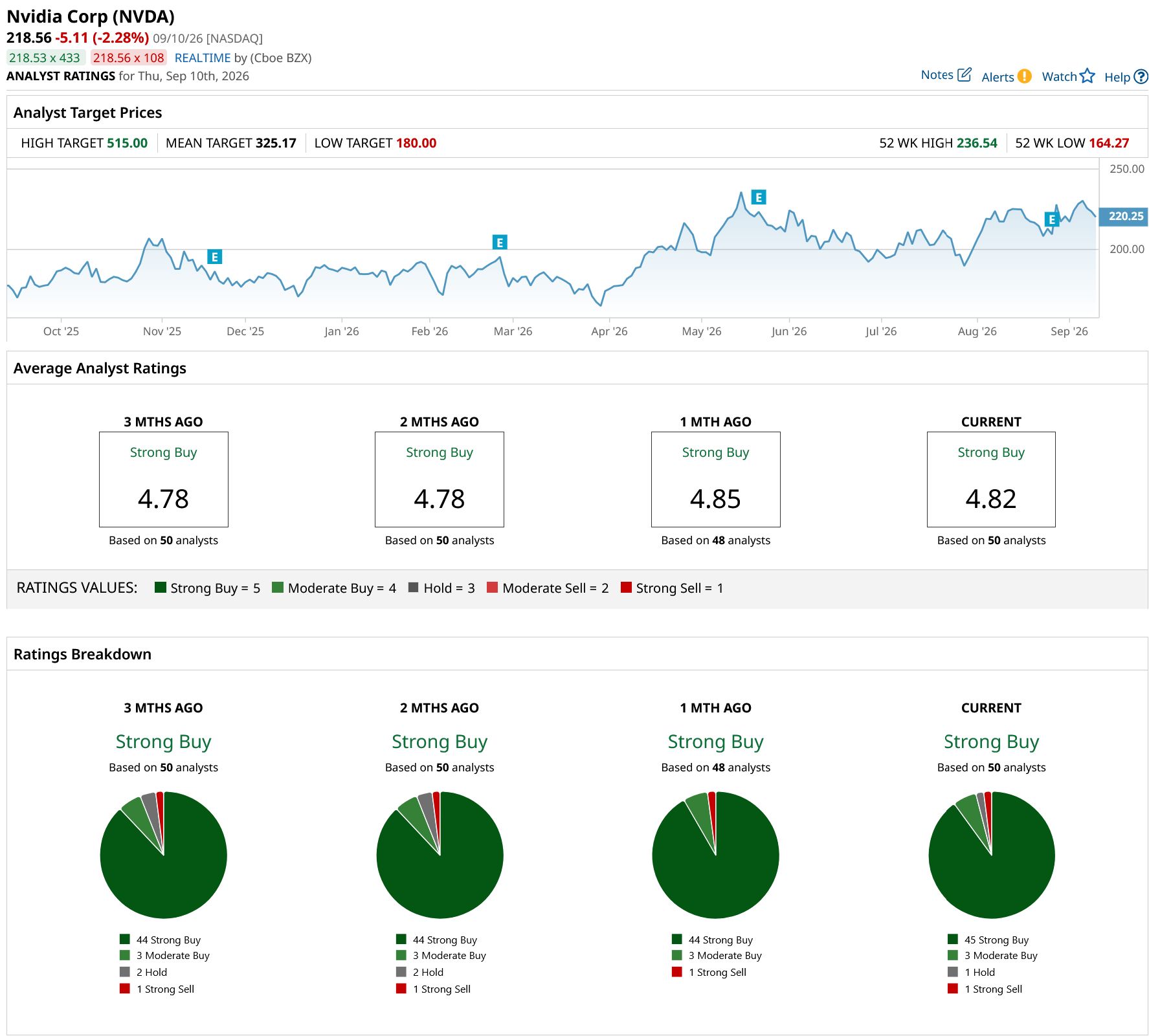
Wall Street’s conviction in NVDA remains remarkably strong. The stock commands a consensus “Strong Buy” rating, with a remarkable 45 of the 50 analysts covering NVDA rating it a “Strong Buy.” Another three analysts have a “Moderate Buy” rating, while just one calls the stock a “Hold” and another a “Strong Sell.” With such overwhelming conviction, it’s clear that Nvidia continues to enjoy broad support from the Street.
And Wall Street’s upside expectations are just as striking. The average analyst price target of $325.17 implies roughly 48% potential upside from current levels. Meanwhile, the Street-high target of $515 points to a staggering 135% potential gain.
 www.barchart.com
 On the date of publication, Anushka Mukherji did not have (either directly or indirectly) positions in any of the securities mentioned in this article. All information and data in this article is solely for informational purposes. For more information please view the Barchart Disclosure Policy here.
More news from Barchart
Foxconn Just Delivered a Major Bullish Signal for Nvidia Stock Why AMD Stock Forecast Has Room to Run ‘Not a Marketing Stunt’ — Ex-OpenAI and Anthropic Researcher Who Quit Explains Why They Keep Building AI That ‘Could Kill Us All’ Within 10 Years Intuit vs. Block: 1 Fintech Stock Is Built for the Next Decade