


As AI chips draw more power, delivering that power efficiently has become a major challenge for data center operators. Investors are paying close attention to companies that can help solve it.
Vicor Corporation (VICR) shares climbed almost 18% on Thursday after the Andover, Massachusetts-based company said it had granted a non-exclusive license for its Vertical Power Delivery technology to a new, unnamed AI original equipment manufacturer.
More Top Stocks Daily: Go behind Wall Street’s hottest headlines with Barchart’s Active Investor newsletter.
The move came only days after Vicor announced plans to nearly triple its manufacturing space. The company bought two New Hampshire sites for its ChiP Fab-2 and Fab-3 facilities, which will together cover nearly 1 million square feet. Its existing Andover fab is nearing capacity.
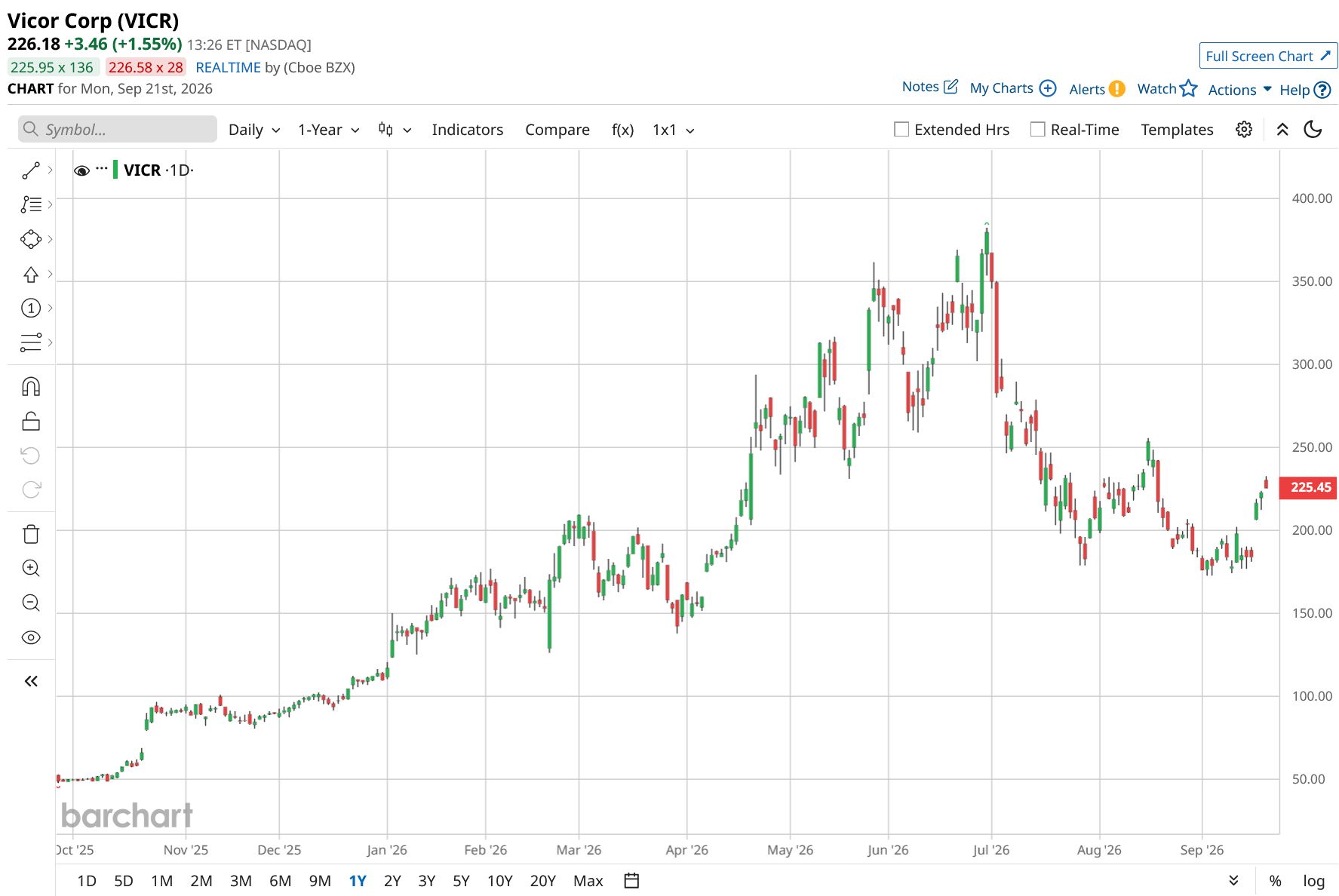
With Vicor Corporation stock trading near $226, up almost 107% year-to-date (YTD), what does a royalty-friendly licensing deal mean for Vicor's long-term earnings power, and does it justify the surge? Let’s find out.
 www.barchart.com
What the New Deal Involves
Vicor announced on Sept. 16 that it had granted a non-exclusive license for its Vertical Power Delivery, or VPD, technology to an unnamed AI equipment maker. VPD helps deliver large amounts of power to AI processors and networking chips from a low-voltage source. It addresses the “last inch” power-delivery issue, where getting power efficiently to the chip becomes difficult. Vicor Corporation’s technology is backed by patents developed over roughly a decade.
This is not a simple product-supply deal. The license allows the customer to buy VPD modules covered by Vicor’s patents from outside suppliers, while Vicor collects royalties. The customer can also buy Vicor’s MCM current-multiplier modules from its U.S. factories and receive a lower royalty rate. That gives the customer more sourcing options while allowing Vicor to make money whether it supplies the modules itself or collects royalties from third-party sales.
Can Fundamentals Support the Rally?
Vicor Corporation posted a strong second quarter even without the recent AI deal. Revenue came in at $143.4 million, up 26.9% from $113.0 million in the first quarter. The year-over-year (YoY) numbers look even better after adjusting for a one-time $45 million patent-settlement payment that boosted the prior-year quarter. On that basis, revenue rose 49.3%. Product revenue increased 31.8% to $112.9 million, while royalty revenue nearly tripled to $30.4 million from $10.4 million. That matters because royalty income carries very little production cost. Gross margin improved to 58.0% from 55.2% in Q1, and operating income reached $34.9 million. Net income more than doubled from the prior quarter to $49.8 million, or $1.04 per share, although it included a $10.9 million tax benefit. Even so, first-half net income rose to $70.5 million from $43.8 million a year earlier.
Vicor is also putting its cash to work. On Sept. 11, the company announced plans to buy a 334,000-square-foot building on 66 acres in Merrimack, New Hampshire, along with 54 acres in Hooksett, to build ChiP Fab-2 and Fab-3. The two facilities will have nearly 1 million square feet of space, much larger than Vicor’s 320,000-square-foot Fab-1 in Andover, which is nearing capacity. Fab-2 could begin initial operations in about a year. The expansion should provide Vicor more room to produce its next-generation VPD chips as orders from AI equipment makers and large cloud customers grow.
Wall Street’s View on VICR Stock
Vicor Corporation is set to report its third-quarter 2026 results on Oct. 20. Analysts expect the company to earn $0.75 per share for the September quarter, up 19.05% from $0.63 a year earlier. For full-year 2026, Wall Street expects earnings of $3.28 per share, up 25.67% from $2.61 in 2025.
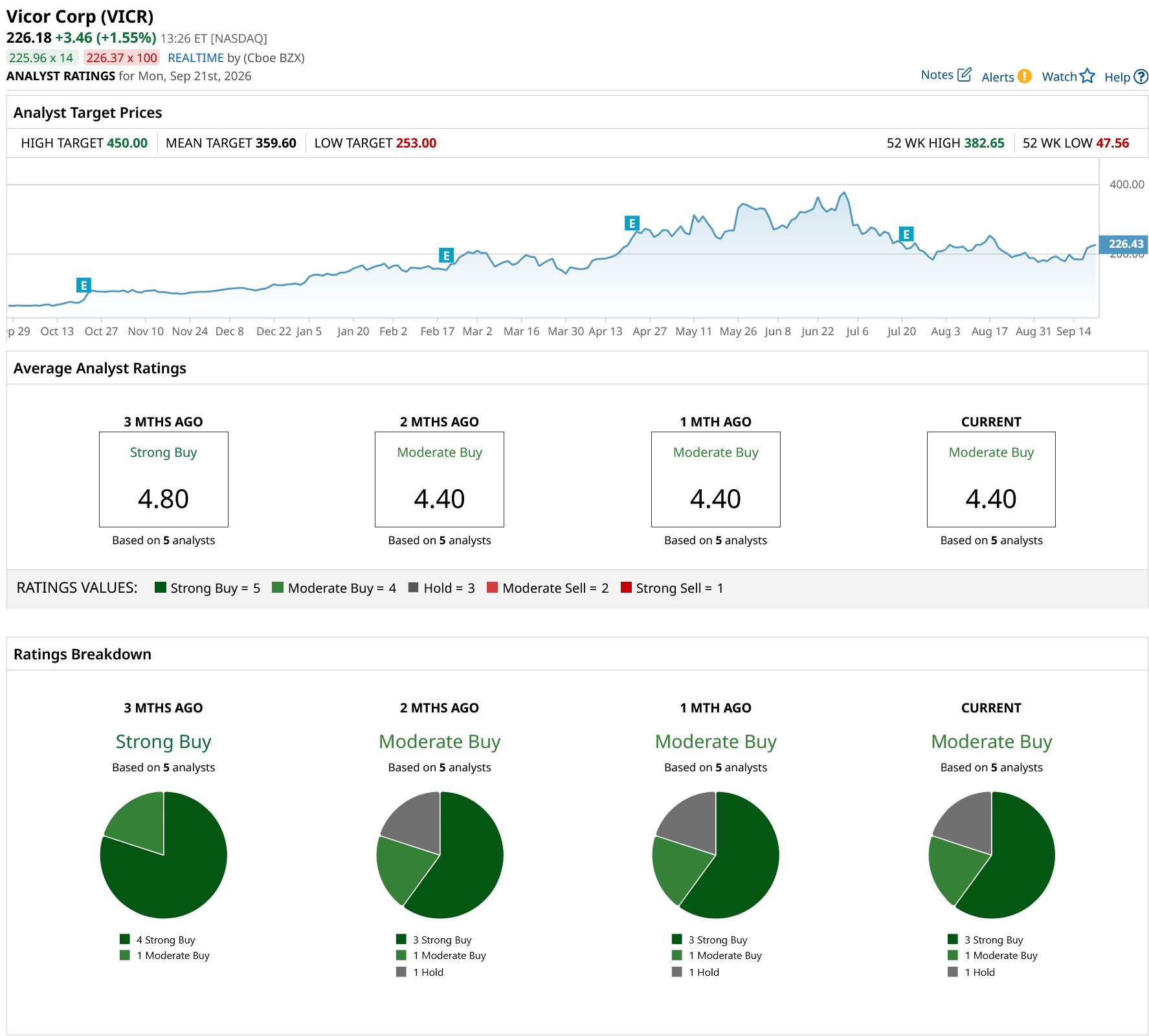
Analysts have become more positive as Vicor’s revenue and royalty income have improved. After the company raised its Q2 revenue outlook to $142 million from $126 million, Needham & Company kept its “Buy” rating and lifted its price target to $350 from $260. The firm pointed to better visibility into revenue from royalties. Roth Capital Partners also kept a “Buy” rating and raised its target to $285 from $245 after Vicor’s better-than-expected first-quarter results. Overall, analysts rate VICR stock a “Moderate Buy,” based on five ratings, with an average price target of $359.60. That suggests 59% upside from recent levels.
 www.barchart.com
Conclusion
Vicor’s latest deal looks like more than a one-day AI headline. The licensing structure could create a high-margin royalty stream while giving customers an incentive to buy Vicor’s own modules, and the company is expanding manufacturing capacity as demand and backlog build. Still, investors should remember that the OEM is unnamed and the agreement does not disclose a revenue commitment, so the ultimate payoff will take time to prove out. After such a steep move, shares could be volatile in the near term. But if Vicor keeps converting AI interest into royalties, product sales, and stronger earnings, the longer-term direction still looks higher.
On the date of publication, Ebube Jones did not have (either directly or indirectly) positions in any of the securities mentioned in this article. All information and data in this article is solely for informational purposes. For more information please view the Barchart Disclosure Policy here.
More news from Barchart
Why General Motors Is Now in the Missile Manufacturing Business and What It Means for GM Stock USAR Stock Alert: USA Rare Earths Jumps on Trump's Greenland Deal Announcement Vicor Shares Moved Higher on a New AI Processing Deal. How Investors Should View the News. Critical Metals Surges 35% on Greenland Pact. The Tanbreez Opportunity Is Huge — But So Is the Risk.