


By practically any measure, McDonald’s (MCD) seems like a lost cause. Upon opening up its Price Overview screen, you’re greeted with the fact that MCD stock ranks as a 100% Strong Sell by the Barchart Technical Opinion indicator. What’s worse is that there doesn’t seem to be a good rationale for going against the grain.
Recently, McDonald’s stock represented one of the 200 securities listed on Barchart’s screener for the worst large-capitalization losers over a one-month period. During the timeframe in question, MCD suffered a drawdown of roughly 13%. That’s incredibly rare for such a stalwart in the fast-food industry.
Can’t Get Enough Options?: Join the list for Barchart’s daily unusual options report, delivered free.
Granted, investors shouldn’t be too surprised at the fact of volatility (if we were to set aside the magnitude argument for a moment). Thanks to a weak consumer economy and macro uncertainties, enthusiasm just isn’t strong for MCD stock. Further, the underlying company’s domestic execution issues have hampered the ticker’s trajectory.
Nevertheless, it may be premature to label MCD stock a lost cause. It’s possible that management’s long-term value strategies and structural investments could offer the Golden Arches much-needed momentum. Also, from a purely technical perspective, mean reversion can never be baked out of the equation entirely.
The question, though, is when the trend might break out into a positive direction. If we were to follow standard trend-following guidance, from my perspective, it certainly looks like McDonald’s stock is poised to sink further.
How do we know when might be an ideal time to consider taking the opposite side of the trade?
Attempting to Cut Down on the Ambiguity of MCD Stock
For the ultimate reality check, the answer is that we simply don’t know what the future will hold for McDonald’s stock. Unfortunately, the problem of calling tops and bottoms is that, in order to make absolute claims, we would need to appeal to information that just hasn’t materialized yet.
Philosophically, then, there is no purely neutral epistemological ground when making a forecast about the future. We can try to calculate (or even feel out) the odds of a trade. But even these calculations are built upon an assumed framework of a reality that may not actually materialize as expected.
As such, the best that we can (probably) say is that, under certain circumstances, some models may be better reflectors of market reality than others. However, there doesn’t appear to be one universal model that is appropriate for all stocks in all circumstances.
As a general rule of thumb — especially for a blue chip like MCD stock — the clinical framework is to assume a random walk. However, I’m not sure if that is the best approach here because of the ticker’s current behavioral state.
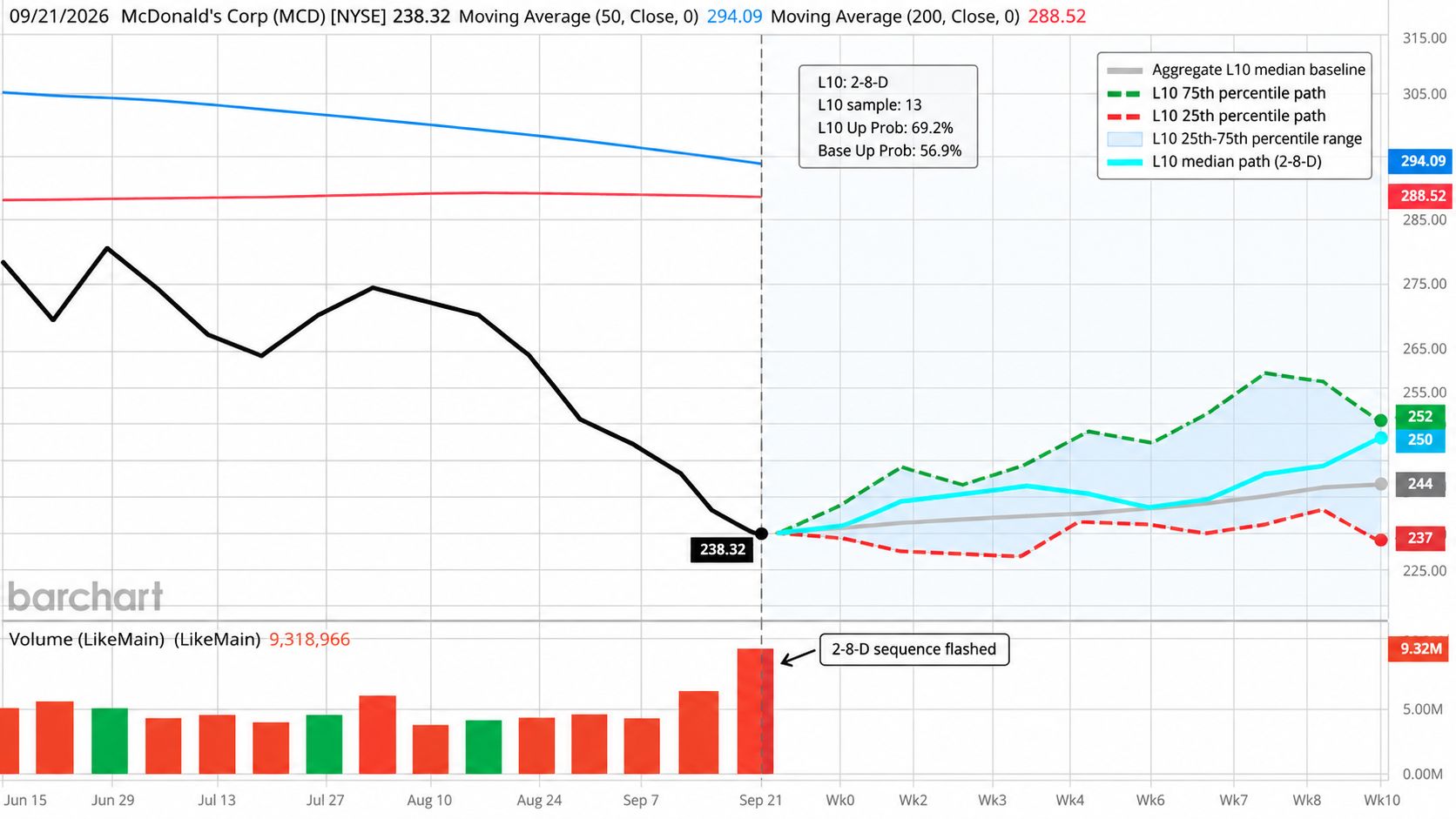
In the last 10 weeks, we know that McDonald’s stock has only managed to print two net positive (weekly) candlesticks, leading to a negative trendline. Mathematically, of the eligible sessions in the period, 80% of the volume was net bearish. First, this dynamic changes the immediate perception of the fast-food giant. Second, this changed perception is likely to alter the ticker’s forward trajectory over the standard baseline expectation.
In fact, if we were to discretize the behavioral state with a binary label — such as 2-8-D or two up, eight down, downward slope — we can then look for this label in McDonald’s historical data. It further turns out that of the 13 times that this signal has flashed on a rolling basis since January 2009, the overall trend has been upward.
Regarding terminal median price targets, speculators may expect McDonald’s stock to range between $241 and $250 between Oct. 16 and Nov. 27. If so, there’s one speculative idea that may be on the radar.
Why the October Bull Spread Might Make Sense for McDonald’s Stock
When it comes to picking out an individual options strategy, my mind is currently focused on the Oct. 16 (monthly) options chain. While the November chain provides more time for the bullish thesis to materialize, MCD stock — at the current pricing structure — would need to rise to $250 for a positively asymmetric risk-reward setup.
With the October chain, I can drop down to the 240/245 bull call spread for such asymmetry. With this transaction in particular, the trader would need to pay a net debit of $229. Should McDonald’s stock trigger the $245 second-leg strike price on the Oct. 16 expiration date, the maximum profit would be $271, an asymmetric payout of over 118%.
While the trade sounds enticing on paper, the primary challenge comes in the form of likelihood of success. Right now, the probability of profit (breakeven) is only 38.2% at $242.29. Based on the calculations found in Barchart’s Expected Move calculator, the odds of full profit at $245 sit at 32.85%.
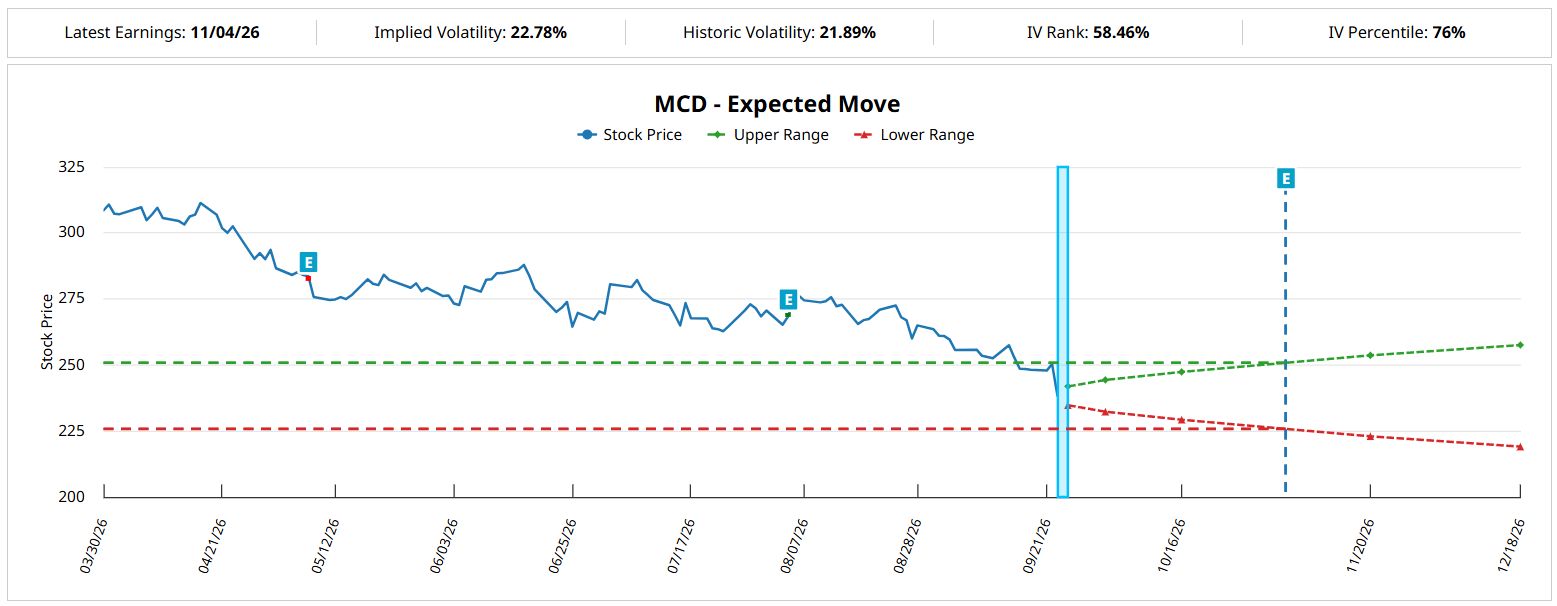
Obviously, these calculations don’t flatter those considering MCD stock but these probabilities assume that the ticker will undergo a random walk between now and the expiration date. Under such random, risk-neutral conditions, then yes, these probabilities are “correct” — they stem from the science of randomness.
But because MCD stock is presently mired in such a severe (and rare) bearish state, I am finding it difficult to believe in the random walk. In my opinion, the ticker would be subject to a nonrandom walk. Based on the data, we can estimate that MCD will break even seven times out of 13 occurrences of the aforementioned signal (53.8%), while it may trigger full profit five times out of 13 (38.5%).
A Caveat Before the Trade
I can’t stress enough that the October 240/245 bull spread is extremely speculative. Regardless of what model you run with, neither a 33% nor 39% probability will inspire confidence. Where the variance is focused on is the breakeven probability. Under a nonrandom walk assumption, there may be a better chance that the spread won’t lose money.
Still, we must be cognizant of the small sample size. It’s not a trade where high statistical confidence can possibly be generated. So, why bother bringing it up?
Frankly, it’s a rare event. Sure, MCD stock is liable to tumble, just like any other name. But when 80% of eligible sessions over a two-month period are net negative? That just doesn’t happen all that much to McDonald’s — and when it does, the typical (though not guaranteed) result has been a bounce back.
Now that you’re armed with this knowledge, you can decide for yourself if the juice is worth the squeeze.
On the date of publication, Josh Enomoto did not have (either directly or indirectly) positions in any of the securities mentioned in this article. All information and data in this article is solely for informational purposes. For more information please view the Barchart Disclosure Policy here.
More news from Barchart
McDonald’s (MCD) Stock Looks Like a Lost Cause — Until You Look at the Data Get Paid to Wait: Buy HOOD at a Discount or Earn Options Income Billionaire Mark Cuban Said He’d Trust a Seeing-Eye Dog Over a Self-Driving Car, ‘A Dog Will Recognize Adversarial Situations Better Than AI Can’ Institutional Investors Invest in Long-Dated Taiwan Semiconductor Call Options - A Bullish Signal on TSM