


With artificial intelligence (AI) lifting a wide range of tech stocks over the past few years, Microsoft (MSFT) has somehow struggled to keep pace. The company’s longer-term stock performance has lagged the broader market, with its massive AI capital investments, constrained Azure growth, and intensifying competition across cloud computing weighing on investor sentiment. But the narrative may be starting to change.
Microsoft’s near-term performance is picking up, and some analysts believe the tech giant’s growth story is beginning to look more convincing. That optimism got a fresh boost Wednesday, when Stifel analyst Brad Reback upgraded Microsoft to “Buy” from “Hold,” saying it is increasingly confident that the company is “getting back on track.” And Stifel is putting more money behind that view, too. Reback raised his price target on MSFT stock to $575 from $530, reflecting greater confidence in the company’s growth outlook. So, what's exactly fueling Stifel’s bullish outlook for Microsoft stock? Let’s take a closer look.
More Top Stocks Daily: Go behind Wall Street’s hottest headlines with Barchart’s Active Investor newsletter.
About Microsoft Stock
Founded in 1975, Microsoft has evolved from a software company into one of the world’s most influential technology giants. Headquartered in Redmond, Washington, the company has shaped modern computing through products such as Windows, Office, Teams, and Xbox, which are deeply embedded in how people work, communicate, and entertain themselves. But Microsoft’s growth story has increasingly moved beyond traditional software.
Its investment in Azure has turned cloud computing into a major engine of the business, helping organizations move more of their operations online and become more digitally efficient. Now, Microsoft is betting heavily on artificial intelligence as its next major growth driver. The company is integrating AI across its products and services, from Copilot to Azure, with the broader goal of making its ecosystem more productive and valuable to customers.
The catch is that this AI opportunity comes with a hefty price tag. Microsoft has been pouring billions into data centers and other AI infrastructure, pushing capital expenditures higher and weighing on investor sentiment as shareholders wait to see how quickly those investments translate into stronger revenue and profits.
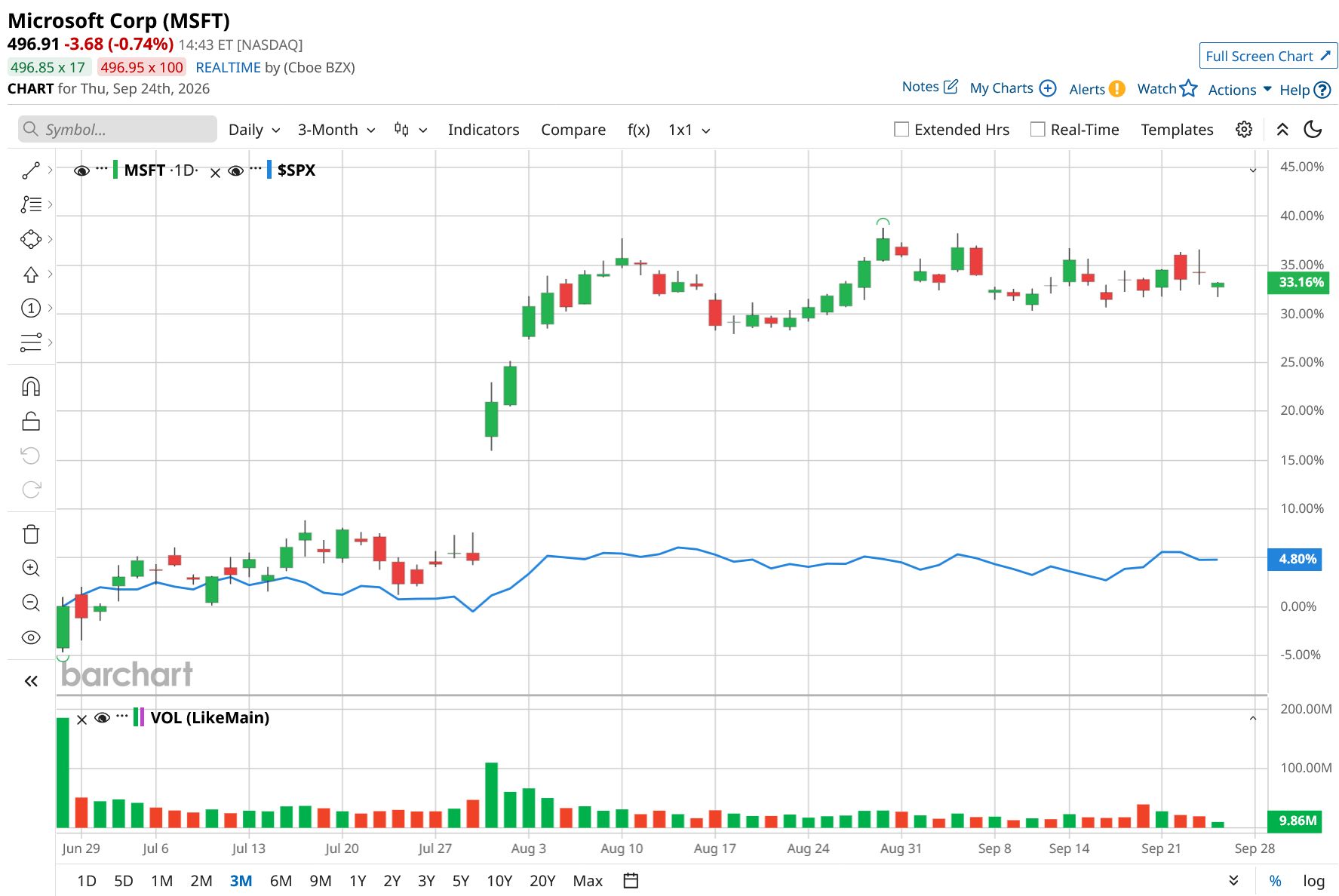
That tension is reflected in the stock’s performance. Despite Microsoft’s enormous scale and a market capitalization of roughly $3.72 trillion, MSFT stock has gained just 2.4% year-to-date (YTD) in 2026 and is down 3% over the past 52 weeks. That trails the broader S&P 500 Index ($SPX), which has advanced about 12% so far in 2026 and 16% over the past year.
In other words, while Microsoft has been spending aggressively to position itself for the next wave of technology growth, its stock has not fully reflected that ambition. The recent trend, however, is telling a different story. Microsoft’s latest earnings report showed solid growth in Azure, offering investors fresh evidence that its cloud and AI investments can translate into meaningful business growth. That helped reignite enthusiasm for the stock, which has surged 35.1% over the past three months, easily outpacing the broader market’s 4.5% gain over the same period.
 www.barchart.com
 Q4 Earnings Snapshot
Microsoft wrapped up fiscal 2026 on a strong note, with its fourth-quarter results comfortably beating Wall Street expectations as robust commercial cloud demand and surging AI workloads continued to fuel growth. Reported on July 29, the quarter saw revenue reach $90 billion, up 18% year-over-year (YoY) and ahead of analysts’ $87.4 billion estimate. Adjusted EPS jumped 23% YoY to $4.74, easily topping the $4.21 consensus forecast, while operating income increased 18% to $40.6 billion.
The biggest growth engine remained Microsoft’s cloud business. Microsoft Cloud revenue climbed 27% YoY to $59.3 billion, while commercial remaining performance obligations (RPO), a key indicator of contracted future revenue, soared 84% to $678 billion. Within the cloud portfolio, the Intelligent Cloud segment stood out, with revenue rising 32% to $39.3 billion. Azure and related cloud services were particularly strong, accelerating 43% YoY as enterprises ramped up spending on computing capacity and custom AI deployments.
Microsoft’s Productivity and Business Processes business also maintained solid momentum. Revenue increased 14% YoY to $37.8 billion, supported by strength across several key businesses. Microsoft 365 Consumer cloud revenue rose 24%, LinkedIn revenue climbed 12%, and Dynamics 365 increased 13%.
Not every part of Microsoft’s sprawling business was firing at the same pace, however. The More Personal Computing segment remained the company’s biggest drag, with revenue falling 4% YoY to $12.9 billion. Continued weakness in hardware demand pushed Windows OEM and Devices revenue down 7%, while Xbox content and services revenue declined 10%.
Microsoft’s growing AI footprint was also hard to miss. During fiscal 2026, management highlighted that Azure revenue surpassed $100 billion for the first time, while Microsoft 365 Copilot surpassed 30 million paid seats. Those milestones point to increasing customer adoption of Microsoft’s AI tools and reinforce the company’s expanding role in helping businesses implement AI at scale.
The company also continued to reward shareholders, returning $10.2 billion through dividends and share repurchases during Q4. But one number that stood out was capital spending. Quarterly capex and finance lease additions jumped to $41 billion, reflecting Microsoft’s aggressive spending on data centers and GPU clusters needed to support its rapidly expanding AI infrastructure.
And Microsoft isn’t planning to take its foot off the accelerator. For Q1 fiscal 2027, the company expects revenue between $89.85 billion and $90.95 billion, representing 16% to 17% growth. At the same time, management expects quarterly capex to exceed $50 billion, underscoring both the scale of Microsoft’s AI ambitions and the enormous investment required to keep its AI and cloud growth engine running.
What Do Analysts Think About MSFT Stock?
Stifel is betting that Microsoft’s growth engine is starting to fire on all cylinders again. The investment firm upgraded MSFT stock to “Buy” this week, saying the tech giant is “getting back on track.” Stifel analyst Brad Reback sees room for Microsoft to sustain mid-to-upper-teens revenue growth, pointing to several factors working in the company’s favor.
Advances in open-weight AI models have strengthened Microsoft’s LLM-agnostic strategy across Azure and Copilot, while better cost and operating efficiencies could help keep margins stable. Meanwhile, Microsoft’s strong cash generation should reduce the need to rely on outside financing. Stifel is also becoming more bullish on Azure, expecting its revenue growth to accelerate despite ongoing capacity constraints in the cloud business.
Reback sees incremental operational efficiencies, the ramp-up of new data center capacity, and a growing OpenAI revenue share as key drivers that could help Azure pick up speed. And Azure isn’t the only piece of the puzzle. Within Microsoft 365, product improvements could encourage more customers to adopt Copilot, while rising GitHub consumption provides another source of growth. Together, Reback believes these trends can help Microsoft sustain mid-to-upper-teens growth.
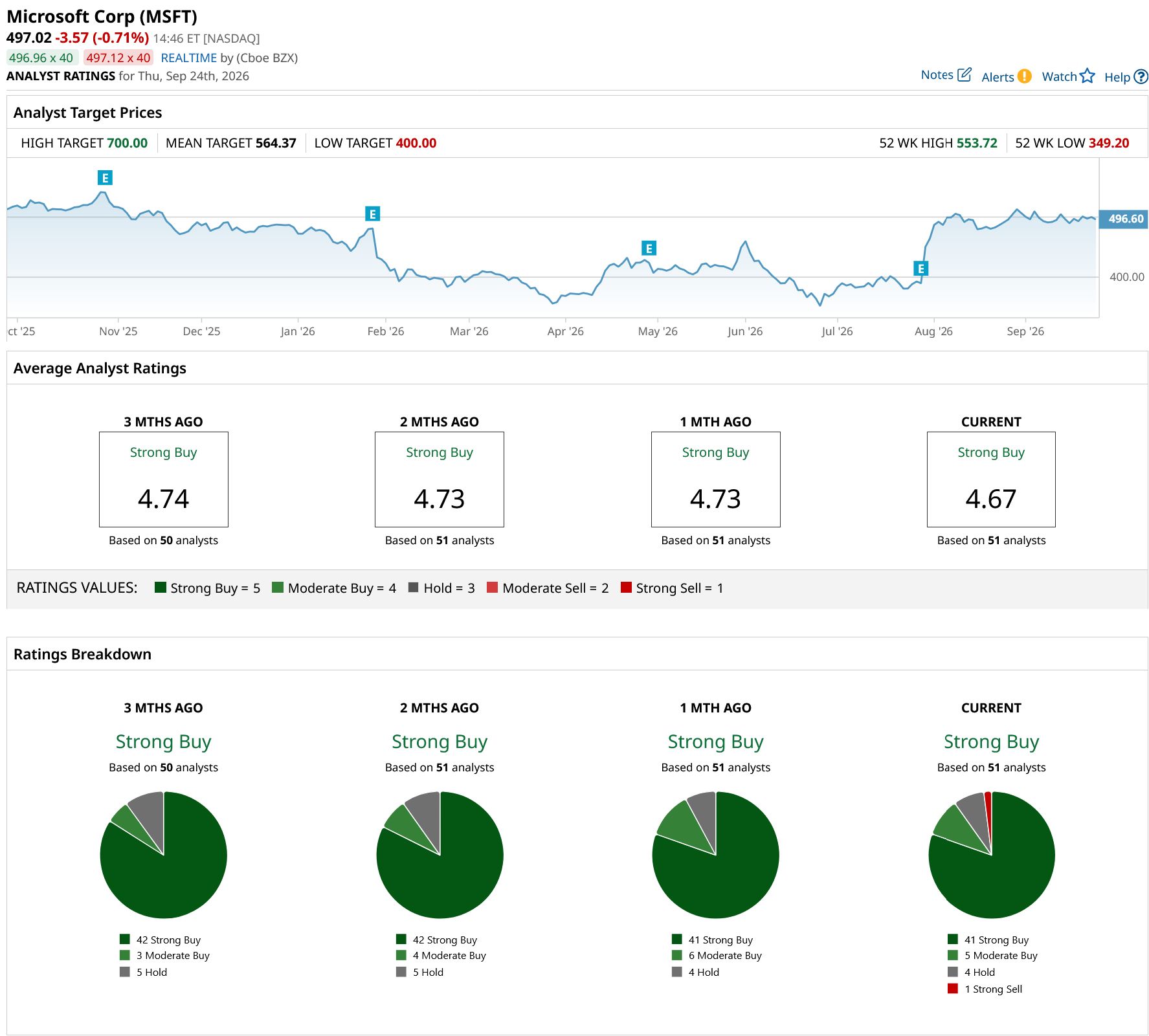
Overall, Wall Street’s bullish stance on Microsoft remains firmly intact, with the stock carrying a consensus “Strong Buy” rating. Of the 51 analysts covering MSFT, 41 rate it a “Strong Buy,” five recommend a “Moderate Buy,” four have a “Hold” rating, and just one calls for a “Strong Sell.” The optimism is reflected in the price targets, too. The average target of $564.37 points to roughly 14% upside, while the Street-high target of $700 implies a potential gain of as much as 41%.
 www.barchart.com
 On the date of publication, Anushka Mukherji did not have (either directly or indirectly) positions in any of the securities mentioned in this article. All information and data in this article is solely for informational purposes. For more information please view the Barchart Disclosure Policy here.
More news from Barchart
Down Nearly 80%, Nike Just Won a University-Sized Catalyst From Adidas Why These Wall Street Analysts Think Microsoft Stock Is ‘Getting Back on Track ‘That’s Immediate Cash in the Bank’: Billionaire Mark Cuban Says the Quickest Way for a Company to Raise Money Is to Change Its PBM Bulls vs. Bears: How to Interpret Unusual Options Activity in Expedia Stock