


Going asset-light can be a smart move for a company that is spending heavily to grow. Instead of owning every piece of infrastructure on its books, a business can bring in outside capital, free up cash, and still keep using the assets it needs to run. That logic is becoming increasingly relevant for Amazon (AMZN), as the e-commerce giant seeks how to fund its massive artificial intelligence (AI) push without putting even more pressure on its balance sheet.
According to a Financial Times report, Amazon is seeking to offload about $8 billion worth of advanced Nvidia (NVDA) chips to external investors through a new special-purpose vehicle. The proposal involves thousands of Grace Blackwell chips installed across more than a dozen U.S. data centers in five states, including Nevada and Virginia.
More Top Stocks Daily: Go behind Wall Street’s hottest headlines with Barchart’s Active Investor newsletter.
The idea is fairly straightforward. Outside investors would finance the vehicle, potentially through debt and up to a 10% equity stake, while Amazon would continue using the chips. In other words, Amazon could keep the computing power without owning all the hardware outright.
And with Amazon expecting capital expenditures of $220 billion this year, finding creative ways to fund that expansion could matter. But does moving ownership off Amazon’s books actually reduce the financial burden, or simply move it somewhere else? More importantly, could this asset-light strategy ultimately give AMZN stock another reason to win over investors?
About Amazon Stock
Few companies need an introduction quite like Amazon. What began as a humble online bookstore has grown into one of the biggest forces in the global digital economy, with a market capitalization of roughly $2.7 trillion. Today, Amazon’s reach stretches far beyond shopping, touching cloud computing, digital advertising, streaming, smart devices, healthcare, and AI.
A major piece of that story is Amazon Web Services (AWS), which provides cloud infrastructure to businesses and organizations around the world. But Amazon is no longer simply renting out computing power. The company is also building its own technology, developing custom chips such as Trainium and Graviton for cloud and AI workloads. That gives Amazon a growing role in the infrastructure powering the next wave of computing while opening another avenue for growth beyond its traditional retail roots.
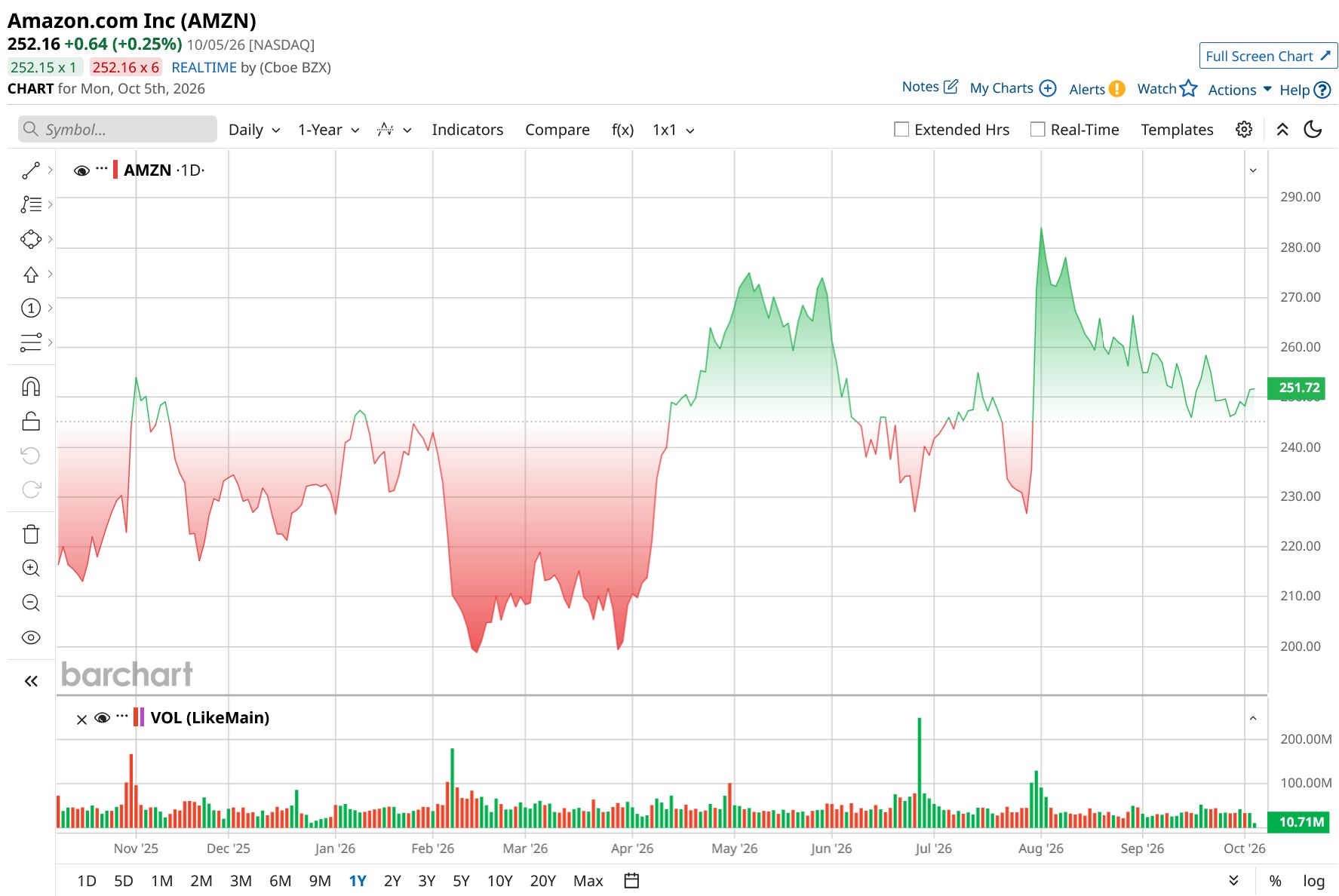
That broader expansion has been reflected in Amazon’s stock performance, although the ride has hardly been a straight line. Over the past 20 years, AMZN stock has delivered an extraordinary 13,106% return, while the stock is up roughly 537% over the past decade. Even over the last three years, shares have gained about 100%, as investors have increasingly valued Amazon for much more than its retail business.
AWS, advertising, and AI have become increasingly important pieces of that valuation story. The latest leg higher was particularly strong after Amazon’s second-quarter results, when faster AWS growth and upbeat AI commentary helped push the stock to a record $287.20 on Aug. 3. Several analysts also raised their price targets, adding fuel to the rally.
But the mood has cooled since then. AMZN is now about 12.4% below that record high and has slipped roughly 1.4% over the past month. Part of the pressure comes from a September lawsuit filed by the Federal Trade Commission and 22 states over Amazon’s advertising practices, allegations the company has rejected.
There have also been near-term operational concerns, including disruptions affecting AWS facilities in Bahrain and parts of the UAE, while Amazon paused work with cargo airline 21 Air following a fatal cargo plane crash in Miami.
Still, the longer-term picture remains positive, with AMZN stock up 15% over the past year, 9% on a year-to-date (YTD) basis, and about 20% over six months.
Amazon’s growth comes with a premium price tag. AMZN currently trades at around 30.3 times forward adjusted earnings and 3.3 times sales, both above sector norms.
 www.barchart.com
 A Closer Look at Amazon’s Q2 Report
Amazon’s second-quarter results were impressive, and the numbers are growing faster than ever. The company continues to benefit from strong consumer demand, a rapidly expanding advertising business, and, most importantly, a cloud operation riding the AI wave. In Q2, Amazon’s net sales climbed 20% year-over-year (YoY) to $200.6 billion, comfortably beating Wall Street’s expectations.
AWS remained the biggest talking point. Revenue from the cloud division jumped 36.7% to $42.2 billion, its fastest growth in roughly 18 quarters. As businesses pour money into the infrastructure required to develop and run generative AI applications, AWS is capturing a meaningful share of that spending. Amazon remains the world’s largest cloud infrastructure provider, with an estimated 30% global market share. The company also said its AWS AI business and custom chip portfolio, including its AI-focused offerings, have each crossed a $25 billion annualized revenue run rate, with both businesses growing at triple-digit rates.
Amazon’s other engines were moving too. Advertising revenue increased 26% to $19.8 billion, as brands leaned further into Amazon’s enormous shopping ecosystem. Subscription services, which include Prime, generated $13.7 billion, up 12%. Online stores brought in $70.4 billion, a 15% increase, while physical-store sales rose a more modest 4% to $5.8 billion.
Amazon posted $5.75 in EPS, more than three times the $1.68 recorded in the year-ago quarter and topping analysts’ expectations.
Amazon is also spending heavily to accelerate its retail machine. During the first half of the year, the company delivered more than 40% more items through same-day or overnight shipping than a year earlier. Its ultra-fast Amazon Now service also expanded into 80 additional U.S. cities and towns, along with several cities in Egypt. The service now operates across nine countries and more than 250 cities and towns.
But there is also the cost of building it. Amazon ended Q2 with $78.2 billion in cash and equivalents against $128.9 billion in long-term debt. Trailing-12-month operating cash flow increased 33% to $161.4 billion, yet free cash flow moved sharply in the opposite direction, falling to a $7.6 billion outflow from an $18.2 billion inflow a year earlier. The key culprit was a $66.1 billion increase in net purchases of property and equipment, reflecting the company’s aggressive investment in AI infrastructure.
For Q3, Amazon expects sales of $197 billion to $202 billion, pointing to 9% to 12% YoY growth. The outlook includes an approximately 80-basis-point foreign-exchange headwind, while the timing of Prime Day shifting into Q2 also affects the comparison. Without that timing impact, Q3 revenue growth would be nearly 400 basis points higher. Operating income is expected to come in between $22.5 billion and $26.5 billion.
Wall Street analysts tracking Amazon anticipate its Q3 revenue to be around $202 billion, with EPS expected to rise 3.6% YoY to $2.02. For fiscal 2026, EPS is expected to be $8.01, indicating an 11.7% YoY surge, before rising by another 32.1% annually to $10.58 in fiscal 2027.
What Do Analysts Expect for AMZN Stock?
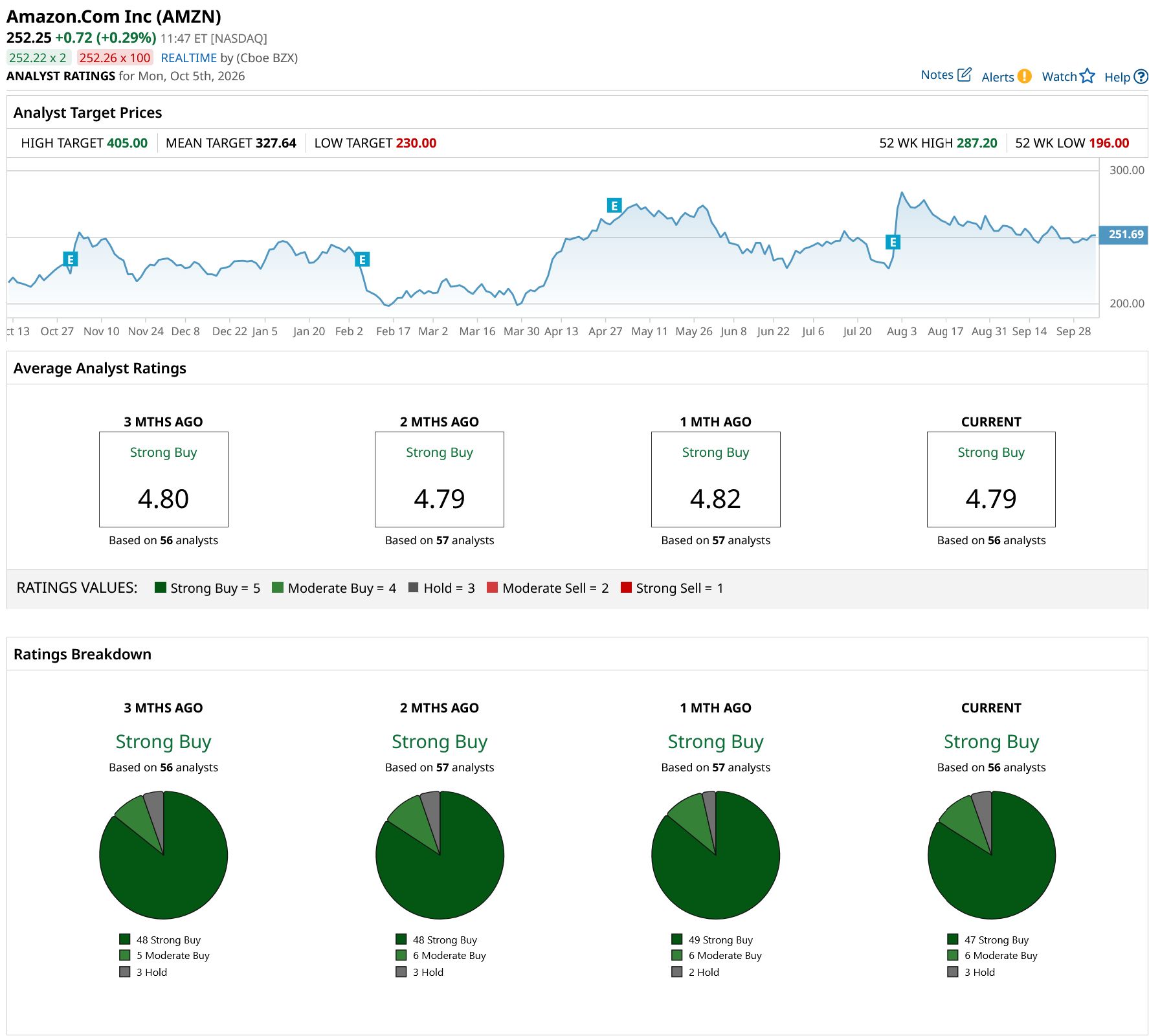
Wall Street remains highly optimistic about AMZN, with the stock earning an overall consensus rating of “Strong Buy.” Out of 56 analysts, 47 advise a “Strong Buy,” six recommend a “Moderate Buy,” and three are cautious with a “Hold” rating.
The average price target of $327.64 suggests a 30% upside potential from here. Meanwhile, the Street-high price target of $405 suggests AMZN stock could rise as much as 61%.
 www.barchart.com
 Final Thoughts on AMZN Stock
Amazon may be changing who owns the AI hardware, but it certainly is not changing who gets to use it. The company's step to move about $8 billion of Nvidia chips off its books through a sale-leaseback could be a neat financial maneuver, as its long-term debt has climbed to about $129 billion.
Amazon can keep running the chips while shifting the obligation into lease disclosures and helping protect its credit rating. And frankly, that is not a bad trick when AI infrastructure is eating billions for breakfast. With capex racing toward $220 billion, AWS growing, and its AI businesses scaling fast, this looks less like Amazon stepping away from AI and more like making the AI bill easier to swallow.
On the date of publication, Sristi Suman Jayaswal did not have (either directly or indirectly) positions in any of the securities mentioned in this article. All information and data in this article is solely for informational purposes. For more information please view the Barchart Disclosure Policy here.
More news from Barchart
Why Amazon Wants to Offload its Nvidia Chips – And Why It Could Be Good News for AMZN Stock Why It’s Time to Load Up on HPE Stock Now 20 Planet Labs Satellites Reached Orbit. What Comes Next for PL Stock. Bank of America Put a $60 Price Target on IonQ. The Quantum Bet Is Picking Up Speed.