


Entering Friday’s trading, the S&P 500 was down 0.86% for the week. As I write this pre-market, the index’s futures are up 0.22%.
Investors are betting that Federal Reserve Chair Kevin Warsh’s lack of interest-rate comments in his International Monetary Fund fireside chat in Bangkok this morning suggests he’s not in a hurry to raise rates. That’s good news for stocks.
Can’t Get Enough Options?: Join the list for Barchart’s daily unusual options report, delivered free.
I find it hard to believe the Fed won’t raise rates this year, given inflation is now 3.7% annualized, about 25% higher than when President Trump took office.
We’ll see what we see.
In the meantime, yesterday’s options volume was exceptional at 77.63 million, 14.74 million higher than the 90-day average. That led to some interesting options trades and unusual options activity. Despite the volume, only two options had Vol/OI (volume-to-open-interest) ratios over 100 on Thursday.
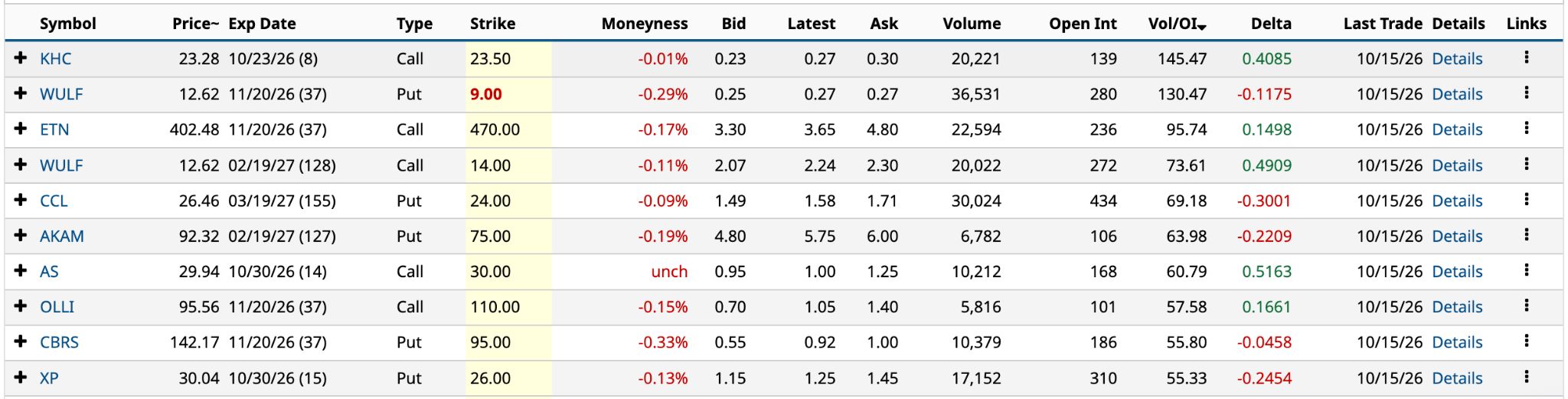
In today’s commentary, I'm looking at three stocks from yesterday's top 10 Vol/OI ratios that caught my attention.
Lastly, the Milwaukee Brewers’ sweep of the Dodgers in Major League Baseball’s National League Championship Series last night was music to this Blue Jay fan’s ears. I still haven’t gotten over the Game 7 loss in last year’s World Series.
Have an excellent weekend.
Kraft Heinz (KHC)

Kraft Heinz (KHC) had two unusually active options on Thursday. I’m focused on the Oct. 23 $23.50 call expiring next Friday that led the top 10 with a Vol/OI ratio of 145.47. The call volume was 20,171, accounting for 39% of the stock’s total options volume and 57% more than the 30-day average.
Based on the Oct. 23 $23.50 call, I found a matched trade (shown above) that took place at 1:10:44 p.m. ET for 20,072 call contracts for both the $23.50 call and the $24 call. With the $24 call marked as “sell to open” at the bid, the matched trade suggests a Bull Call Spread (shown below for illustrative purposes only).

In this situation, the bull call spread involved the institution buying $521,800 in long $23.50 calls and selling $220,700 in $24 calls for a net debit of $301,100, or $0.15 per share [20,072 contracts * 100 * $0.15 net debit].
The defined-risk bet is a low-cost/low reward trade with a maximum profit of $702,520, or $0.35 per share [$24 strike price - $23.50 strike price - $0.15 net debit * 20,072 contracts * 100], if the share price is $24 or higher next Friday.
Based on the expected move of 2.92% up or down, the upside target is $23.91, just shy of $24, delivering a profit of $521,872 [$23.91 share price - ($23.50 strike price + $0.15 net debit) * 20,072 contracts * 100].
The maximum loss of $301,100 would occur if KHC is below $23.50 at expiration. The expected move in either direction suggests it’s more than possible.
Eaton (ETN)

Eaton (ETN) had just one unusually active option yesterday, but it was a big one. The Nov. 20 Nov. 20 $470 call was the third-highest Vol/OI ratio at 95.74. Call volume was 22,594, accounting for 42% of the stock’s total options volume, nearly nine times the 30-day average.
Based on the Nov. 20 $470 call, I found a matched trade (shown above) that took place at 10:59:20 a.m. ET for 22,500 call contracts for both the $470 call and $420 call. The $420 call didn’t make the unusual options activity list because its open interest was below the 100-contract minimum.


Shown above are a bull call spread and a bear call spread. The bear call spread has about twice the likelihood of profit at 67.8%, compared to 30.2% for the bull call spread.
If you look at the two 22,500-contract trades from yesterday shown earlier, you’ll see that the $420 call is marked “buy to open,” which suggests, but doesn’t confirm, that the trade was a bull call spread. Even the trade at the ask price doesn’t confirm this to be the case because the volume on the ask was only 6.
However, the bear call spread here--the trade is the inverse of the bull call spread; you’d sell the $420 short and buy the $470 long--is awfully tempting.
Based on the two trades, the bear call spread would have generated a net credit of $9.05 per share [$420 call trade price of $12.30 - $470 call trade price of $3.25], or $20,362,500 [20,500 contracts *9.05 per share net credit * 100].
To keep that $20+ million, the share price must be below $420 in November. ETN stock has stalled in the past five days, down nearly 6%. The expected move over the next 36 days is 9.71%. Based on the $400.90 share price as I write this early Friday trading, the upside move would put the share price at $440, resulting in a loss of $10.95 per share [$420 strike price + $9.05 net credit], or $24,637,500.
The maximum loss of $40.95 per share [$470 strike price - $420 strike price - $9.05 net credit], or $92,137,500 [$40.95 per share * 22,500 contracts * 100] would occur if the share price is above $470 at expiration.
That’s unlikely.
Ollie’s Bargain Outlet Holdings (OLLI)
This last one is a doozy. I'd never try something like this in my own account. Just getting to the trade was difficult enough.
Ollie’s had just one unusually active option yesterday that’s shown in the top 10 in the introduction. The Nov. 20 $110 call had a Vol/OI ratio of 57.58. The call’s volume was 5,816, accounting for 17% of the stock’s total options volume, more than 12 times the 30-day average.
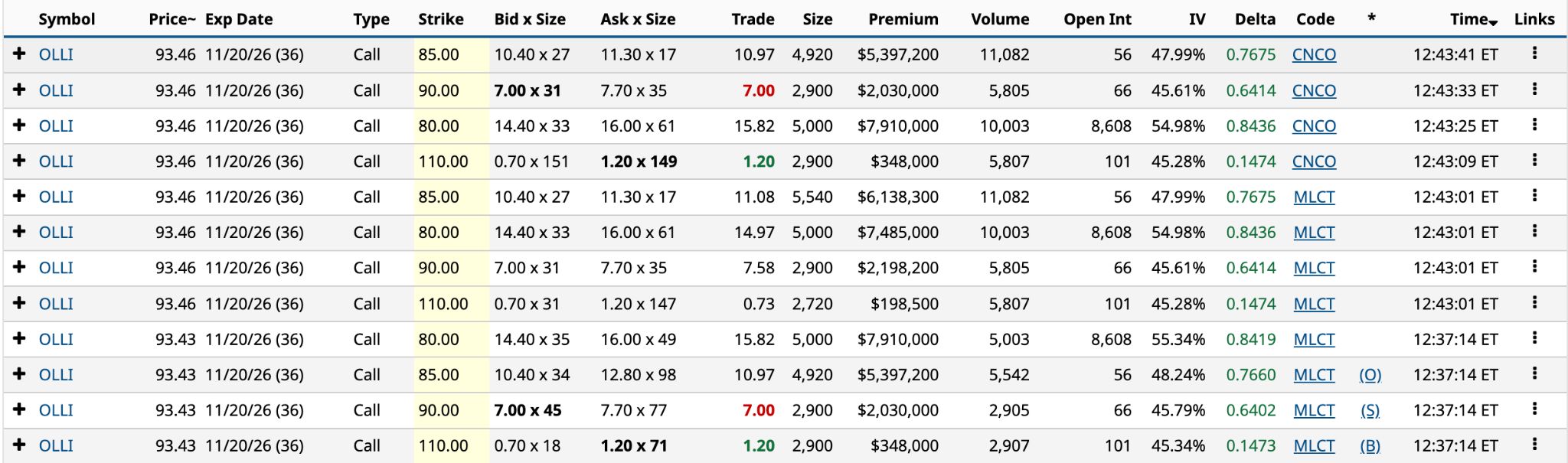
Based on the Nov. 20 $110 call, I found a matched trade at 12:43:01 p.m. ET for 16,160 call contracts across four strike prices, including the $110 call (shown below).

Before I get into the options strategy at play, the options flow from yesterday’s Nov. 20 activity is shown below. Essentially, the four trades at 12:37:14 p.m. ET were cancelled between 12:43:09 and 12:43:41 p.m. ET (the four at the top), leaving the four in the middle as the actual trades, which I’ve isolated above.
As I said, it was a tough one to follow.
The four calls have different trade sizes. If they were all identical, we’d likely have a Short Call Condor Spread, which would involve buying one $80 call, selling one $85 call and one $90 call, and buying one $95 call, with a $5 strike-price differential.
That’s not what we have here.
What we have is a Short Asymmetrical Call Condor, meaning that, unlike a symmetrical short call condor spread, the strike-price spacing and trade sizes vary to favour a move in one direction over the other, making the risk/reward unbalanced.
So, I think the four trades were: the institution bought 5,000 $80 call contracts, sold 5,540 $85 call contracts, sold 2,900 $90 call contracts, and bought 2,720 $110 call contracts for a net credit of $653,000.
Calculation: [$80 call $7,485,000 + $110 call $198,500 - $85 call $6,138,300 - $2,198,200].
If the share price at expiration is below the $80 long call, all four calls expire worthless. The institution keeps the $653,000 net credit.
If the share price is $85 at expiration, the short $85, short $90, and long $110 calls expire worthless, while the long $80 generates a maximum profit of $3,153,000. Calculation: [$85 share price - $80 call strike price * 5,000 contracts * 100 + $653,000 net credit].
If the share price is $90 at expiration, the short $90 call and the long $110 call expire worthless, while the long $80 call is worth $5,000,000; the short $85 call reduces profits by $2,770,000, for a total profit of $2,883,000.
Calculation: [($90 share price - $80 call strike price * 5,000 contracts * 100 + $653,000 net credit) - ($85 call strike price - $90 share price * 5,540 contracts * 100)].
If the share price is $110 at expiration, the institution loses $3,997,000: the $110 call expires worthless, the other three calls lose $4,650,000, and the net credit is subtracted ($653,000).
For every $1 above $110, the institution loses $72,000 on top of the $3,997,000. The institution makes money below the $98.38 breakeven.
That was quite the mathematical workout.
**********
Calculation for long $80 call: [$110 share price - $80 call strike price * 5,000 contracts * 100] = $15,000,000.
Calculation for short $85 call: [$85 call strike price - $110 call strike price *5,540 contracts * 100] = -$13,850,000.
Calculation for short $90 call: [$90 call strike price - $110 call strike price * 2,900 contracts * 100] = -$5,800,000.
Breakeven calculation: [500,000 shares * (share price - $80)] - [554,000 shares * (share price - $85] - [290,000 shares * (share price - $90)] + $653,000 net credit
Set the profit to $0
0 = -344,000 shares * share price + $33,843,000
Share price = $33,843,000 / 344,000 shares = $98.38
On the date of publication, Will Ashworth did not have (either directly or indirectly) positions in any of the securities mentioned in this article. All information and data in this article is solely for informational purposes. For more information please view the Barchart Disclosure Policy here.
More news from Barchart
How to Play Unusual Options Activity in 3 Stocks: Kraft Heinz, Eaton, and Ollie’s Bargain Outlet Why Speculators May Want Another Crack at McDonald’s (MCD) a163% Options Payout Domino's Pizza Sees Lower FCF Margins, But It's Worth One-Third More - What's the Best DPZ Play? Unusual Options Activity in These 4 Stocks Shows Bull and Bear Vertical-Spread Setups