


I asked why cocoa prices had recovered in an August 4, 2026, Barchart article, where I concluded with the following:
The bottom line is that cocoa futures have shifted from selling all rallies after late 2024 to buying dips since March 2026. No ETF or ETN tracks cocoa, so futures and futures options on the Intercontinental Exchange are the only vehicles for trading in the volatile soft commodity. In early August 2026, buying cocoa on price weakness is optimal, as the trend is a trader’s best friend until it bends.
Don’t Miss a Day: From crude oil to coffee, sign up free for Barchart’s best-in-class commodity analysis.
Nearby ICE cocoa futures were trading $5,920 per ton on August 3. In late October, the price was lower, but it remained in a bullish trend.
Cocoa futures have recovered since early March 2026
After trading at a record high of over $12,900 per ton in December 2024, the continuous ICE cocoa futures contract reached a low of $2,846 on March 2, 2026, a decline of 78%.
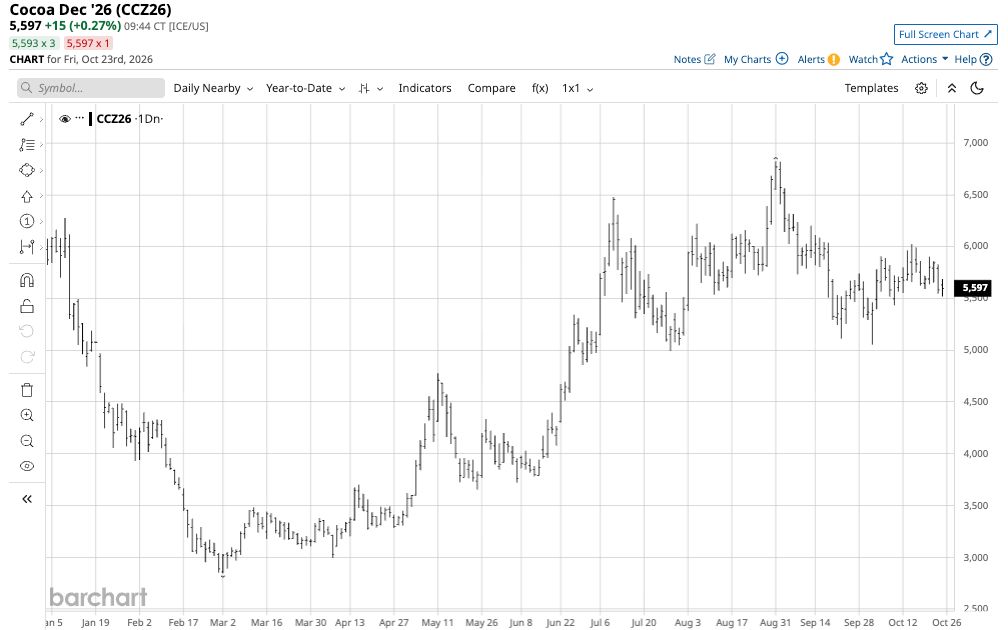
The continuous year-to-date ICE cocoa futures chart shows the March 2 low as a bottom, and cocoa futures have made higher lows and higher highs over the past months, reaching a 2026 high of $6,821 per ton on August 31 and correcting to near $5,600 per ton on October 23. At current prices, cocoa futures are double the early March low.
The long-term price action is choppy but remains bullish
The long-term chart shows the explosive and implosive price action since early 2024.
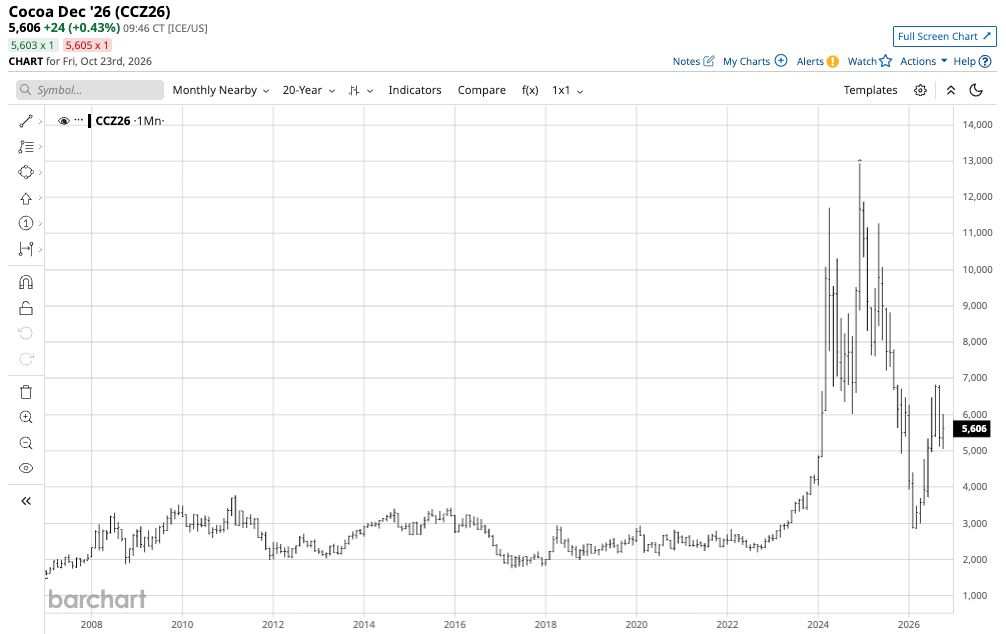
The monthly 20-year continuous contract chart shows that after trading in a range from 2007 through September 2023, cocoa broke out to the upside, with the price tripling to nearly $13,000 per ton on production issues in West Africa. In commodities, the cure for high prices is always more high prices, and cocoa plunged and bottomed at $2,846 per ton in March 2026 before doubling to $5,600 in late October.
Cocoa is now back above its long-term support level
The long-term quarterly chart shows that cocoa’s long-term support level dates back to 1977.
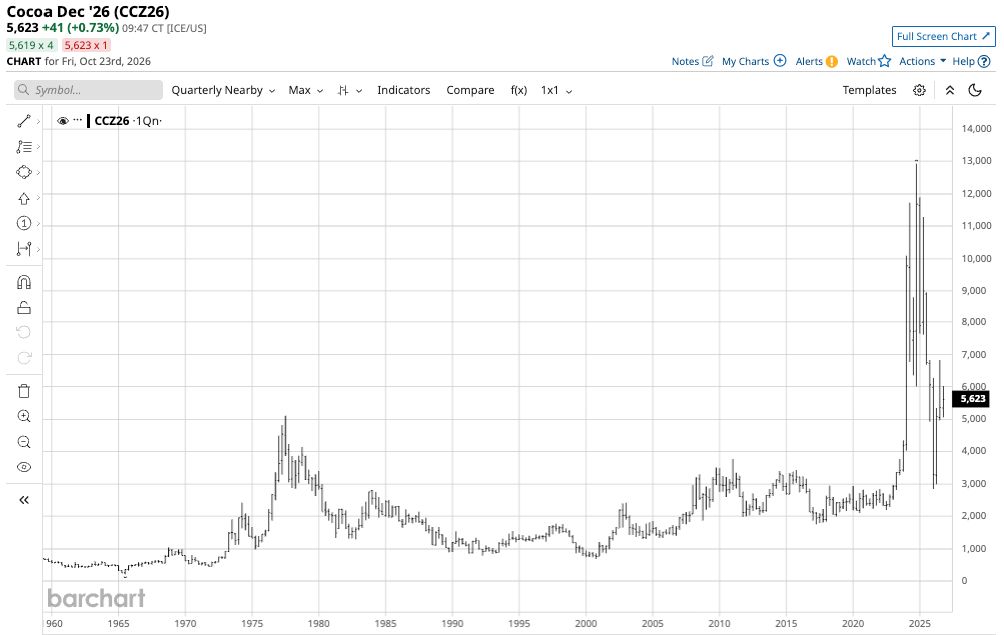
The chart shows that the 1977 high of $5,104 per ton served as support when cocoa prices soared. The soft commodity fell well below that level from January through July 2026, but recovered and held above the 1977 high in August and September. The 1977 $5,104 per ton level could become a pivot point for cocoa in the coming weeks and months, as the price traded around it in October 2026.
Critical technical levels suggest continued volatility. Super El Niño could be a significant factor in 2027
While $5,104 per ton could become a pivot point for the ICE cocoa futures, weather in West Africa over the coming months and into 2027 will determine the path of least resistance for prices.
A super El Niño is a very strong climate anomaly that occurs when the average sea-surface temperatures in the central and eastern tropical Pacific Ocean rise by 3.6 degrees Fahrenheit or more above the normal baseline. This intense warming acts like a massive boulder dropped into the global climate system, shifting atmospheric jet streams and triggering severe, widespread weather conditions across the Earth. Average sea-surface temperatures in the region have been well above the normal baseline in 2026, suggesting severe weather conditions are on the horizon over the coming months and into 2027.
Weather is the most critical factor in agricultural production; a super El Niño over the coming year could affect crop yields, and cocoa beans are no exception. The Ivory Coast and Ghana are the world’s leading cocoa bean producers and exporters. Droughts, floods, wildfires, and other environmental events could affect the cocoa bean crop. According to an article in the African Financial Review:
Forecasters say that an El Nino weather pattern is strengthening and could develop into one of the strongest episodes on record, boosting temperatures, disrupting rainfall and posing risks to crops the world over.
“We are at the early stages, but it’s already pushing on prices, and we’ve seen some reduction in supplies in some regions,” said Westpac senior economist Justin Smirk. “At the moment, it is mostly focused on the tropics, around cocoa, coffee, and some esoteric commodities like vanilla.”
Equatorial crops are uniquely vulnerable to climate shocks, which hit growing regions with severe droughts or torrential rain.
“Cocoa is particularly susceptible to weather because it’s a relatively fragile crop that so much of the world depends on,” said Michael Whitehead, ANZ’s director of agribusiness. “If it’s too wet, it gets a crop disease, and that impacts cocoa supply. If it’s too dry, that also impacts supply.”
The bottom line is that another explosive move in cocoa could be on the horizon if the Super El Niño causes crop destruction over the coming months and into 2027.
The futures are the only route for cocoa exposure
Cocoa is a highly volatile soft or tropical commodity. The only route to take a risk position in cocoa prices is the ICE futures market; no ETFs directly track the futures. Agricultural ETFs such as DBA and others may include the cocoa futures, but only as a small part of a larger agricultural portfolio.
Cocoa futures are leveraged and require specialized futures trading accounts. Each ICE cocoa futures contract contains 10 metric tons of coffee beans. At $5,600 per ton, the contract value is $56,000. ICE’s original margin requirement is currently $9,317 per contract. A market participant can control $56,000 worth of cocoa futures on the long or short side for a 16.6% down payment. If equity on a long or short position falls below $8,470, the exchange requires maintenance margin payments. Margin requirements can change as volatility changes. Rising price volatility increases margin levels, while falling price volatility lowers them.
A super El Niño could cause substantial price swings in the cocoa futures market over the coming months and into 2027. Trade the trends until they bend, as cocoa is a market for trading, not investing. Given cocoa’s explosive and implosive price action, stops and profit targets will protect capital and enhance profits in this volatile futures market.
On the date of publication, Andrew Hecht did not have (either directly or indirectly) positions in any of the securities mentioned in this article. All information and data in this article is solely for informational purposes. For more information please view the Barchart Disclosure Policy here.
More news from Barchart
Where Are Cocoa Prices Heading in 2027? Where Are ICE Arabica Coffee Futures Heading in 2027? Buy Sugar Here Before Prices Rise Again on Global Deficits, Ethanol Production Amazon Stock Has Been Flat for the Past Month, But AMZN Put Credit Spreads Have Worked Out Well