

Just two weeks ago, Micron Technology (MU) was facing a major labor dispute in Taiwan. On Oct. 7, workers at its Taoyuan facilities voted to authorize a strike, with 1,994 workers, or 99% of those who voted, backing the move.
The Taoyuan and Taichung unions wanted a one-time fiscal 2026 bonus equal to about 83 months of pay, along with quarterly bonuses funded by 15% of operating profit beginning in fiscal 2027. They said similar profit-sharing arrangements are already used by Samsung Electronics and SK Hynix (SKHY). Taiwan is Micron Technology’s largest manufacturing base, so a strike could have disrupted chip supply while AI customers are already competing for limited memory capacity.
More Top Stocks Daily: Go behind Wall Street’s hottest headlines with Barchart’s Active Investor newsletter.
But the situation changed quickly. According to an Oct. 21 report, Micron Technology’s Taiwan unit reached a labor deal with the union representing workers at its Taichung site. So, how much does this agreement change the outlook for MU investors? Let’s take a closer look.
Inside Micron’s Taiwan Labor Agreement
Micron Memory Taiwan and the union representing workers at its Taichung site said on Oct. 21 that they had reached a labor agreement. Both sides then canceled a mediation meeting planned for Oct. 22. The terms have not been made public, and employees are expected to get more details in the coming days.
Still, the deal only covers the Taichung union. The Taoyuan union remains in dispute after it rejected Micron Technology’s earlier offer of a NT1 million ($31,386) cash payment as part of a package worth at least NT1.7 million($53,356) per worker. That union still has approval to strike.
Investors welcomed the Taichung deal, with MU shares rising more than 2% in premarket trading on Wednesday. The agreement lowers the risk of a work stoppage at one important Taiwan site, but Micron Technology still needs to reach a deal with the Taoyuan union to fully put the labor issue behind it.
The Fundamentals Behind Micron’s Stock
Micron Technology posted strong results in its fiscal 2026 fourth quarter, which ended Sept. 3. Revenue reached a record $54.23 billion, up 31% from the prior quarter and 379% from $11.32 billion a year earlier. GAAP net income was $37.70 billion, or $32.87 per diluted share, while adjusted earnings came in at $33.42 per share. Micron Technology generated $43.97 billion in operating cash flow and spent $10.77 billion on capital expenditures, ending the year with $73.48 billion in cash and investments. For fiscal 2027’s first quarter, management expects $61.5 billion in revenue and adjusted EPS of $38.15.
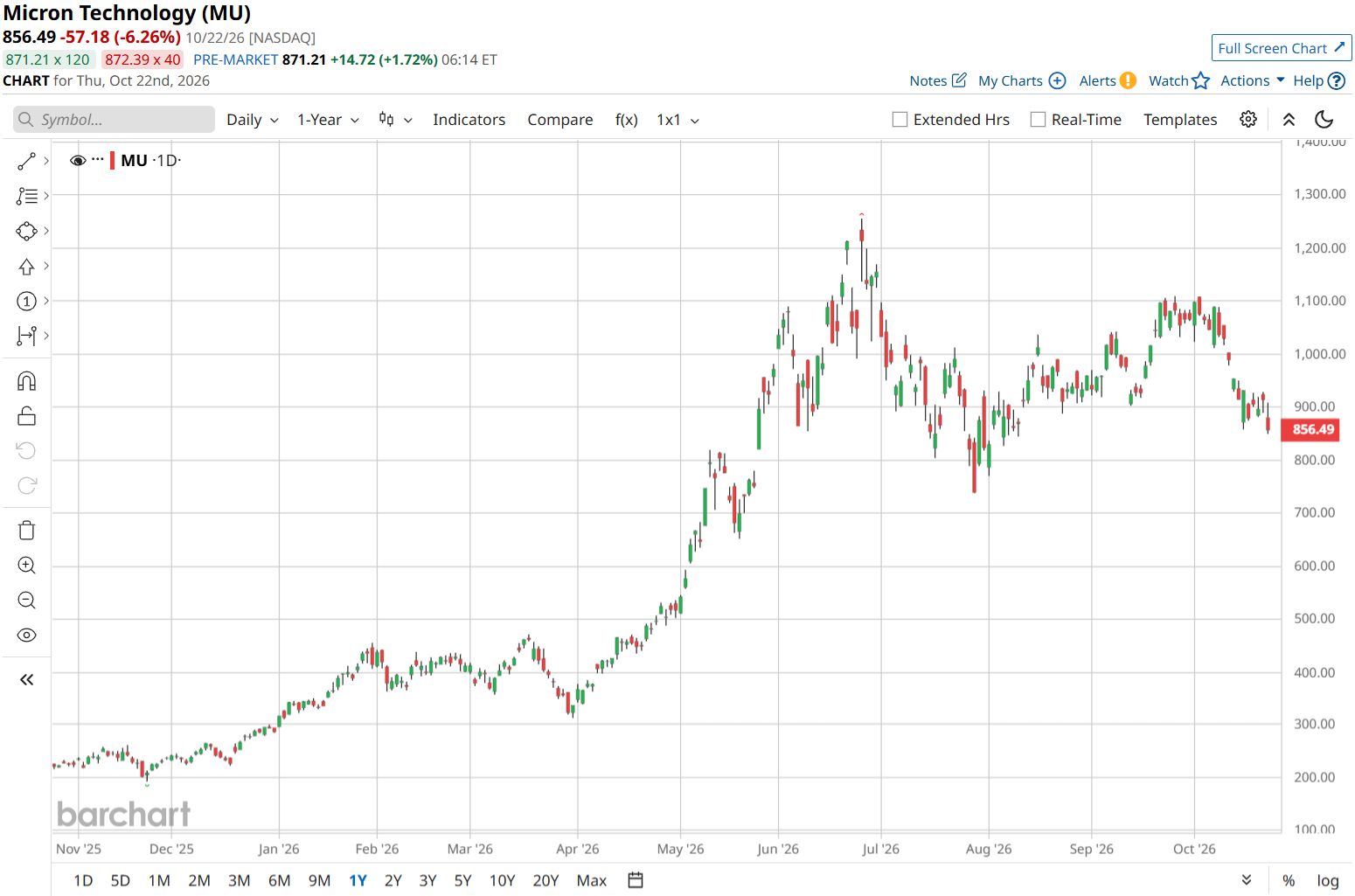
That strength has shown up in the stock. MU is up 331.55% over the past 52 weeks and 200.09% year to date.
 www.barchart.com
Micron Technology has also signed 16 customer agreements covering data centers, consumer devices, and automotive markets. Those deals include $22 billion in commitments and $18 billion in cash deposits. The company is also preparing HBM4E memory for volume production in 2027 and has expanded its share buyback authorization to $35.16 billion. Broader repurchases, however, remain restricted until Dec. 9.
Analyst Ratings and the Road Ahead
Micron Technology is expected to report earnings on Dec. 16. Analysts expect Micron Technology to earn $37.93 per share for the November 2026 quarter, up from $4.61 a year earlier. For fiscal 2027, the average estimate is $177.03 per share, up 136.51% from $74.85 in fiscal 2026.
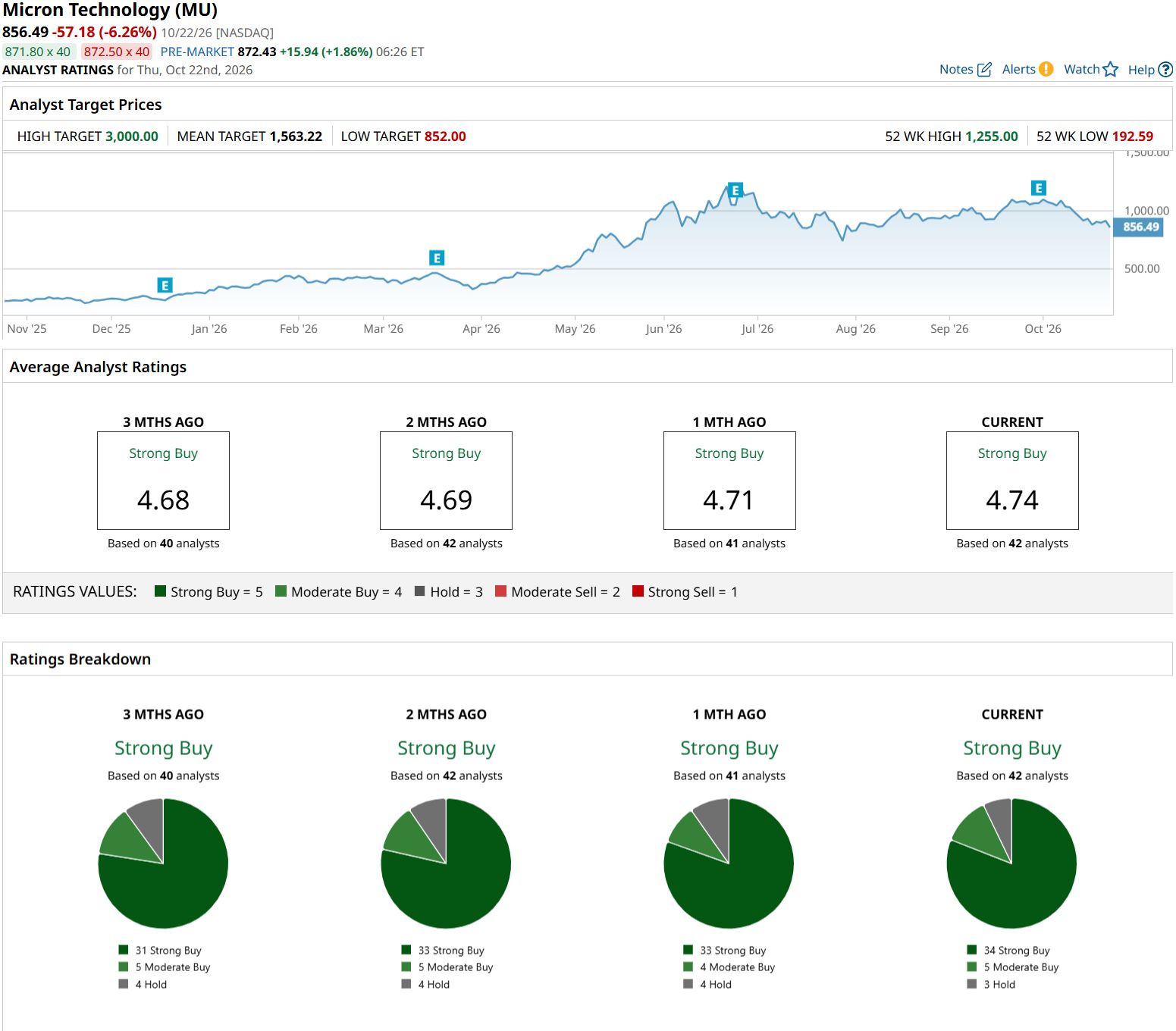
Wall Street remains very bullish. D.A. Davidson analyst Gil Luria kept a Buy rating and raised his price target to $3,000 from $2,100 on Oct. 7. He expects memory demand to stay ahead of supply through 2027 and 2028, helped by Micron Technology’s long-term customer deals and rising profits. Baird analyst Tristan Gerra also kept an Outperform rating and raised his target to $1,520, citing stronger demand for AI memory, tight DRAM supply, and more sales of higher-margin HBM chips.
Overall, all 42 analysts surveyed rate MU a consensus “Strong Buy”, with an average price target of $1,563.22, implying 82.51% upside from current levels.
 www.barchart.com
Conclusion
The Taichung agreement is a positive development for Micron because it reduces the risk of an immediate disruption at an important Taiwan manufacturing site, but does not fully settle the company’s broader labor situation as the Taoyuan union remains in dispute. Still, MU’s near-term direction will likely be driven more by memory pricing, AI-related HBM demand, production execution, and December earnings than by this localized agreement alone. With earnings expectations and analyst targets exceptionally high, shares could remain volatile after a huge run. Even so, the balance of evidence points to a constructive longer-term outlook if Micron meets its guidance and avoids further Taiwan labor disruptions.
On the date of publication, Ebube Jones did not have (either directly or indirectly) positions in any of the securities mentioned in this article. All information and data in this article is solely for informational purposes. For more information please view the Barchart Disclosure Policy here.
More news from Barchart
Micron’s Taiwan Unit Reached a Deal With the Taichung Union. Here’s What to Know. IBM’s CEO Just Issued a Warning Message on AI Spending. He Ended Up Hurting His Own Stock. What the New Class C Share Structure Actually Means for Meta Platforms Stock Investors Lockheed Vs. RTX: The Cheaper Defense Giant Is The Clear Value Win