

When automakers unveil a new car, they usually promise better mileage, faster acceleration, or a sleeker design. Elon Musk apparently looked at that checklist and decided it was far too ordinary. On Oct. 15, Tesla (TSLA) showcased its long-awaited Roadster at a SpaceX (SPCX) facility in Texas, complete with dramatic aerial stunts powered by SpaceX-developed thrusters. Yes, a car that briefly lifts off the ground. Because apparently, driving fast is no longer enough.
Tesla has outlined three Roadster versions, each with a different level of ambition: Performance for the road, Thrust for the track, and Rocket for the air. The Performance model is designed for regular road use, while Thrust adds rear-mounted cold-gas thrusters that use compressed air to boost acceleration. The invite-only, single-seat Rocket takes things further, with multiple thrusters designed for brief flight-like maneuvers. However, Tesla has yet to confirm final prices, full production specifications, or customer delivery dates.
Don’t Miss a Day: From crude oil to coffee, sign up free for Barchart’s best-in-class commodity analysis.
Musk has suggested the car could reach production in 2028, nearly a decade after the initial second-generation Roadster was first unveiled. For now, though, the gravity-defying demonstrations are brief, and the flying feature is hardly something commuters should expect to use on their morning drive.
The bigger question is whether this futuristic showcase can do much for Tesla stock. TSLA stock has struggled over the past year, pressured by concerns about electric vehicle (EV) demand, rising costs, and heavy investments in artificial intelligence (AI) and robotics. The Roadster reveal briefly sparked excitement, but TSLA stock soon gave back its gains as investors weighed the spectacle against its limited near-term financial impact.
Some Wall Street analysts largely see the Roadster as a “halo car” — a chance to revive Tesla’s premium image and showcase its engineering ambitions rather than a major near-term revenue driver. Meanwhile, speculation about closer ties or a potential merger between Tesla and SpaceX has added another layer to the story.
Elon Musk has never been short on big ideas. But with Tesla shares under pressure, the question is whether a car that can briefly defy gravity can also lift investor confidence.
About Tesla Stock
Founded in 2003 and headquartered in Austin, Texas, Tesla has grown from an EV maker into a major player in clean energy, AI, and autonomous driving, boasting a market capitalization of $1.47 trillion. While vehicle sales remain its core business, Tesla is expanding into energy storage, Robotaxi services, and humanoid robotics through Optimus.
The company is also drawing attention with its next-generation Roadster, featuring a thruster system that has fueled comparisons to flying-car technology. Under CEO Elon Musk, Tesla continues to push the boundaries of mobility and automation.
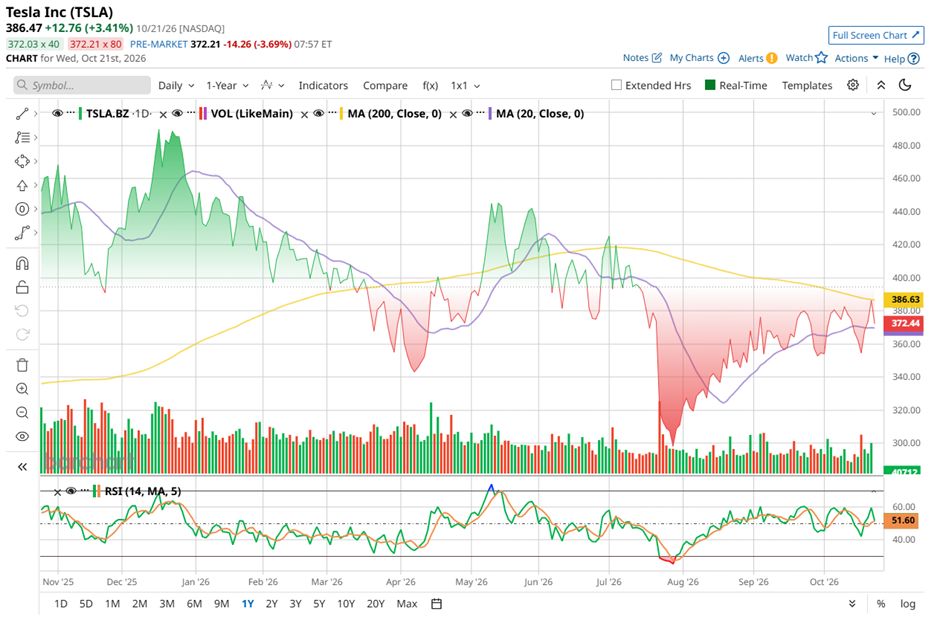
Tesla shares have had a bumpy ride from 2025 into 2026. After climbing to a record high of $498.33 in December 2025, TSLA stock lost steam, falling to a low of $297.38 in late July and currently down roughly 25% from its peak. The stock has slipped 17% over the past 52 weeks and dropped 17% on a year-to-date (YTD) basis, making Tesla the weakest performer among the “Magnificent Seven.” Softer EV demand, rising costs, and concerns over heavy spending plans have kept investors cautious, leaving TSLA stock moving largely sideways for months.
More recently, though, hopes surrounding potential Tesla-SpaceX merger discussions and better-than-expected third-quarter 2026 earnings and cash flow have brought buyers back. TSLA stock has gained 5% over the past five sessions, although the rally has been volatile, with the latest capex cut raising concerns about the pace of the company's AI and robotics expansion.
Technically, TSLA stock is holding above its 20-day moving average but remains below its 200-day average, suggesting some short-term strength without a full recovery. Trading volumes have been relatively light, although recent sessions have shown signs of buying interest. Meanwhile, the 14-day RSI sits around 51, firmly in neutral territory — neither overbought or oversold.
 www.barchart.com
The Roadster may be built to defy gravity, but Tesla's valuation is already reaching for the stars. The stock trades at 529 times forward earnings and 15.6 times sales, outpacing sector averages and historical medians. With investors pricing in ambitious growth, the challenge is whether Tesla’s futuristic ambitions can justify today’s sky-high expectations.
A Closer Look at Tesla’s Q3 Earnings Report
Tesla delivered mixed numbers for Q3 2026. For the quarter ended September 2026, the EV maker reported revenue of $28.05 billion, which was flat year-over-year (YOY), while non-GAAP EPS came in at $0.48, down 4% YOY from $0.50. Revenue fell just short of analyst estimates, but the bottom line beat expectations.
Tesla delivered 486,532 vehicles in Q3, including 478,237 Model 3 and Model Y units and 8,295 other models. Meanwhile, deployed energy storage totaled 13.7 gigawatt-hours. Automotive sales revenue declined 1% YOY to $20.1 billion, while total automotive revenue fell 3% to $20.6 billion. Energy generation and storage revenue also slipped 16% to $2.88 billion.
Cash generation, however, remained a bright spot. Tesla generated $6.3 billion in operating cash flow, while capital expenditures surged 110% to $4.73 billion. Free cash flow consequently dropped 62% YOY to $1.53 billion. Even so, cash, cash equivalents, and short-term investments increased 9% YOY to $45.45 billion.
Beyond the numbers, Tesla highlighted strong demand across several markets, including Canada, Australia, Japan, and Taiwan, where it achieved record quarterly deliveries. The company also reported record production at Gigafactory Berlin and said it remains focused on expanding output across its factories.
Its Full Self-Driving (FSD) business continued gaining traction, with record net new subscriptions and more than 75% of new North American deliveries including FSD subscriptions. Tesla also secured FSD approvals in Croatia, Slovenia, the Czech Republic, and Slovakia, bringing availability to nine countries in the European Union.
Meanwhile, Tesla is pushing ahead with its Robotaxi ambitions. The firm began deploying Cybercab vehicles into its Austin, Texas fleet and reached nearly 2 million cumulative unsupervised Robotaxi miles by quarter-end. Austin operating hours now run from 6:00 a.m. to midnight, with Tesla looking to reduce wait times through fleet expansion and improved operating algorithms. Cybercab also integrates Grok, allowing hands-free management of inboxes, calendars, files, chats, and more alongside entertainment features.
Looking ahead, Tesla said it maintained momentum across AI, robotics, and renewable energy projects. Its core business also continued generating more than $100 billion in trailing 12-month revenue for the second consecutive quarter.
Tesla has lowered its 2026 capex forecast to around $20 billion from its earlier estimate of more than $25 billion, a cut of roughly 20%. The revised outlook comes as the company’s spending on AI and robotics falls short of Wall Street’s expectations. However, Tesla has not explained which projects or areas will see lower spending.
Analysts tracking Tesla predict EPS to decline 35% YOY to $0.71 in fiscal 2026, before rising 66% YOY to $1.18 in fiscal 2027.
What Do Analysts Expect for Tesla Stock?
The recent Roadster unveiling has given Wall Street something new to talk about, although analysts are not expecting the futuristic car to transform Tesla's near-term financials.
Yorkville Ives analyst Dan Ives believes the Roadster may do little to boost sales or revenue if production remains limited. However, Ives sees it as a way to restore Tesla’s brand image and showcase its engineering capabilities. Ives estimates an 80% chance that Tesla and SpaceX combine by the end of 2027, with the Roadster's SpaceX thrusters reviving merger speculation.
Cantor Fitzgerald has an “Overweight” rating and a $485 price target following the unveiling. While the firm called the demonstration breathtaking, it does not expect the event to materially affect Tesla’s bottom line.
Meanwhile, UBS raised its price target to $425 from $391 after Q3 results but kept a “Neutral” rating. UBS lifted its 2027 and 2028 EPS estimates, citing stronger FSD adoption, and also sees opportunities in energy storage and Robotaxi.
Piper Sandler recently raised its price target to $475 from $450 and reiterated an “Overweight” rating. The brokerage firm said Tesla’s results compared favorably with expectations, with several profit drivers improving. It also highlighted progress in Robotaxi and FSD.
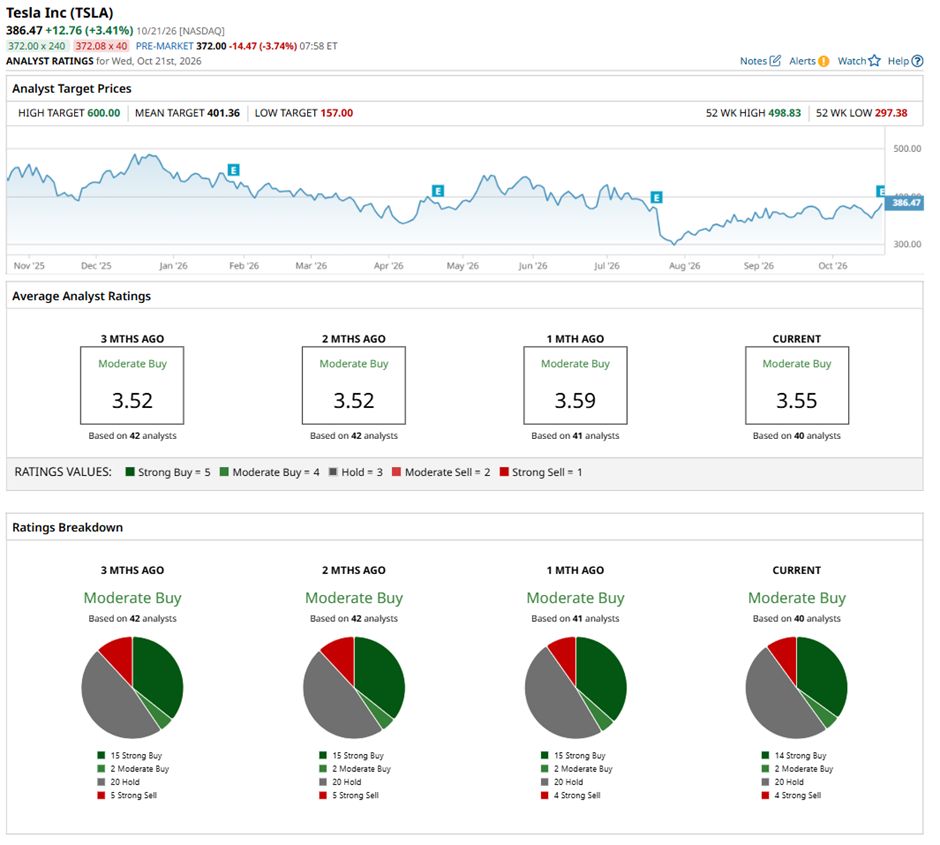
Taken together, analysts see promise in Tesla’s AI, autonomy, energy business, and brand appeal, but the Roadster itself is unlikely to deliver an immediate earnings boost. Analysts are bullish with a dash of caution when it comes to TSLA stock, offering a consensus “Moderate Buy” rating overall. Of the 41 analysts covering the stock, 14 recommend a “Strong Buy,” two have a “Moderate Buy,” 22 suggest a “Hold” rating, and three analysts have a “Strong Sell” rating.
The mean price target of $409.53 suggests potential upside of 10% from current levels. Meanwhile, the Street-high target of $600 implies TSLA stock could rise as much as 61% from here.
 www.barchart.com
On the date of publication, Sristi Suman Jayaswal did not have (either directly or indirectly) positions in any of the securities mentioned in this article. All information and data in this article is solely for informational purposes. For more information please view the Barchart Disclosure Policy here.
More news from Barchart
How to Play the Brutal Selloff in CoreWeave Stock Tesla Is Betting on a Flying Car to Combat Its Stock Slump Wedbush Gives a Thumbs Up to Super Micro’s Preliminary Q1 Results. Troubles for SMCI Stock Could Finally Be in the Rear-View. Comcast Q3 Results Show Peacock and Wireless Gains Amid Widening Broadband Losses