


Eli Lilly (LLY) is making billions from the weight-loss boom. But it’s no longer simply fighting for a bigger slice of the weight-loss drug market. It’s fighting to stay ahead of a growing army of rivals. Analysts forecast the weight-loss market to generate close to $100 billion in annual sales over the next decade.
Novo Nordisk (NVO) is striking back with Wegovy and Ozempic, while Amgen (AMGN), Roche (RHHBY), and Pfizer (PFE) are crafting new treatments that could shake up the market.
More Top Stocks Daily: Go behind Wall Street’s hottest headlines with Barchart’s Active Investor newsletter.
Amid the market’s AI selloff, Lily stock has climbed 19% so far this year and has done better than the overall market. On Oct. 29, the company will unveil its third quarter earnings, offering investors a front-row seat to see if its blockbuster drugs and its latest challenger, Foundayo, can keep the growth engine roaring or if rivals are finally closing in.
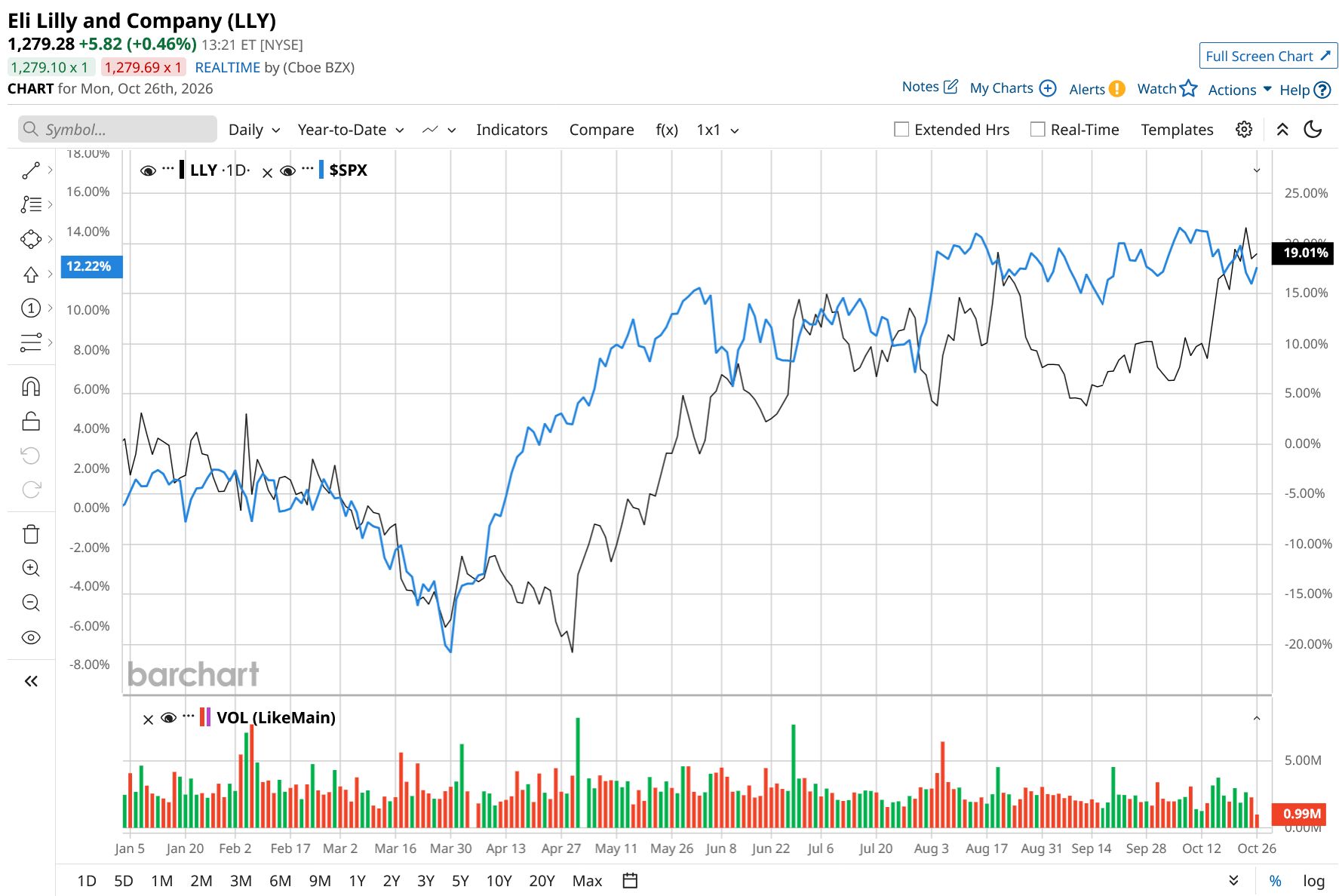 www.barchart.com
Mounjaro and Zepbound Are Carrying Enormous Expectations
Eli Lilly has made waves in the obesity market with its two blockbuster drugs, Mounjaro and Zepbound. These once-weekly injections activate the GIP and GLP-1 hormone receptors, helping regulate blood sugar and appetite. Notably, Mounjaro helps adults and children aged 10 and older with type 2 diabetes manage blood sugar. Zepbound is used alongside dietary changes and physical activity to help adults with obesity, or those carrying excess weight alongside a related health problem, achieve and maintain weight loss. Its approved uses also extend to adults with obesity who have moderate-to-severe obstructive sleep apnea, a condition that repeatedly interrupts breathing during sleep.
In the second quarter, Mounjaro generated nearly $9.9 billion in worldwide revenue, up 91% year-over-year (YoY), while Zepbound brought in about $4.9 billion in U.S. sales, up 41% YoY. Total revenue increased 48% from the year-ago quarter to $23 billion, while adjusted earnings climbed 33% to $8.38. Both drugs remain in high demand, though lower realized prices have tempered some of the volume gains. Looking ahead to the third quarter, investors are eager to see if prescription demand stays robust, if Lilly can expand access, and if sales growth will hold up against pricing pressures.
Novo Nordisk Is the Rival Lilly Cannot Ignore
Even a blockbuster medicine can hit a wall when affordability, reimbursement, or supply issues loom large, particularly in a fiercely competitive market. Novo Nordisk stands as Lilly's closest challenger in the battle for obesity and diabetes treatments, a rival it can’t ignore. Its portfolio includes Wegovy for weight management and Ozempic for type 2 diabetes.
And now the competition is expanding beyond injections. Novo's Wegovy pill and Lilly's oral medicine Foundayo offer patients alternatives to weekly shots. This could widen the market and intensify competition. Now, it’s not just about which company can deliver the most weight loss. Patients may also consider convenience, how well they tolerate the treatment, cost, and how easy it is to get the medicines.
Meanwhile, Amgen is advancing MariTide, its promising investigational obesity treatment, while Roche advances CT-388 and enicepatide, both poised to become strong contenders. Not to be left behind, Pfizer and Viking Therapeutics (VKTX) are also racing to develop new obesity therapies. That said, a promising clinical candidate is not the same as a medicine that has cleared regulatory review and successfully generated revenue. Lilly already has established products and a commercial infrastructure that new challengers might find hard to beat.
Foundayo and Retatrutide Could Set Up Lilly's Next Battle
Lilly is looking beyond just Mounjaro and Zepbound. With Foundayo, its oral obesity medicine, the company is expanding its lineup and opening the door for patients who prefer a pill over a shot. If oral medicines attract people who previously avoided injections, the overall market could grow even bigger.
Lilly is advancing retatrutide, an investigational treatment that targets three hormone receptors. The company plans a U.S. submission for obesity and related conditions in the first quarter of 2027. If the clinical and regulatory process succeeds, retatrutide could strengthen Lilly's position. However, investors should note that it is a pipeline asset, not an approved product. Furthermore, Eli Lilly is advancing its oncology pipeline. During the 2026 European Society for Medical Oncology (ESMO) Congress, Lilly presented new data on its investigational drug olomorasib, showing durable activity in previously untreated patients with KRAS G12C-mutant non-small cell lung cancer. If successful, this investigational drug could strengthen Lilly's efforts to expand beyond diabetes and obesity treatments into cancer care.
Lily is also using artificial intelligence (AI) to change how medicines are discovered, developed, and manufactured. In January 2026, the company unveiled a bold partnership with Nvidia (NVDA), pledging up to $1 billion over five years to create an AI co-innovation lab where scientists and engineers will craft models to pinpoint and refine promising drug candidates. Building on its AI supercomputer and the TuneLab platform, Lilly gives biotechnology companies access to predictive models shaped by its research data. The rewards, such as accelerating early-stage research, reducing costly missteps, and streamlining manufacturing, could be transformative. While AI cannot erase the clinical and regulatory challenges that determine a drug’s fate, these ambitious investments could propel Lilly to new heights, giving it an edge beyond its blockbuster weight-loss medicines.
The Next Earnings Report Will Be About More Than Beating Estimates
Lily’s stellar second quarter has set a new benchmark. Management responded by raising full-year revenue guidance to $85 billion to $87 billion and boosting the adjusted earnings-per-share outlook to $35.5 to $36.5. Nonetheless, the path ahead is becoming more difficult. Novo Nordisk is already a formidable rival, and other drugmakers like Amgen, Roche, and Pfizer are preparing their own challengers.
Investors would be wise to track not just Mounjaro and Zepbound sales but also to follow Foundayo's first steps in the market, shifts in pricing, manufacturing momentum, and the unfolding story of Retratutide's development. It will show whether Lily’s long-term growth story can survive a much more crowded market.
Wall Street maintains an overall consensus “Strong Buy” rating for LLY stock. Of the 29 analysts who cover the stock, 23 rate it a “Strong Buy,” three rate it a “Moderate Buy,” and three recommend a “Hold.” The average analyst price target of $1,360.79 suggests a 6% increase from current levels. Furthermore, the Street-high estimate of $1,600 implies that the stock could rally by up to 25% over the next year.
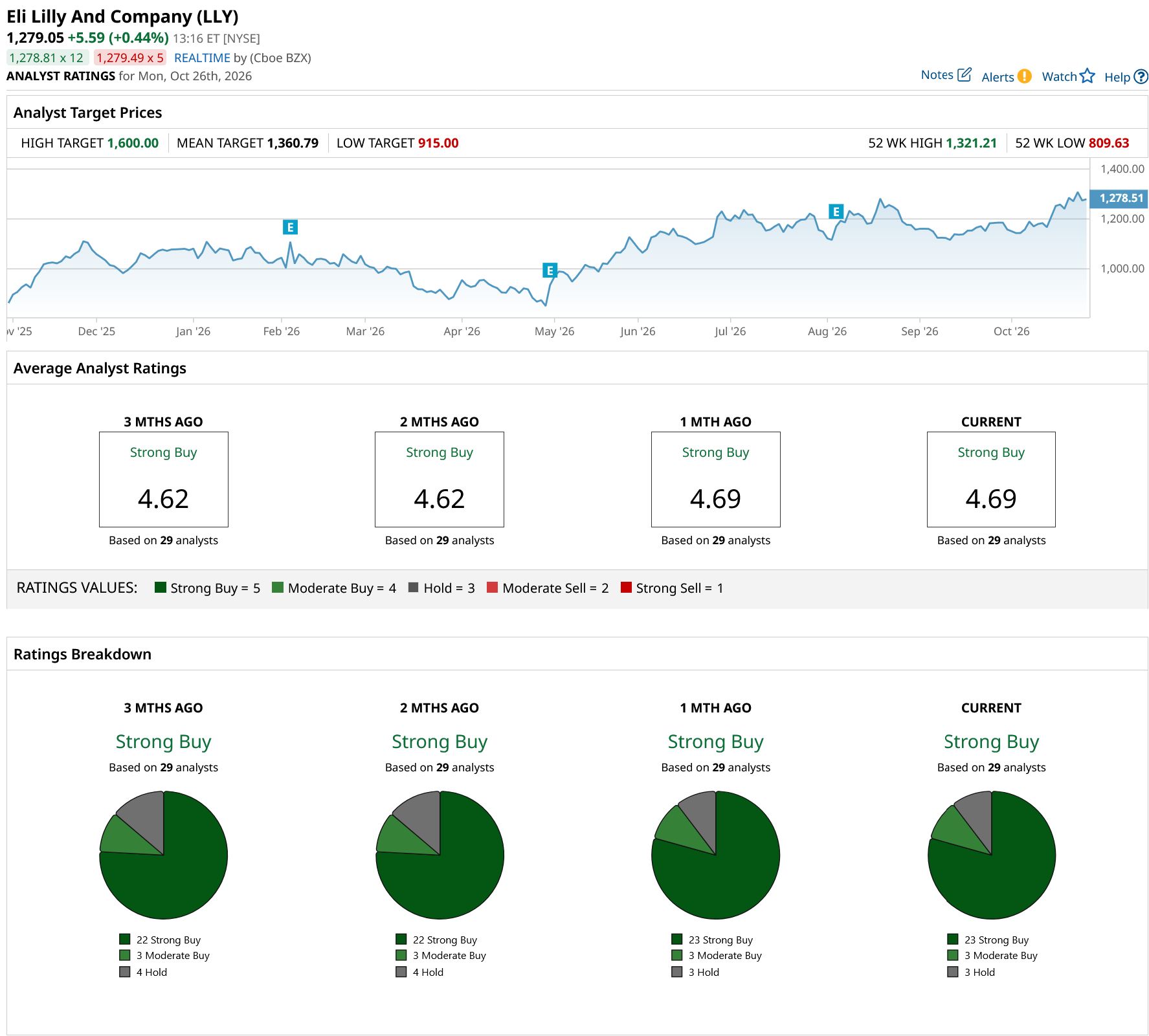 www.barchart.com
On the date of publication, Sushree Mohanty did not have (either directly or indirectly) positions in any of the securities mentioned in this article. All information and data in this article is solely for informational purposes. For more information please view the Barchart Disclosure Policy here.
More news from Barchart
Lumentum Just Scored a New 'Buy' Rating. Here's Why. Meta Stock Alert: Meta: The $25 Billion Legal Blow Investors Cannot Ignore A $95 Billion Reason Why META Stock Is in Focus Today How to Play Amazon Stock Before Q3 Earnings as the AI Trade Flounders