


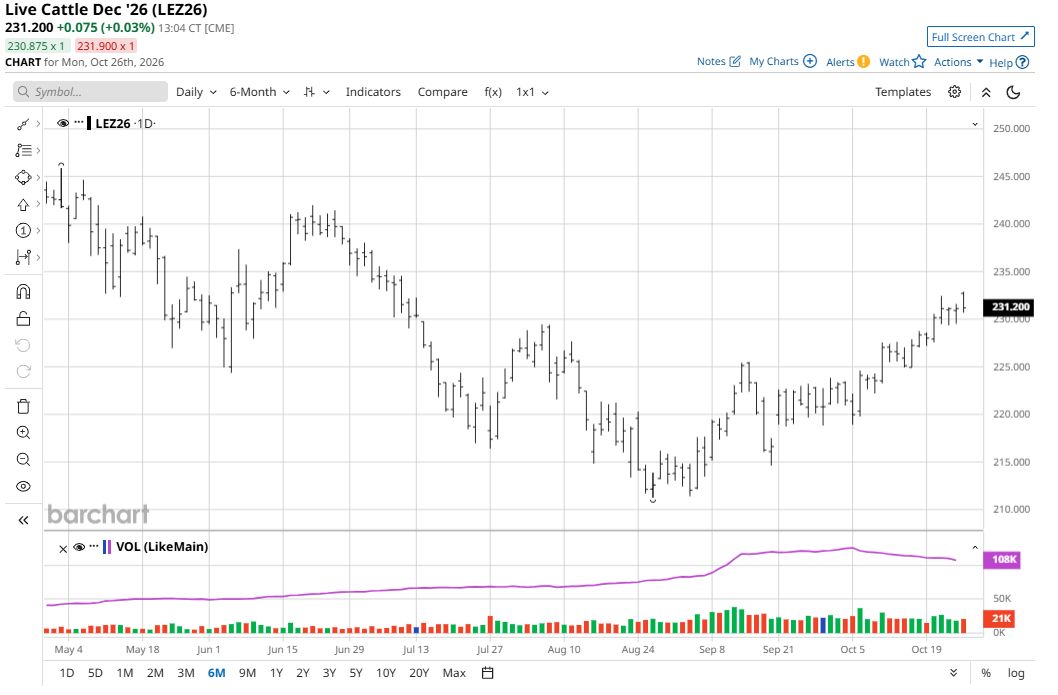
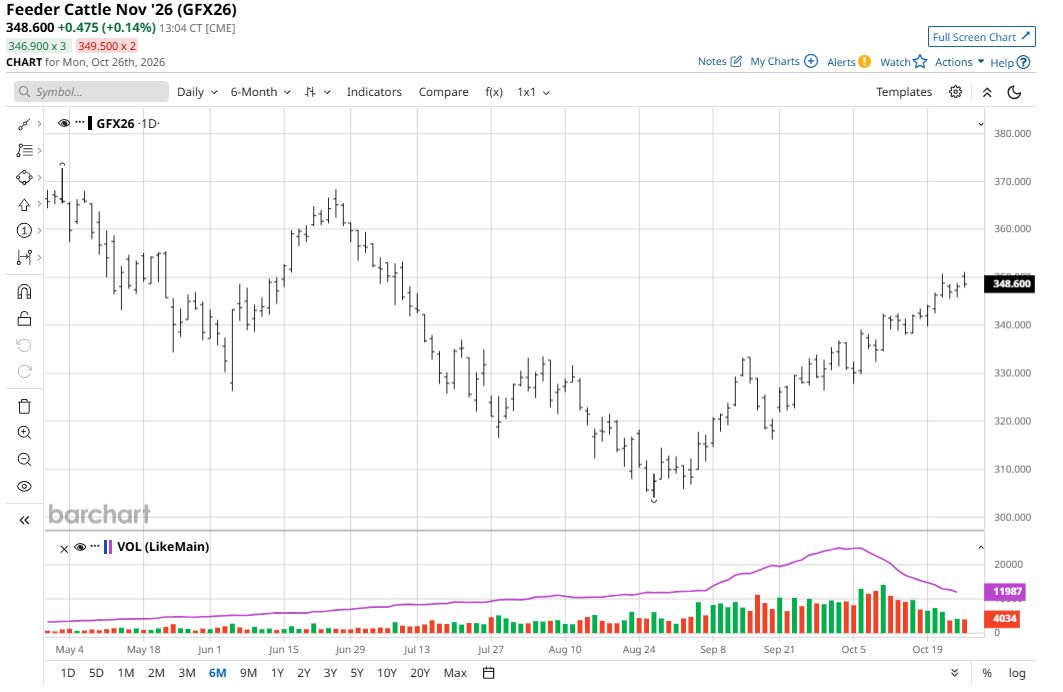
December live cattle (LEZ26) futures were posting slight gains in midsession trading Monday, while November feeder cattle (GFX26) futures were modestly up. Both futures markets hit 3.5-month highs following a bullish USDA monthly cattle-on-feed report released Friday afternoon.
The USDA on Friday said the number of U.S. cattle on feed as of Oct. 1 fell less than 1% from a year ago, while placements decreased by 12%. September marketings were down 7% from a year ago. Inventory figures came in below analyst expectations, with placements also coming in sharply below expectations as well. Marketings came right in line with the average estimate.
Don’t Miss a Day: From crude oil to coffee, sign up free for Barchart’s best-in-class commodity analysis.
Cattle and calves on feed for the slaughter market in the U.S. for feedlots with capacity of 1,000 or more head totaled 11.4 million head on Oct. 1, 2026. The inventory was slightly below Oct. 1, 2025. The inventory included 7.07 million steers and steer calves, up slightly from the previous year. This group accounted for 62% of the total inventory. Heifers and heifer calves accounted for 4.30 million head, down 1% from 2025.
Placements in U.S. feedlots during September totaled 1.78 million head, 12% below 2025. Net placements were 1.73 million head. Placements were the lowest for September since the series began in 1996. During September, placements of cattle and calves weighing less than 600 pounds were 360,000 head, 600-699 pounds were 260,000 head, 700-799 pounds were 385,000 head, 800-899 pounds were 422,000 head, 900-999 pounds were 255,000 head, and 1,000 pounds and greater were 95,000 head.
Marketings of fed cattle during September totaled 1.52 million head, 7% below 2025. Marketings were the lowest for September since the series began in 1996. Other disappearance totaled 49,000 head during September, 4% below 2025.
 www.barchart.com
 www.barchart.com
Speculator buying interest in the live cattle futures markets accelerated after solidly higher cash cattle trade was reported early last week for the week prior, while wholesale beef values firmed as consumer demand has remains resilient.
Meanwhile, herd rebuilding continues to lag, which reinforces a price-constructive fundamental backdrop and limits the prospect of a rapid supply recovery.
Feeder cattle futures have seen buying support from the decline in the grain futures prices, which is conducive to improved margins for cattle feeders.
Steady, solid demand for beef at the meat counter in recent months has also kept cattle futures markets elevated. Even with heightened inflation concerns, including higher energy prices, most consumers are still stepping up to the meat counter and preferring beef over other proteins. The U.S. economy appears to be showing enough strength to keep consumers mostly upbeat despite higher gasoline prices at the pump. Such suggests retail demand for beef will continue strong in the coming months — barring any major, sustained setback in the U.S. stock market.
Lean Hog Futures Bears Remain in Command
December lean hog (HEZ26) futures Monday hit another contract low as prices have been trending down on the daily bar chart since late July, prompting sustained technical selling pressure. The CME cash hog index and cash hog prices continue to trend down, also. The latest CME lean hog index is down 99 cents to $71.16.Tuesday’s projected cash index price is down another $1.08 to $70.08. The national direct five-day rolling average cash hog price quote for Monday is $66.99.
Technical and fundamental challenges continue to roil short-covering interest in lean hog futures. Pork cutout continues to linger around multi-year lows amid pressure from weaker consumer demand. Rising energy costs and softer consumer sentiment have weighed heavily on pork, even as production runs slightly below year-ago levels. Managed money remains heavily short lean hog futures, which has curbed sustained small speculator buying interest and limited follow-through strength in futures.
Ample frozen U.S. pork stocks and cheaper alternative proteins continue to overshadow pork at the meat counter. Heavier carcass weights have offset much of the year-over-year decline in hog inventories.
A sustained recovery in cash hogs and futures depends on better evidence that smaller supplies are tightening pork production. Demand for U.S. pork abroad has also been unremarkable and will likely need to improve in the coming months to help revive the presently depressed lean hog futures bulls.
Let me know what you think! I enjoy hearing from my valued Barchart readers worldwide. And I answer all your emails. Email me at jim@jimwyckoff.com.
On the date of publication, Jim Wyckoff did not have (either directly or indirectly) positions in any of the securities mentioned in this article. All information and data in this article is solely for informational purposes. For more information please view the Barchart Disclosure Policy here.