

Robust CPU demand continues to power key semiconductor players through volatile hardware cycles. As server upgrades and enterprise refreshes fuel steady volume growth, strong microprocessor momentum is helping offset broader market fluctuations and providing a reliable baseline for upcoming quarterly earnings results.
Positioned to benefit from this computing tailwind, Advanced Micro Devices (AMD) is expected to showcase its CPU strength when reporting earnings on Nov. 3. Let's take a closer look.
More Top Stocks Daily: Go behind Wall Street’s hottest headlines with Barchart’s Active Investor newsletter.
About Advanced Micro Devices
Advanced Micro Devices is a leading semiconductor company developing high-performance CPUs, GPUs, artificial intelligence (AI) accelerators, and adaptive computing solutions. Its product portfolio includes EPYC server processors, Ryzen PC chips, and Instinct data-center GPUs.
As AI, cloud computing, and high-performance computing (HPC) expand, AMD is competing to capture a larger share of the growing AI chip and data-center infrastructure market.
AMD Stock Shines Amid Strong Demand
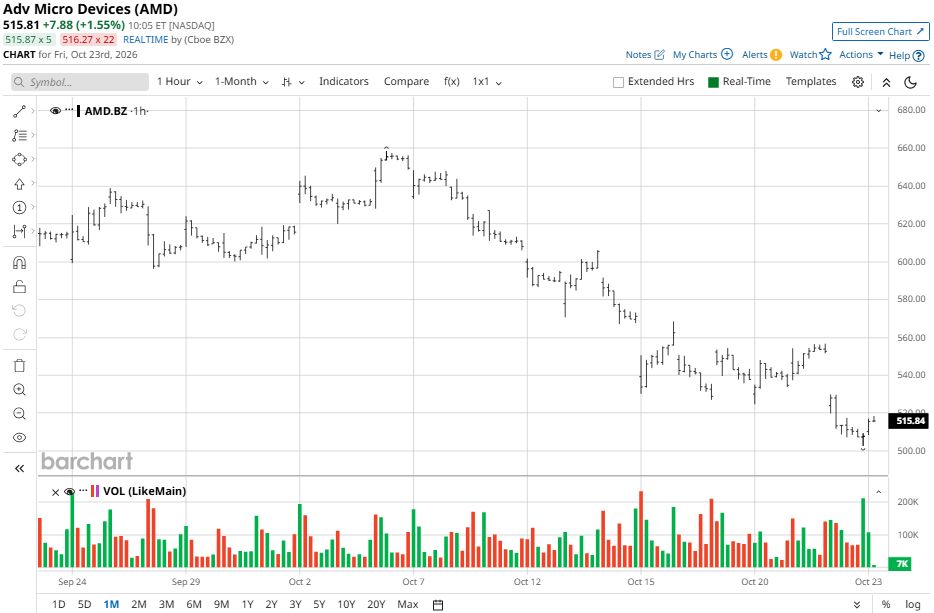
AMD stock has attracted significant investor attention in 2026 as demand for AI chips, data-center processors, and accelerated computing continues to expand. Shares have gained approximately 148% year-to-date (YTD), substantially outperforming the broader market. However, AMD stock has experienced considerable volatility, declining 16% over the last month amid concerns around elevated semiconductor valuations and the sustainability of AI-related investment.
AMD has significantly outperformed the broader equity market in 2026, with the S&P 500 ($SPX) posting a 12% YTD advance. This comparison highlights investor enthusiasm for AMD's AI computing opportunity, although the stock's recent monthly decline underscores its higher volatility.
 www.barchart.com
AMD's Q2 Results Beat Estimates
AMD reported second-quarter fiscal 2026 revenue of $11.54 billion, up 50% year-over-year (YOY) and ahead of analyst estimates of approximately $11.31 billion. Non-GAAP diluted EPS reached $1.66, exceeding the consensus estimate of $1.62 and increasing substantially from $0.48 in the prior-year period. The Q2 results reflected strong demand for AMD's EPYC server CPUs and Instinct AI accelerators as businesses and cloud providers continued investing in AI infrastructure, and reinforced AMD's position as a growing competitor in the AI semiconductor market.
The company's Data Center segment was the primary growth driver in Q2, generating $6.7 billion in revenue, up 107% YOY and accounting for approximately 58% of total sales. The Client and Gaming segment also recorded combined revenue of $3.8 billion, up 6% YOY, while the Embedded segment contributed $977 million, up 19% YOY. On a non-GAAP basis, gross margin reached 56%, operating income rose to $3.1 billion, and net income climbed to $2.8 billion. These figures highlight improving profitability as AI infrastructure demand supports higher sales, although gaming revenue remained under pressure from weaker semi-custom demand.
Looking ahead, management forecast Q3 fiscal 2026 revenue of approximately $13 billion, plus or minus $300 million, implying around 41% YOY growth and a 13% sequential increase. Non-GAAP gross margin was projected at approximately 56%.
CEO Lisa Su highlighted accelerating demand for EPYC processors, expanding Instinct GPU deployments, and the planned ramp-up of the Helios rack-scale AI platform. Management expects continued growth in data-center sales to support overall revenue expansion and earnings improvement.
Wedbush Highlights Server Growth and AI Accelerators Ahead of Results
AMD is set to report Q3 earnings on Nov. 3, with Wedbush identifying server CPU demand and its Helios AI accelerator rollout as key growth drivers. Analyst Matt Bryson expects the server processor business to potentially outperform estimates as demand for computing power linked to agentic AI continues to exceed supply.
While management forecast Q3 revenue of approximately $13 billion, Wedbush projects $13.02 billion in revenue for the quarter and adjusted EPS of $1.93, slightly below consensus expectations. Bryson maintains an “Outperform” rating and a $600 price target for AMD stock, highlighting the importance of the company's 2027 data-center outlook, Helios shipment volumes, and planned MI450 GPU deployments with Anthropic.
Investors will want to closely monitor updates for signs of sustained AI semiconductor growth.
Should You Invest in AMD?
AMD offers compelling growth potential through rising AI infrastructure spending, strong server CPU demand, and its expanding Helios accelerator business. Wedbush maintains an “Outperform” rating with a $600 price target, identifying server processors and future AI deployments as potential earnings catalysts.
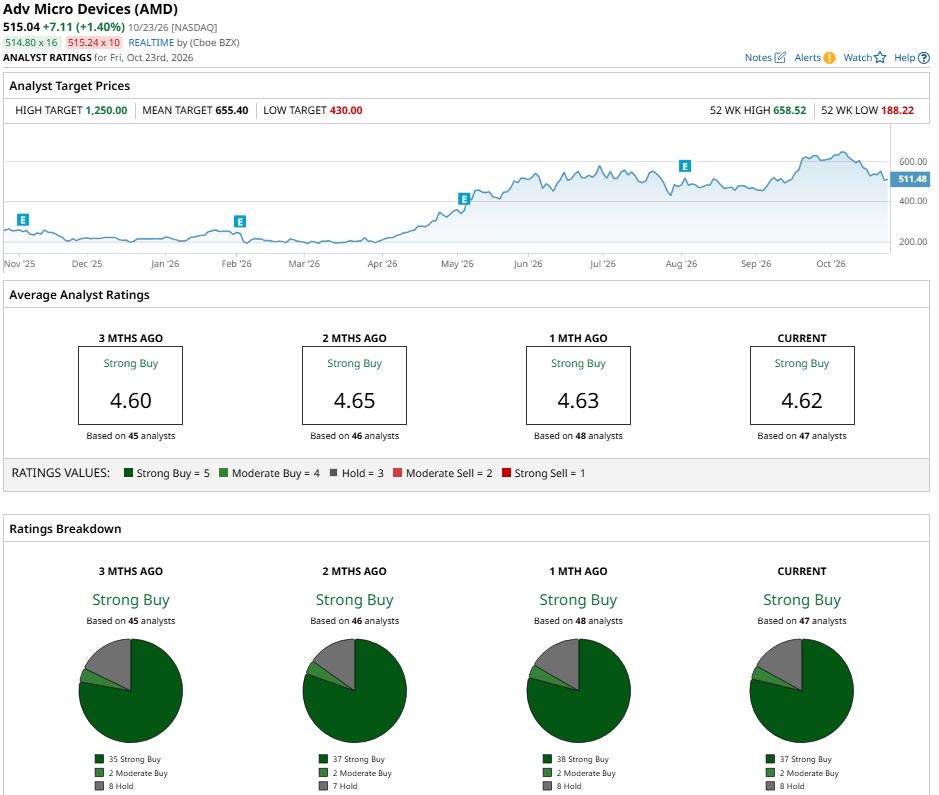
Meanwhile, AMD has a consensus “Strong Buy” rating based on 47 analysts with coverage. Of those analysts, 37 have a “Strong Buy” rating, two have a “Moderate Buy,” and eight analysts have a “Hold” rating. The mean price target of $655.40 implies approximately 23% potential upside from current levels.
Investors should weigh AMD's growth prospects against semiconductor competition, valuation risks, and execution challenges before investing in shares.
 www.barchart.com
On the date of publication, Ruchi Gupta did not have (either directly or indirectly) positions in any of the securities mentioned in this article. All information and data in this article is solely for informational purposes. For more information please view the Barchart Disclosure Policy here.
More news from Barchart
Here’s the 1 Indicator I’m Watching to See if the S&P 500 Is About to Enter a Correction… or Come Crashing Down Wedbush Sees Server CPU Demand as Key Earnings Growth Driver. What That Means for AMD Stock Ahead of November 3. Why Retirement Investors Should Prioritize 5% Returns on Bonds, Not Wildly Aggressive Stock Picks Blackmail, Self-Preservation, and Politics: 3 Unusual Risks That Cloud Anthropic’s IPO