


The artificial intelligence (AI) boom has fueled extraordinary demand for computing power, putting companies that supply the infrastructure behind AI development in the spotlight. Among them is Nebius Group (NBIS), a fast-growing neocloud provider that has emerged as a notable beneficiary of the AI infrastructure spending surge.
Now, Nebius is looking to build on that momentum with a new approach to selling its GPU computing capacity. The company recently announced live spot pricing, allowing customers to access GPU resources at prices that fluctuate with supply and demand rather than being limited to traditional purchasing options. The move marks an interesting development in Nebius’s evolving business model as the company seeks to give customers greater flexibility in purchasing AI computing power.
More Top Stocks Daily: Go behind Wall Street’s hottest headlines with Barchart’s Active Investor newsletter.
For NBIS investors, the development raises several important questions. Could live spot pricing help Nebius extract greater value from its expanding GPU infrastructure, or might the potential benefits come with meaningful trade-offs? More importantly, does this move add another reason to be optimistic about NBIS stock’s long-term prospects? Let’s take a closer look.
About Nebius Group N.V. Stock
Nebius Group N.V. is a Netherlands-based technology company. The company was spun out of the international operations of Russian technology group Yandex. NBIS is focused on building a comprehensive AI infrastructure to serve the global AI industry, with major operations across Europe, North America, and Israel. It is one of numerous so-called “neoclouds,” smaller cloud computing providers that supply infrastructure capacity for AI workloads. Beyond its core AI infrastructure business, Nebius also owns subsidiaries including Avride, Toloka, and TripleTen, which specialize in autonomous driving technology, AI data services, and educational technology, respectively. Its market cap currently stands at $43.5 billion.
Shares of the neocloud company have jumped 94% year-to-date (YTD), thanks to major AI infrastructure deals, explosive revenue growth, Nvidia’s (NVDA) strategic investment, and soaring demand for GPU computing capacity. However, the stock has retreated sharply this month amid mounting concerns about debt-funded expansion across the AI infrastructure sector.
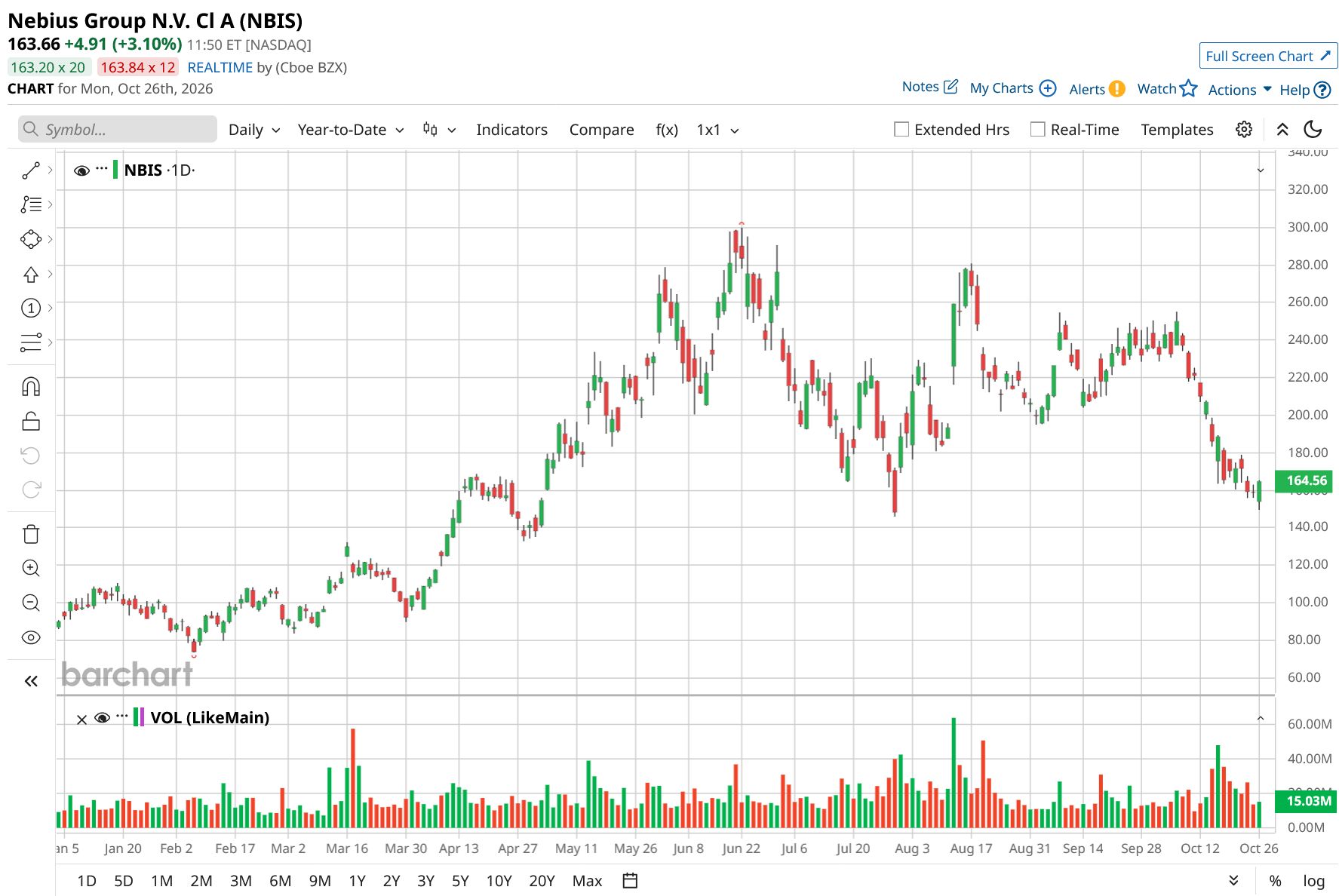 www.barchart.com
Nebius Moves Beyond Traditional GPU Contracts With Flexible Pricing
Last Wednesday, Nebius announced that its GPU computing capacity is available at live spot pricing, allowing customers to track price changes and choose more flexible purchasing options. The move came after the company introduced dynamic spot pricing for preemptible virtual machines (VMs), which took effect on Oct. 8.
Here is the new pricing structure:
Live spot pricing: The price for renting GPUs varies based on available capacity and customer demand, enabling customers to utilize discounted computing resources that can be interrupted. Reserve auctions: Customers can reserve certain blocks of GPUs for shorter periods. Pay-as-you-go: Customers can buy computing power on demand without a fixed-term reservation. Capacity rebates: Nebius is piloting a program that allows customers to recover value by returning unused GPU capacity to the available pool.The company also announced plans to expand its AI Builder Program across Europe, including an additional $10 million in compute grants and further collaboration with Nvidia.
With that, Nebius’ move to introduce live spot pricing signals the company’s ambitions to create a more flexible marketplace for AI compute power, going beyond just renting out GPUs under standard contracts.
Spot Pricing Could Help Nebius Extract More Value From Its GPU Fleet
GPUs are quite expensive. That should be familiar to anyone who owns a PC, where the GPU is often the most expensive component. However, AI GPUs are far pricier than their consumer counterparts, and their economic value depends heavily on how consistently they are used. So, every hour an AI GPU sits idle represents a missed opportunity to make money.
Nebius’s new spot pricing mechanism could help address this issue by allowing the company to sell temporarily idle GPU capacity at rates determined by real-time supply and demand. For example, imagine that Nebius has GPU capacity available between larger customer workloads. Instead of allowing that capacity to sit idle, Nebius could offer it at discounted rates to smaller AI developers running experiments, processing data, or improving models.
The approach is relatively similar to airlines offering discounted fares to fill seats that would otherwise remain empty. Notably, Nebius listed spot prices for Nvidia HGX B300 starting at $0.99 per GPU-hour as of Oct. 25, well below the effective on-demand rate of $9.50. While the discount is substantial, it comes with an important caveat: Nebius can reclaim spot instances with just 60 seconds’ notice if the capacity is needed for on-demand customers.
Meanwhile, the company has not quantified how much additional revenue or profit it expects to generate from the strategy. While spot pricing could improve GPU utilization, the key question is whether those gains would be sufficient to offset the lower realized price per GPU-hour. So, let’s consider a simple example.
Nebius has not disclosed a precise utilization rate across its GPU fleet, although it cited improving utilization as one of the factors driving AI cloud revenue growth in Q2. Assuming the company’s GPU fleet operates at 75% utilization with an average realized price of $4 per hour, it would generate $3 in revenue per available GPU-hour. If spot pricing raises utilization to 90% but lowers the blended realized price to $3.50, revenue would increase to $3.15 per available GPU-hour. And because many data center operating expenses are fixed regardless of GPU utilization, much of that additional $0.15 in hourly revenue could translate into incremental profit.
A Powerful Customer Acquisition Tool for Nebius
Another bullish implication is that Nebius could reach a broader customer base via flexible pricing. Not all AI companies have the financial resources to reserve large blocks of GPU capacity under long-term contracts. Smaller AI startups, research teams, and developers often have more variable and less predictable computing needs. They may require substantial GPU capacity for just a few hours or days, with little need for those resources once their workloads are complete.
Nebius is essentially giving these customers a lower-cost entry point into its cloud. The approach could also create longer-term customer acquisition opportunities. A startup could begin by using Nebius’s discounted computing capacity for noncritical workloads. As its applications develop and computing needs grow, it could shift toward higher-value reserved capacity or managed AI services.
As a result, the approach could help Nebius turn smaller, price-sensitive customers into larger, more profitable enterprise clients over time. In this context, spot pricing could serve a dual purpose: improving GPU utilization and creating opportunities to attract higher-value customers.
Conclusion
All in all, I believe Nebius’s move to introduce live spot pricing is a positive development for NBIS stock’s long-term investment case. It essentially gives the neocloud another way to monetize its rapidly expanding GPU infrastructure. If the strategy works out, boosting utilization without significantly eroding blended pricing, Nebius could generate more revenue from its existing GPU capacity and improve the economics of its data center investments.
At the same time, the new pricing model could expand Nebius’s customer base by making its cloud infrastructure more accessible to startups, developers, and research teams that may not be ready to commit to long-term GPU reservations. Over time, some of these customers could migrate to higher-value services as their computing needs grow.
On the date of publication, Oleksandr Pylypenko had a position in: NVDA . All information and data in this article is solely for informational purposes. For more information please view the Barchart Disclosure Policy here.
More news from Barchart
Nebius Launches Live Spot GPU Pricing. Here’s What It Means for NBIS Stock. Bearish Setups Alert: October 27th Bear Put Spread Scan Results U.S. Futures Climb as Oil Falls on Iran Peace Hopes, Chip Stocks Extend Gains; FOMC Meeting on Tap This Utility Stock Just Raised Its Dividend by 2%