

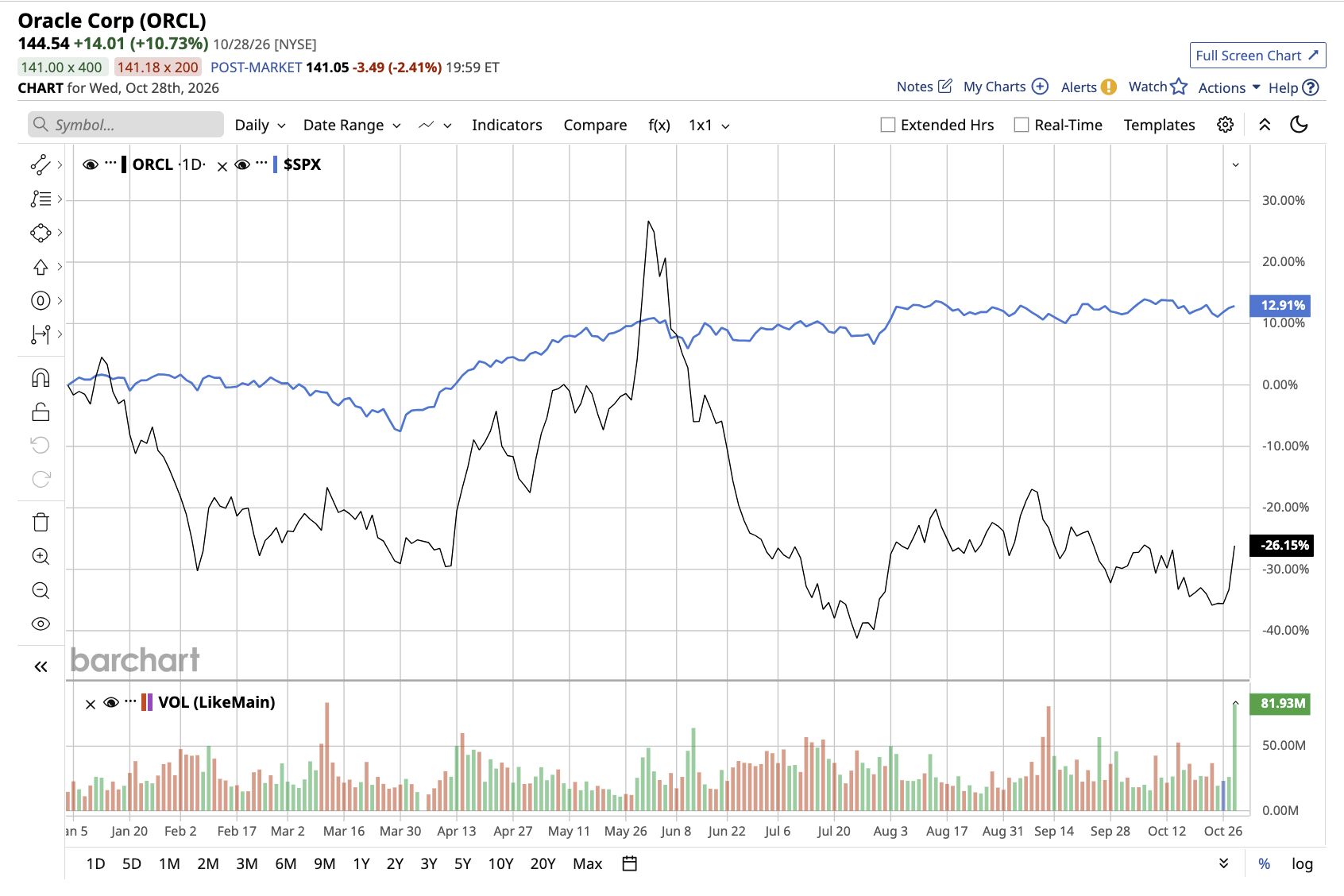
Oracle (ORCL) stock just gave investors a reason to pause before selling. After a brutal year for the shares, a fresh set of forecasts during its Investor Day event has reignited hopes that the company’s expensive AI ambitions could deliver serious cash flow. Oracle stock jumped 10.73% on October 28, closing at $144.54, though it remained down roughly 26% year to date. The rebound is significant, but one good day does not erase the risks.
However, before completely giving up on Oracle, investors should consider answering these three questions.
More Top Stocks Daily: Go behind Wall Street’s hottest headlines with Barchart’s Active Investor newsletter.
 www.barchart.com
1. Can Oracle Turn Its AI Spending Into the Revenue Growth It Is Promising?
At its latest Investor Day, management didn’t hold back, unveiling a bold vision. Oracle projects that its annual revenue will surpass $225 billion by fiscal 2030, representing average annual growth of more than 35% from fiscal 2026 levels. The company also doubled down on its fiscal 2027 targets of at least $90 billion in revenue and adjusted earnings per share of $8.10, in line with the consensus estimates. While these are forecasts, they give investors a clear sense of how high Oracle is aiming.
The opportunity goes beyond simply renting computing power to AI companies. Oracle combines cloud infrastructure, enterprise databases, and business applications into a powerful ecosystem. This matters because companies developing AI tools rely on reliable data storage, stable database services, and dependable software to keep operations running efficiently. Oracle’s leadership sees these businesses amplifying each other. AI workloads drive demand for cloud capacity and database services. Meanwhile, AI-powered applications unlock new opportunities to sell subscriptions and services. For investors, this paints a richer growth story than a wager on data centers alone.
Oracle’s contracted business offers another bright spot. At Investor Day, management spotlighted a staggering $664 billion in remaining performance obligations, with over 90% tied to infrastructure. This figure, representing revenue already locked in but not yet recognized, points to healthy demand for Oracle’s future services. Still, it is important not to confuse it with immediate revenue.
The only challenge now is execution. Oracle must build capacity, bring it online, and deliver the services customers contracted for. Management plans to add about 7 gigawatts of capacity over the next two years. They target a portfolio of roughly 10 gigawatts by the end of fiscal 2028. If Oracle delivers that capacity on schedule and converts its backlog into revenue, the long-term growth targets become more credible. Delays, cost overruns, or slower customer deployment would weaken that case.
2. Will Oracle’s Capital Spending and Financing Needs Remain Under Control?
This lingering question has tested investors’ patience, which may be why the stock has struggled this year. Building AI infrastructure requires large upfront spending, yet revenue and cash flow regularly lag. Investors fear Oracle may have to repeatedly tap debt and equity markets to fuel its ambitions, which may reduce future growth rewards for existing shareholders. The company already has a high debt-to-equity ratio of 1.75. Oracle now plans to raise an additional $20 billion by fiscal 2030, split evenly between equity and gross debt, excluding any debt refinancing. Building on its impressive $20 billion equity raise in the first quarter of fiscal 2027, the company also plans to reduce upfront spending. By tapping into vendor financing, leveraging customer-supplied hardware, and encouraging customer prepayments, Oracle aims to free up more cash for its ambitious infrastructure projects.
Oracle’s plans depend on timely project delivery, financing, and customer commitments. In the coming quarter, investors should monitor actual debt, capital spending, and cash flow. This will help assess progress.
3. When Will Oracle’s Massive Investments Start Generating Real Cash?
Revenue growth is only one part of the story. A company might land impressive contracts, build out its infrastructure, and boast rising sales, yet still scramble for cash after covering expansion costs. For Oracle shareholders, the actual turning point will be when the business can fuel its own growth, no longer relying on outside capital to keep moving forward.
Oracle expects its free cash flow to turn positive in the latter half of fiscal 2028, soaring past $30 billion in fiscal 2029. Capital expenditures are projected to peak in fiscal 2027 and 2028, then decline as 2029 arrives. If these forecasts materialize, investors may see Oracle shift from a period of heavy infrastructure spending to a powerhouse that generates impressive cash flow while still expanding.
Furthermore, Oracle aims for an adjusted operating margin above 40% and adjusted earnings per share above $21 by fiscal 2030. These ambitious goals fueled the market’s upbeat response on Oct. 28 as investors ultimately expect to see profitable growth, not simply a bigger infrastructure business.
The Bottom Line: Oracle Stock Could Reward Patient Investors
Oracle’s bold forecasts during Investor Day don’t completely eliminate the risks around its AI infrastructure expansion. The spending is substantial, and the execution challenge is real. The company still has to prove its enormous backlog can translate into sustainable cash generation. Investors who need near-term certainty may find that difficult to stomach.
The next few quarters will reveal whether management’s bold predictions are truly materializing. Investors who see promise in its cloud and AI potential and have the stomach to tolerate the volatility may find it rewarding to hold the stock for the long haul or gradually add it to their portfolio.
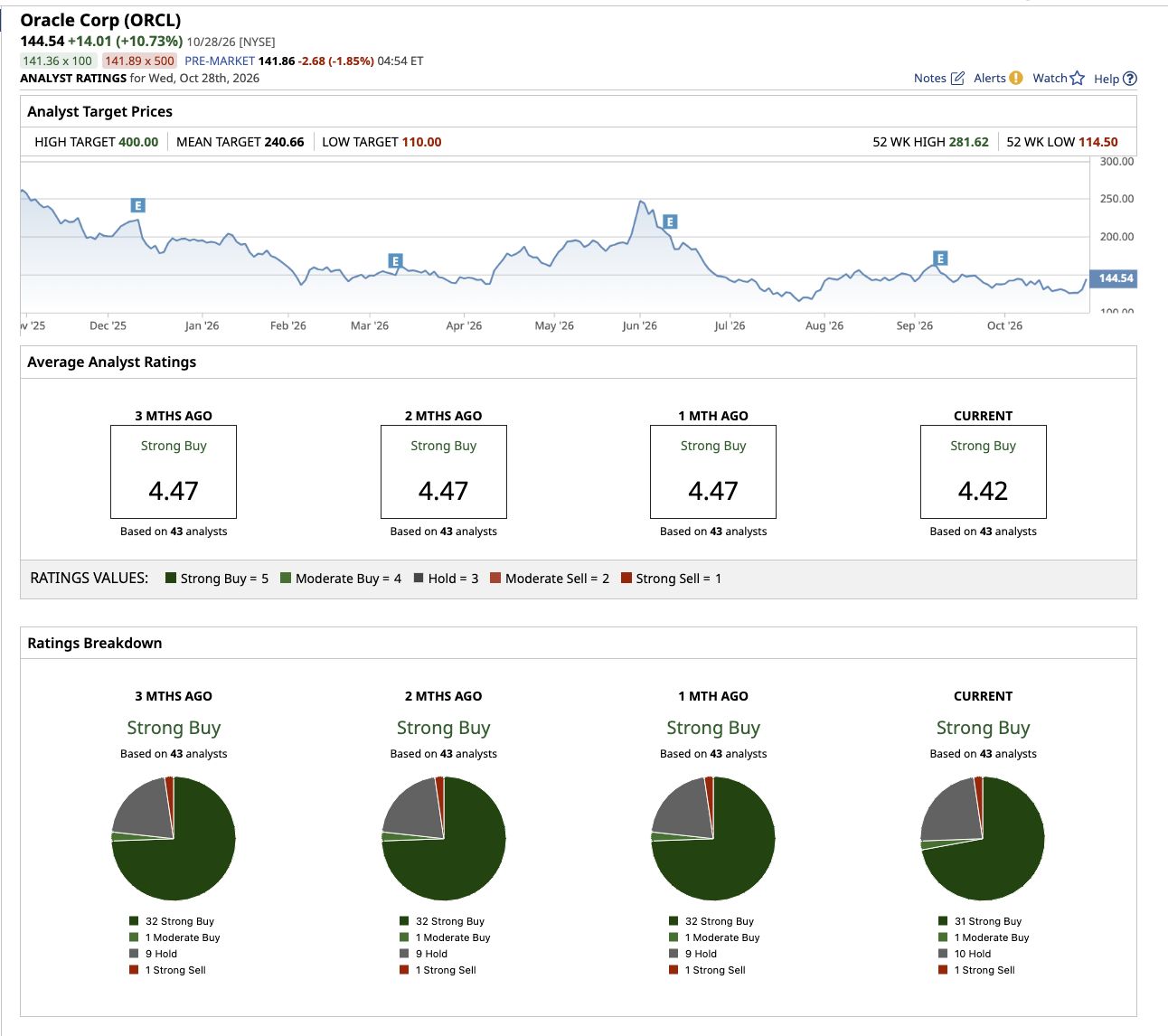
On Wall Street, of the 43 analysts covering the stock, 31 rate it a “Strong Buy,” one rates it a “Moderate Buy,” 10 rate it a “Hold,” and one rates it a “Strong Sell.” The average target price for Oracle stock is $240.66, representing potential upside of 66.5% from its current levels. Many analysts have set a high price target of $400, suggesting upside potential of 176.7% over the next year.
 www.barchart.com
On the date of publication, Sushree Mohanty did not directly have a position in any of the securities mentioned in this article. All information and data in this article is solely for informational purposes. For more information please view the Barchart Disclosure Policy here.
More news from Barchart
Alphabet's Earnings Horror Show Continues, But GOOG Stock Is a Buy Below $300 Reddit Sinks as Google's AI Shift Takes a Bite Out of Search Traffic. What's Next for RDDT Stock. How to Play the Nasty Post-Earnings Selloff in Enphase Stock Oracle Surges 10% on Ambitious New Targets: 3 Questions to Answer Before Dumping ORCL Stock