


The artificial intelligence (AI) trade, which has propelled several stocks to extraordinary heights in recent years, is beginning to face a reality check on Wall Street. Growing concerns that the AI boom could be turning into a bubble have rattled investors, sending the tech-heavy Nasdaq Composite ($NASX) tumbling 2.9% on Friday in its steepest single-day decline since June. The broader S&P 500 Index ($SPX) also shed about 1.8% as investors questioned whether the hundreds of billions of dollars pouring into AI infrastructure will ultimately deliver returns worthy of such massive investments.
And even the biggest names in tech aren't immune to the growing skepticism. E-commerce giant Amazon (AMZN) has found itself in the crosshairs, with its latest Q3 earnings report leaving investors disappointed. The company's bottom line fell short of Wall Street expectations, while its aggressive AI investments weighed heavily on cash flow, resulting in a staggering $42.4 billion outflow. But is the Amazon story really losing its shine? Not quite.
More Top Stocks Daily: Go behind Wall Street’s hottest headlines with Barchart’s Active Investor newsletter.
On its earnings conference call, management laid out an ambitious growth roadmap, projecting that the company’s cloud segment, Amazon Web Services (AWS), could deliver more than 40% growth in both 2027 and 2028, with annual revenue potentially reaching $1 trillion within five to ten years. Management also highlighted that inference already accounts for well over half of AWS' AI revenue. Meanwhile, Amazon's chips business continues to expand at triple-digit rates, supported by growing commitments to its Graviton and Trainium chips.
So, while mounting AI spending and cash flow pressures have put Amazon under the spotlight, its cloud ambitions and rapidly expanding chip business tell a more compelling story. With investor sentiment turning cautious, could Amazon's latest pullback present a buying opportunity, or is Wall Street right to be wary?
About Amazon Stock
From revolutionizing how the world shops to powering the digital economy, Amazon has grown into one of the world's most influential technology and e-commerce giants. Headquartered in Seattle, Washington, Amazon operates across a vast ecosystem spanning online retail, third-party seller services, digital advertising, subscription services, cloud computing, and artificial intelligence. Its diverse offerings include the flagship Amazon marketplace, Prime memberships, Prime Video, Kindle, Alexa, and a growing portfolio of AI-powered services.
Its operations are organized into three major segments: North America, International, and AWS. While the first two drive its global retail, advertising, and subscription businesses, AWS serves businesses, governments, and developers with cloud computing, data storage, database, and AI services. With a vast international presence, an extensive fulfillment and logistics network, and a growing cloud infrastructure footprint, Amazon has evolved far beyond its e-commerce roots into a diversified technology powerhouse.
But despite its dominance across e-commerce and technology, Amazon’s stock has struggled to keep pace with the broader market, leaving investors increasingly impatient. With a market capitalization of approximately $2.59 trillion, the tech giant has plenty of scale. Still, its aggressive AI spending and questions over how quickly those investments will translate into meaningful returns have weighed on investor sentiment.
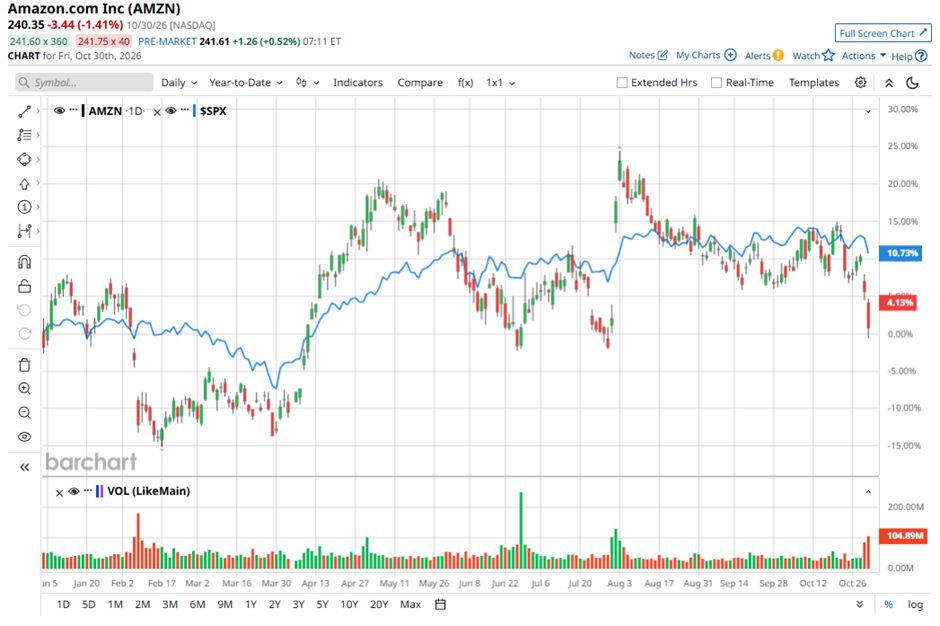
Over the past year, AMZN has gained just 7.9%, with shares up a modest 4.1% in 2026, significantly underperforming the S&P 500 Index’s respective gains of 11.1% and 10.7%. The stock's recent weakness is even clearer when you look at its trading peak. After touching a 52-week high of $287.20 in early August, Amazon shares have retreated roughly 16.3%, putting the spotlight on whether Wall Street has become too cautious about its growth prospects.
 www.barchart.com
Inside Amazon’s Q3 Earnings Report
Amazon delivered a mixed set of results with its fiscal 2026 third-quarter earnings report, released on Oct. 29, as heavy investor expectations in the AI era left little room for disappointment. Both its top and bottom lines fell short of Wall Street estimates, sending shares down 1.4% in the following trading session. While the company's cloud business continued to fire on all cylinders, softer retail growth, a weaker-than-expected bottom line, and soaring AI-related investments raised fresh questions about the cost of its ambitious expansion plans.
Amazon's net sales climbed 12% year-over-year to $201.9 billion in Q3, compared with $180.2 billion in the year-ago quarter. Excluding the unfavorable $0.9 billion impact from foreign exchange rate movements during the quarter, revenue growth accelerated to 13%. Nevertheless, the topline narrowly missed Wall Street's consensus estimate of $202.3 billion. The clear standout was AWS, which continued to strengthen its position as a major growth engine.
Segment revenue surged 39% year-over-year to $46 billion, marking its fastest growth rate in nearly five years. The acceleration reflects surging enterprise demand for AI infrastructure and services, supported by an expanding multi-hundred-billion-dollar backlog. However, the momentum was less pronounced across Amazon's retail operations, which remain its largest business by revenue.
Within the retail business, North America segment sales increased 6% year-over-year to $112.9 billion, while International segment revenue grew 5% to $43.1 billion. The bottom line, meanwhile, proved to be another sore spot. Earnings per share (EPS) declined to $1.89 from $1.95 in the year-ago quarter, also falling short of Wall Street's consensus estimate of $1.96. Perhaps the biggest concern for investors was the mounting financial toll of Amazon's AI ambitions.
Heavy infrastructure investments have put considerable pressure on cash generation, with trailing-12-month free cash flow swinging to an outflow of $42.4 billion, compared with an inflow of $14.8 billion for the trailing 12 months ended Sept. 30, 2025. The deterioration was primarily driven by a $94.8 billion year-over-year increase in purchases of property and equipment, net of proceeds from sales and incentives, largely reflecting investments in artificial intelligence.
The scale of that spending is becoming increasingly difficult to ignore. Amazon's capital expenditures reached $77.3 billion during the quarter, more than doubling from $35.1 billion in the same period last year. Looking ahead, management expects the investment spree to continue, maintaining its forecast for approximately $220 billion in cash capital expenditures for full-year 2026.
Despite the near-term pressures, Amazon offered a relatively upbeat outlook for the holiday quarter. The company expects fourth-quarter net sales to range between $240 billion and $247 billion, representing year-over-year growth of 12% to 16%. This guidance factors in an approximately 60-basis-point unfavorable impact from foreign exchange rate movements. On the profitability front, operating income is projected to come in between $28.5 billion and $33.5 billion, compared with $25 billion in Q4 2025.
What Do Analysts Think About Amazon Stock?
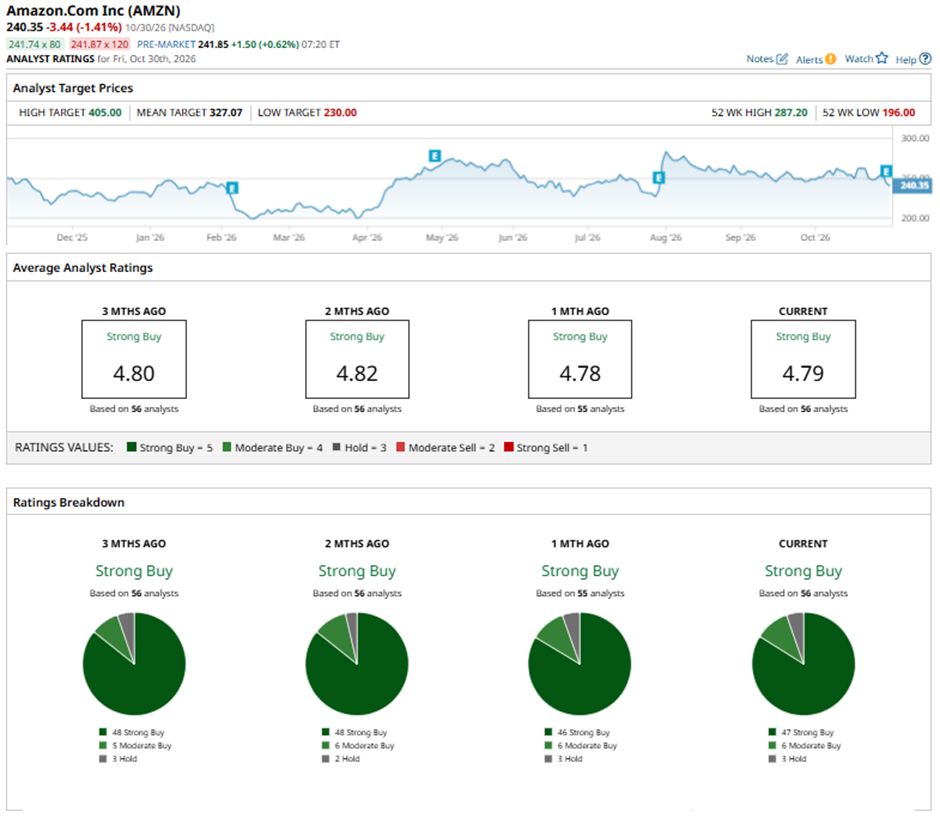
Despite growing investor skepticism, Wall Street isn't losing faith in Amazon just yet. The stock continues to command a consensus “Strong Buy” rating, reflecting considerable optimism about its upside potential. Of the 56 analysts covering AMZN, 47 recommend a “Strong Buy,” six assign a “Moderate Buy,” and just three maintain a “Hold” rating. The average price target of $327.07 points to an impressive 36.1% upside from current levels, while the Street-high target of $405 signals potential gains of as much as 68.5%.
 www.barchart.com
On the date of publication, Anushka Mukherji did not directly have a position in any of the securities mentioned in this article. All information and data in this article is solely for informational purposes. For more information please view the Barchart Disclosure Policy here.
More news from Barchart
Intel Stock Had Its Worst Day Since 1974 Despite 8th Straight Guidance Beat. Here’s What Investors Missed. OpenAI Wants to Buy Google AI Chips. What That Means for GOOGL Stock Here. A $1 Trillion Reason to Buy Amazon Stock Today Rocket Lab Plunged 7% Amid Amazon Fears — but That Could Be the Best Reason to Buy