

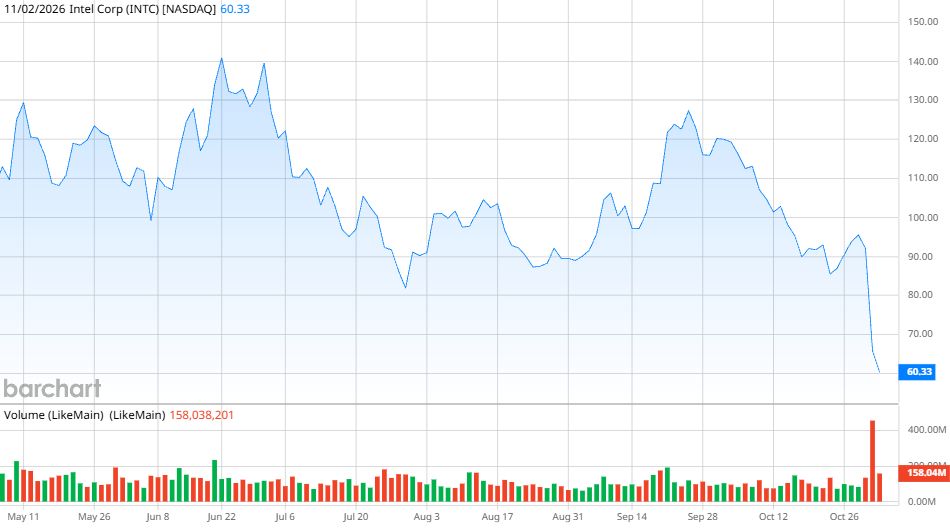
Intel (INTC) investors got a nasty surprise last week when the semiconductor company's third-quarter earnings report sent shares plunging 29% in a single session. The selloff wiped out roughly $140 billion in market value and helped drag down other technology stocks.
And while INTC stock is still up 64% this year, shares have fallen 33% over the past week.
More Top Stocks Daily: Go behind Wall Street’s hottest headlines with Barchart’s Active Investor newsletter.
The interesting part is that Intel's third-quarter results weren't particularly bad. Revenue increased 21% year-over-year (YoY) to $16.5 billion, and its data center business delivered outstanding growth.
But Intel's fourth-quarter guidance exposed a problem that investors may have overlooked during the stock's rally. Despite its ambitions to become a major semiconductor foundry and artificial intelligence (AI) chip supplier, Intel remains heavily dependent on the personal computer market. And that market is headed for a difficult stretch.
 www.barchart.com
PC Business Is Becoming a Liability
Intel's client computing group generated $8.1 billion in third-quarter revenue, accounting for more than half of the $15.4 billion generated by Intel Products. The segment’s revenue declined 5% from a year earlier, even as the company's overall sales increased.
But the fourth-quarter outlook is considerably worse. Management expects client revenue to fall more than 20% sequentially, and Chief Financial Officer David Zinsner indicated that weakness in the PC market could persist through at least the first half of 2027.
One culprit is rising memory prices. Intel's quarterly regulatory filing identified higher memory costs as a factor weighing on PC demand, with conditions expected to worsen in the fourth quarter.
That's particularly troubling because Intel can't do much about memory prices. Higher costs for DRAM and other components make PCs pricier, potentially discouraging consumers and businesses from upgrading their computers.
And unlike Nvidia (NVDA) or Broadcom (AVGO), Intel has substantial exposure to that issue.
Intel Can’t Capitalize on All the Demand It Has
There's another frustrating aspect to Intel's situation. Demand for its data center products is strong, but the company is struggling to supply enough chips.
Data center and AI revenue jumped 78% in the third quarter. Ordinarily, that kind of growth would give investors plenty to celebrate.
But Intel faces manufacturing constraints, including a shortage of substrates used in chip packaging. The company also reportedly lost approximately $300 million in potential fourth-quarter revenue following a shutdown at an Israeli fabrication facility.
That creates an unfortunate combination: weakening demand in its largest product category and insufficient manufacturing capacity to capitalize fully on growth elsewhere.
It's as much an execution problem as a market problem. And investors have little reason to reward Intel for demand if it cannot convert it into revenue.
Why INTC Stock Could Fall Further
Intel expects fourth-quarter revenue between $15 billion and $16 billion, with non-GAAP earnings of $0.25 per share.
Those projections fell well short of Wall Street's expectations. The consensus estimate from 13 analysts who cover the stock is for EPS of $0.32.
Margins also appear to be a developing concern. Intel forecasts a non-GAAP gross margin of 38%, compared with 44.1% in the third quarter, which was a decline of 6.1 percentage points.
That combination explains why INTC stock dropped so quickly. Investors weren't simply disappointed by a weak earnings forecast. They were forced to reassess how quickly Intel can turn its business around.
Intel's foundry ambitions remain intriguing, and its data center growth demonstrates that the company still has competitive products. But building a successful contract manufacturing business requires enormous investment and consistent execution.
Neither comes with guarantees.
 www.barchart.com
What Do Analysts Expect From INTC Stock?
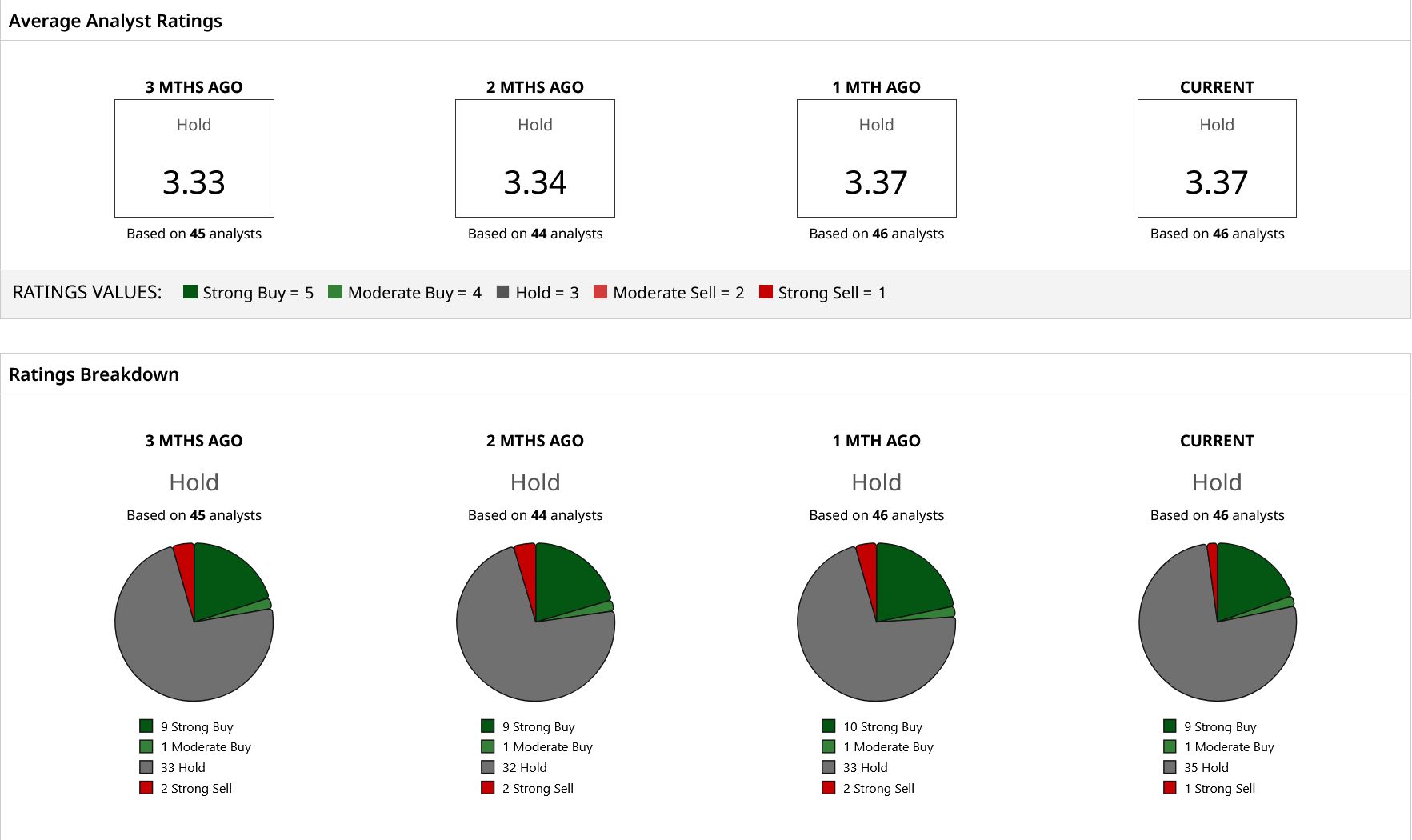
Despite Intel’s fall, the stock has its supporters. Forty-six analysts surveyed by Barchart have a consensus “Hold” rating on INTC stock, although it will be interesting to see how much these ratings shift following Intel’s most recent earnings report. Some analysts appear to have already made their revisions, as the consensus has switched from “Moderate Buy” to “Hold” in just the last few days. The stock has a mean price target of nearly $95, which represents a potential upside of 56%.
Even weighing that potential, however, I don't see an especially compelling reason to buy the dip. Intel needs to demonstrate that it can stabilize its PC business, resolve its manufacturing bottlenecks, and turn stronger data center demand into profitable growth before I would consider it a potential buy.
Until then, I'd rather own semiconductor companies that are already benefiting from AI infrastructure spending without carrying Intel's PC-market baggage.
On the date of publication, Patrick Sanders had a position in: NVDA . All information and data in this article is solely for informational purposes. For more information please view the Barchart Disclosure Policy here.
More news from Barchart
CrowdStrike Stock Is Climbing, but 1 Risk Could Derail the Rally Intel’s Earnings Disaster Exposed a Problem Investors Shouldn’t Ignore Billionaire Mark Cuban Says the Hardest Part of Fixing Health Costs Isn’t the CEOs or Insurance Companies, ‘Employees Fight Any Change’ Dear Okta Stock Fans, Mark Your Calendars for November 4