

It has been a bumpy ride for Uber Technologies (UBER) investors in 2026, and the company’s upcoming earnings report could be an important checkpoint. Uber is scheduled to announce its third-quarter results on Nov. 4, before the market opens. Now, the question is whether its growing ride-hailing and delivery businesses can keep the growth engine running while delivering better earnings.
There are reasons to remain optimistic, with stronger demand across U.S. markets, rising trip volumes, and improving cost efficiency supporting the business. But there are a few clouds on the horizon, too. Higher fuel costs, tariff-related pressures, geopolitical tensions, and the hefty price tag attached to autonomous vehicle investments could complicate the picture. More importantly, investors will be keen to hear how Uber plans to turn its expansion and robotaxi ambitions into sustainable profits.
More Top Stocks Daily: Go behind Wall Street’s hottest headlines with Barchart’s Active Investor newsletter.
Uber’s earnings track record has been somewhat mixed. The company has beaten revenue estimates in two of the past four quarters while missing in the other two. On the earnings front, however, it has performed better, surpassing EPS expectations in three of the past four quarters. Looking ahead to Q3, management expects both revenue and earnings to grow, while Wall Street analysts project a decline in EPS despite a healthy increase in revenue.
So, with the earnings date just around the corner, let’s take a closer look at what analysts expect from Uber’s Q3 report — and what investors should know.
About Uber Stock
Headquartered in San Francisco, California, Uber is a global platform that helps people get around, order food and groceries, and move goods through freight services. Founded in 2009, the company started with a simple idea: Making it easier to book a ride with just a tap on your phone. Since officially launching, Uber has expanded its services worldwide and completed more than 79 billion trips. Today, it has a market capitalization of around $136.2 billion.
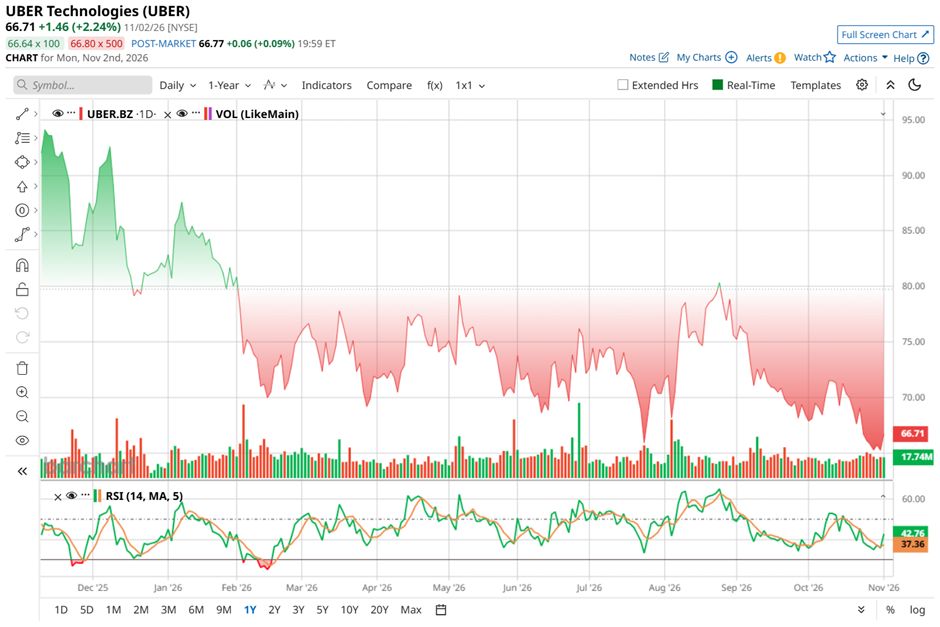
Shares have struggled in 2026, as investors weigh the company’s growth outlook against its rising investments in autonomous vehicles. UBER stock is down 18% year-to-date (YTD) and 33% over the past 52 weeks. The stock also trades about 30% below its 52-week high of $95.44, and touched a 52-week low of $64.04 on Oct. 29.
However, not every recent development has triggered a selloff. When Uber announced layoffs on Sept. 2, shares actually gained roughly 1.6%. Investors appeared to view the move as a cost-saving effort aimed at simplifying operations and freeing up capital for its autonomous vehicle ambitions.
Earlier this year, UBER stock also came under pressure after Q2 revenue missed estimates and its growth outlook fell short of expectations.
 www.barchart.com
A Snapshot of Uber’s Q2 Earnings Report
Uber reported its Q2 2026 results on Aug. 5, and the numbers showed that its core business continues to gain momentum. The company is attracting more customers, handling more trips, and generating higher profits as its platform grows.
Gross bookings jumped 24% year-over-year (YOY) to $58 billion, supported by an 18% increase in trips to 3.9 billion. Monthly active platform consumers also grew 16%. Management pointed to particularly strong customer acquisition, revealing that Uber added more first-time users over the past 12 months than in any comparable five-year period.
Revenue increased 12% YOY to $14.2 billion, missing estimates. The slower growth compared with gross bookings was partly due to changes in how Uber accounts for certain driver payments in markets such as the U.K., rather than simply reflecting weaker business activity.
By segment, Mobility revenue edged up 1% YOY to $7.4 billion, while Mobility operating income rose a much stronger 28%. Delivery performed better on both fronts, with revenue climbing 28% YOY to $5.3 billion and operating income rising 38%. Freight remained the weaker link, reporting a $24 million operating loss despite revenue growing 26% to $1.6 billion.
Profitability was a clear bright spot. Adjusted EPS rose 35% YOY to $0.81, narrowly beating analysts’ expectations, while adjusted EBITDA increased 33% to $2.8 billion. Uber also generated more than $10 billion in free cash flow over the trailing 12 months for the first time in its history, giving it considerable financial flexibility. The company had repurchased approximately $3.5 billion of its shares by mid-2026, and management plans to restart buybacks over the coming months.
However, Uber is also preparing for a major shift in transportation. Rather than developing autonomous vehicles entirely on its own, it is building partnerships across the industry. Collaborators include Wayve, Zoox, Baidu (BIDU), Lucid (LCID), and Nuro, with future deployments also expected with Rivian (RIVN) and Nvidia (NVDA). Management discussed more than $10 billion in multiyear autonomous vehicle (AV) investments.
CEO Dara Khosrowshahi said Uber was operating in seven cities with AV partners and aims to expand that number to 15 by the end of 2026. While this could open another growth avenue, turning these investments into sustainable profits remains the bigger question.
Uber is all set to unveil its Q3 numbers soon. For Q3, management expects gross bookings between $58.3 billion and $60.3 billion, representing 18% to 22% YOY growth, and adjusted EPS between $0.84 and $0.88, representing growth of 28% to 35% YOY.
That profit outlook proved less exciting than investors had hoped. Shares initially dropped after the announcement, as concerns over the earnings guidance and substantial AV spending overshadowed the strong quarterly performance.
Meanwhile, analysts tracking Uber anticipate Q3 revenue of $14.7 billion, while EPS is expected to decrease 70% YOY to $0.94. Looking ahead to fiscal 2026, EPS is projected to decline 40% annually to $3.20, then rise by 43% YOY to $4.57 in the next fiscal year.
What Do Analysts Expect for Uber Stock?
UBS recently cut its price target on UBER stock to $106 from $110 but maintained a “Buy” rating. The firm slightly lowered its 2026 to 2027 bookings and EBITDA estimates, citing tougher U.S. comparisons and competition in Brazil. However, analysts believe Uber's underlying growth remains strong enough to support further upside, even without clear visibility into its robotaxi business.
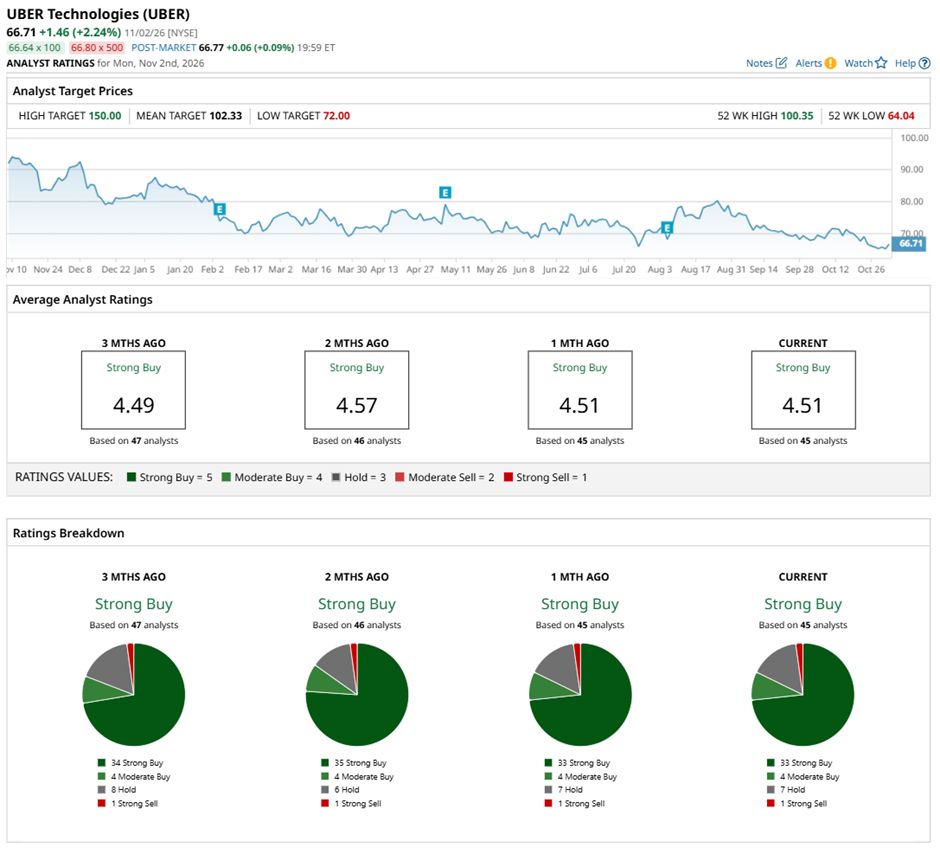
Analysts remain optimistic about Uber’s long-term potential. UBER stock has a consensus “Strong Buy" rating overall. Of the 45 analysts covering UBER stock, 33 have a “Strong Buy” recommendation, four suggest a “Moderate Buy,” seven have a “Hold" rating, and one analyst has a “Strong Sell” rating.
The average price target of $102.24 points to potential upside of roughly 54% from current levels. Meanwhile, the Street-high price target of $150 implies the stock could rise as much as 125% from here.
 www.barchart.com
On the date of publication, Sristi Suman Jayaswal did not directly have a position in any of the securities mentioned in this article. All information and data in this article is solely for informational purposes. For more information please view the Barchart Disclosure Policy here.
More news from Barchart
Dear Uber Stock Fans, Mark Your Calendars for November 4 Ahead of Qualcomm Earnings, Here's What Barchart Data Says Comes Next for QCOM Stock Ahead of Arm Earnings, Here's What Barchart Data Says Comes Next for ARM Stock As Meta Stock Suffers Its Worst Month in Years, S&P Delivers a Brutal $39 Billion Cash Flow Warning