

Strong sales can win headlines, but the cost of delivering them can change the conversation. That tension is coming into focus as investors scrutinize the returns on artificial intelligence (AI) spending and Apple (AAPL) confronts the rising costs of sustaining its growth.
Apple sells iPhones, Macs, iPads, wearables, and accessories worldwide. Its Services business adds cloud storage, digital content, payments, and AppleCare to the equation, extending its revenue streams beyond device sales.
More Top Stocks Daily: Go behind Wall Street’s hottest headlines with Barchart’s Active Investor newsletter.
That combination helped Apple generate fiscal fourth-quarter revenue of $114.5 billion, up 12% year-over-year (YOY) and above analysts’ roughly $113 billion forecast. Yet shares fell 2% after earnings, showing that a sales beat alone was not enough to satisfy investors.
Now, higher memory costs are bringing profitability into sharper focus ahead of the December quarter. Can Apple sustain its momentum without letting rising costs take too large of a bite out of profits? Let’s dive in.
Apple’s Growth Faces a Supply Squeeze
Apple’s memory costs were rising before its latest warning about the December quarter. The company previously said it had paid more for memory in three consecutive quarters and expected another increase in September. Apple had already raised prices on some Macs and iPads, illustrating how component inflation was reaching customers.
Those increases have only partially offset memory inflation. Further adjustments could recover additional costs, but the company said it was too early to assess customers’ sensitivity to pricing changes.
Higher prices also offer little relief when products remain unavailable. Strong early demand for the iPhone Duo has met constrained supply, restricting Apple’s ability to convert customer interest into shipments.
Together, these challenges put profitability under scrutiny heading into December. Apple expects a gross margin of 45% to 46%, reflecting higher memory costs and initial Siri AI expenses, including cloud infrastructure spending. The company's 47.9% gross margin in fiscal Q4 included approximately one percentage point from tariff refunds, so the projected decline cannot be attributed entirely to component inflation.
Apple must therefore secure enough components to fulfill orders while controlling procurement and infrastructure expenses. Better availability would support sales, but translating those shipments into stronger profits also depends on how effectively Apple manages the cost of delivering them.
Apple’s Reports Q4 Results
Apple released Q4 fiscal 2026 results on Nov. 2. The company generated $114.5 billion in revenue, up 12% YOY and above analysts' roughly $113 billion forecast. Diluted EPS reached $2.10 per share, increasing 14% YOY and beating the $1.99 consensus estimate.
The iPhone business contributed $57.6 billion in revenue, while Mac sales reached $10.8 billion, and Services generated a record $31.6 billion. This combination highlights the importance of hardware demand and recurring revenue to Apple’s growth.
Apple reported a gross margin of 47.9%, including approximately one percentage point from tariff refunds. The refunds also added $0.05 to EPS, making that benefit important when assessing underlying profitability. Operating cash flow for the quarter totaled $28 billion, matching the amount returned to shareholders through dividends and repurchases.
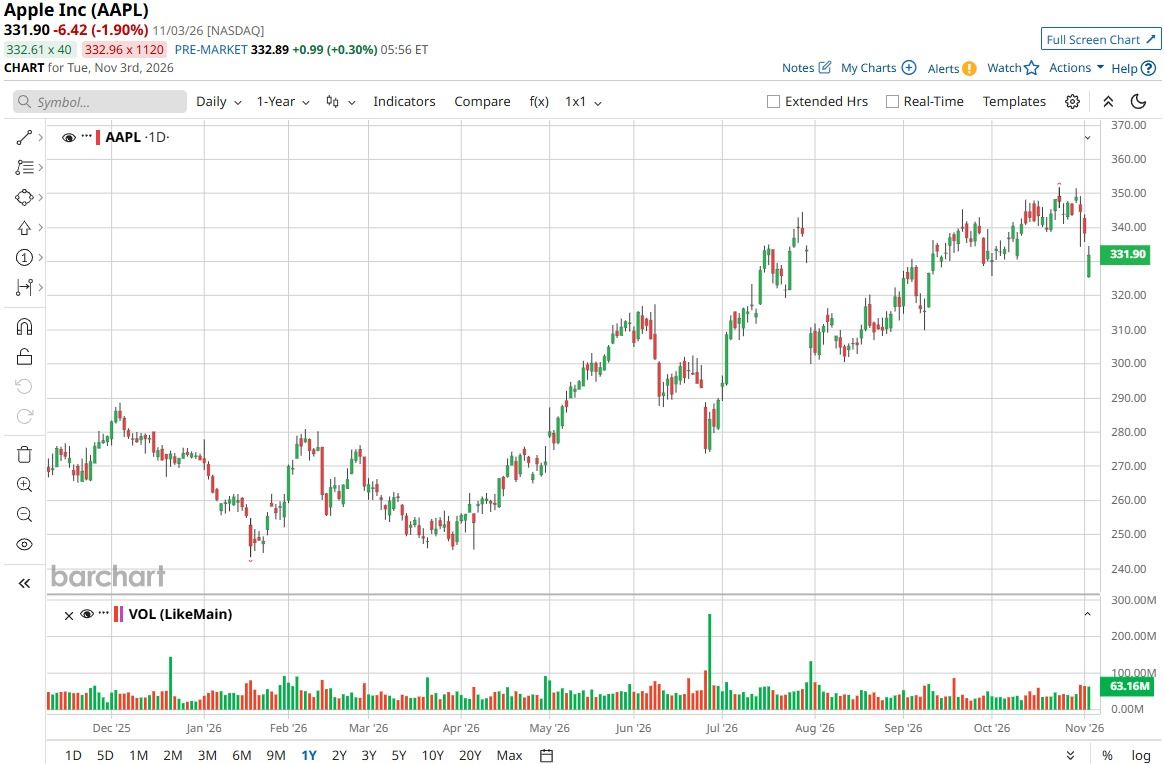
AAPL stock currently trades near $344 per share. The stock is up 27% year-to-date (YTD) and up 28% over the past 52 weeks.
 www.barchart.com
The market capitalization now stands at $5.1 trillion, while Apple's PEG ratio of 2.75 times exceeds the sector median of 1.13 times, indicating a premium valuation.
Supporting future growth, Apple recently acquired Ascend.io to strengthen its internal data infrastructure and AI capabilities through the startup’s expertise in data automation.
How Analysts Read Apple’s Next Quarter
Apple’s next earnings release is scheduled for Feb. 4, 2027, covering the December 2026 quarter. Analysts expect earnings of $2.93 per share versus $2.84 a year earlier, representing 3% YOY growth.
Some analysts see considerably more room for AAPL stock to climb from here. Bank of America analyst Wamsi Mohan sees more room for the stock to rise, recently keeping a “Buy” rating and a $370 price target for Apple.
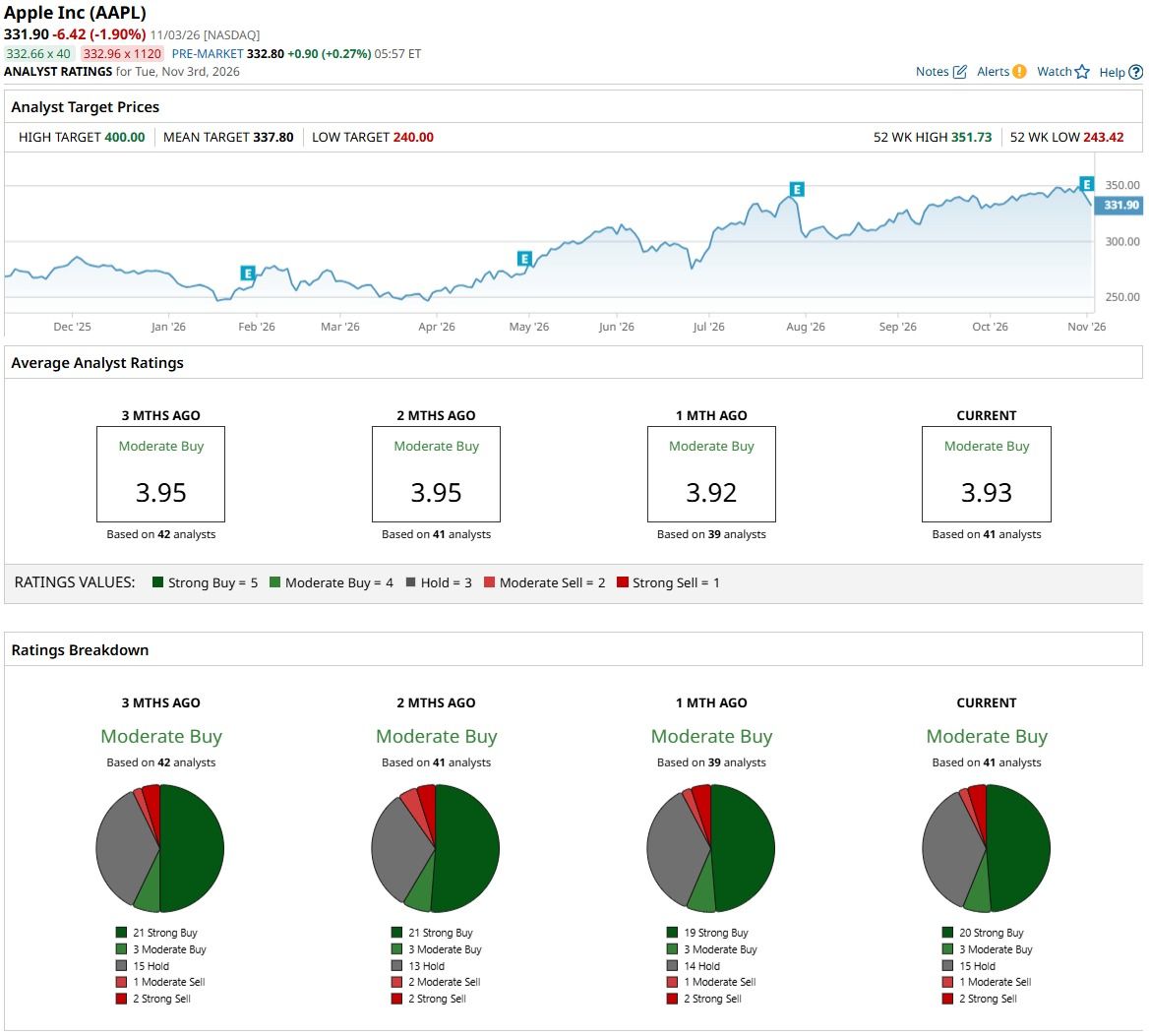
The consensus among 41 analysts with coverage is a “Moderate Buy” rating, reflecting a broadly positive outlook rather than unanimous agreement. The average price target of $339.42 has already been surpassed, while the high target of $400 suggests potential upside of 16% from current levels.
 www.barchart.com
Conclusion
Apple can keep growing, but higher memory costs and limited supply will likely make that growth less profitable in December. Strong demand offers support, while modest earnings estimates and limited upside to the average analyst target suggest expectations already leave little room for disappointment. The most likely outcome is continued sales growth with tighter margins rather than a sharp slowdown. Apple’s next test is straightforward: Deliver enough products, contain costs, and show that demand can still translate into earnings growth.
On the date of publication, Ebube Jones did not directly have a position in any of the securities mentioned in this article. All information and data in this article is solely for informational purposes. For more information please view the Barchart Disclosure Policy here.
More news from Barchart
Apple Flagged Supply Constraints and Rising Memory Costs Ahead of Its December Quarter. Here’s What to Know. Dan Ives Remains Bullish on Palantir Despite Sector Weakness. What This Means for PLTR Stock. Wendy's Rejected Nelson Peltz Takeover Offer. What That Means for WEN Stock. Don’t Make Any Sudden Moves After the Midterm Elections (and 3 Charts I’m Watching Here)