

The housing market is still feeling the squeeze, according to the latest data from the National Association of Realtors (NAR). U.S. existing home sales slid to their lowest level in more than 16 years in October, as rising mortgage rates and still-elevated home prices pushed would-be buyers to the sidelines. Sales fell 5.5% last month to a seasonally adjusted annual rate of 3.75 million units, the weakest reading since August 2010. Borrowing costs aren’t helping.
The average 30-year fixed mortgage rate climbed above 7% this year, and higher rates mean higher monthly payments, which keep many people from buying a home. That’s bad news for home improvement giant Lowe’s Companies (LOW), whose shares have lagged the broader market’s gains this year. When home transactions slow, as they have now, low housing turnover typically means fewer big-ticket renovation projects. With a backdrop this choppy, the next earnings report matters more than ever.
More Top Stocks Daily: Go behind Wall Street’s hottest headlines with Barchart’s Active Investor newsletter.
Lowe’s lifts the curtain on its fiscal 2026 third-quarter results on Wednesday, Nov. 18, before the market opens. Ahead of the big event, here’s a closer look at LOW stock.
About Lowe's Stock
Headquartered in Mooresville, North Carolina, Lowe’s Companies is a Fortune 100 home improvement retailer that generated more than $86 billion in fiscal 2025 sales. With a workforce of approximately 300,000 associates, the company operates over 1,750 home improvement stores, 540 branches, and 120 distribution centers. A member of the S&P 500 Index ($SPX) and a recognized Dividend King, Lowe’s has built a strong reputation for shareholder returns.
Beyond its retail operations, the company is committed to giving back through initiatives that promote affordable housing, revitalize community spaces, develop skilled trade talent, and provide disaster relief. Despite its commanding position in the home improvement industry, Lowe’s has struggled to keep its stock performance on track. The company enjoyed a post-pandemic boom as consumers poured money into home renovations and upgrades, but that momentum has gradually faded.
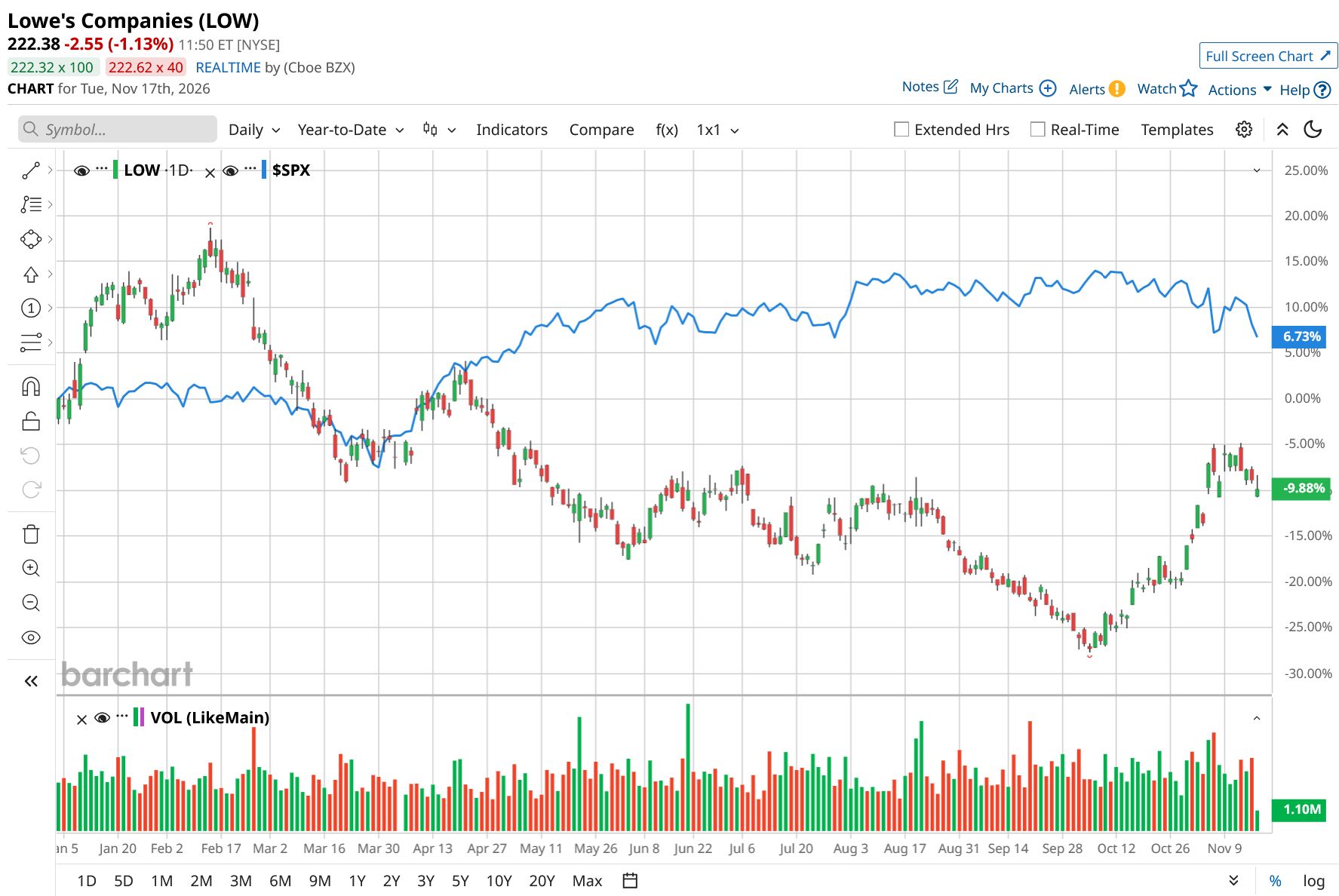
Persistent inflation and the Federal Reserve’s interest rate hikes have weighed on consumer spending and housing activity, creating a challenging environment for the retailer. The pressure is reflected in its share performance. With a market capitalization of approximately $126.20 billion, Lowe’s has slipped 1.6% over the past year and is down another 8% in 2026. That puts it well behind the broader S&P 500 Index, which has advanced 10.1% over the past year and 7.3% so far in 2026.
 www.barchart.com
Although Lowe’s shares have struggled to deliver meaningful capital gains, the company has remained generous on the shareholder-return front. The home improvement giant recently declared a quarterly dividend of $1.25 per share, payable on Feb. 3, 2027. That puts its forward annualized payout at $5 per share, offering investors a dividend yield of around 2.2% at current levels. With its impressive dividend-paying legacy, Lowe’s continues to offer an income cushion even as its stock navigates a challenging market environment.
A Look Inside Q2 Earnings Report
Lowe’s delivered a solid second-quarter performance for fiscal 2026, reporting its results on Aug. 19 and beating Wall Street’s expectations on bottom lines. Revenue came in at $26 billion, up from $24 billion in the year-ago quarter and broadly in line with analysts’ estimates. Comparable sales edged up 0.2% year-over-year (YoY), supported by continued strength in Pro customers and home services, alongside a robust 15.7% jump in online sales.
However, persistent macroeconomic pressures on DIY customers continued to weigh on overall performance. During the quarter ended July 31, 2026, Lowe’s recorded $96 million in pre-tax expenses related to its acquisitions of Foundation Building Materials (FBM) and Artisan Design Group (ADG). Excluding these costs, adjusted diluted EPS increased 1.6% YoY to $4.40, comfortably surpassing Wall Street’s consensus estimate of $4.22. Both reported and adjusted diluted EPS also included a $0.11 benefit from IEEPA tariff refunds.
Lowe’s continued to prioritize shareholder returns alongside its growth initiatives, distributing $673 million in dividends during the quarter. As of July 31, 2026, the retailer operated 1,761 stores spanning 196 million square feet of retail selling space. Looking ahead, however, management struck a cautious tone, revising its full-year fiscal 2026 outlook to reflect persistent macroeconomic headwinds and trends observed during the first half.
The company now expects total sales of approximately $92 billion, with comparable sales projected to remain flat YoY. Full-year diluted EPS is forecast at approximately $11.75, while adjusted diluted EPS is expected to reach $12.25. Lowe’s also plans to invest approximately $2.5 billion in capital expenditures as it navigates cautious consumer spending while maintaining tight cost controls.
How Do Analysts View LOW Stock?
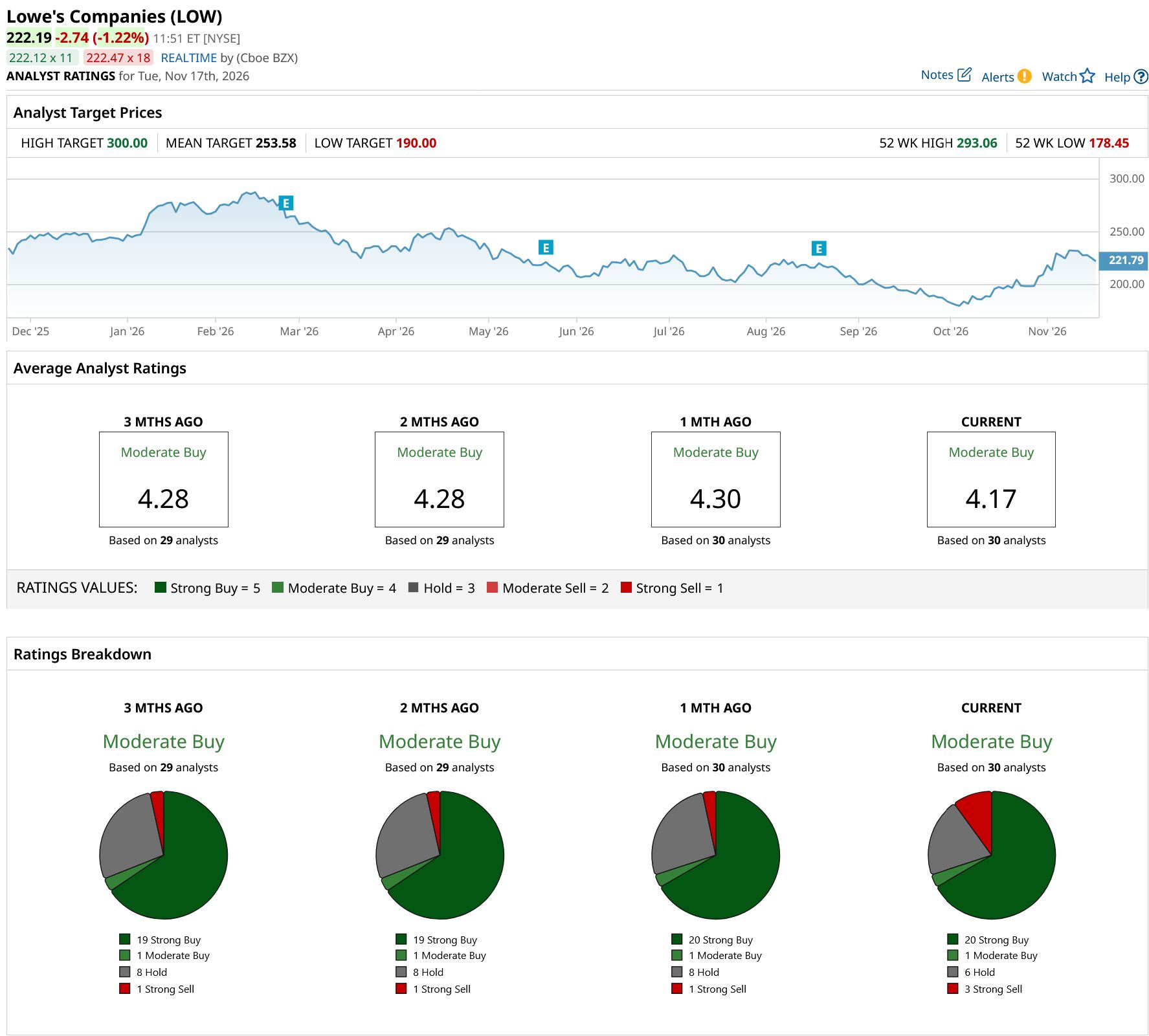
Despite its lackluster performance this year, Lowe’s continues to enjoy a vote of confidence from Wall Street heading into its upcoming earnings report. LOW stock carries a consensus “Moderate Buy” rating, with 20 of the 30 analysts covering it assigning a “Strong Buy,” one recommending a “Moderate Buy,” six maintaining a “Hold,” and three issuing a “Strong Sell.” The average price target of $253.58 points to a potential upside of approximately 14%, while the Street-high target of $300 signals a possible 35% rally from current levels.
 www.barchart.com
On the date of publication, Anushka Mukherji did not directly have a position in any of the securities mentioned in this article. All information and data in this article is solely for informational purposes. For more information please view the Barchart Disclosure Policy here.
More news from Barchart
McKesson Stock Is a Triple Threat at New All-Time Highs. How to Trade It Here. Ahead of Target Earnings, Here's What Barchart Data Says Comes Next for TGT Stock Dear Lowe’s Stock Fans, Mark Your Calendars for November 18 Dan Ives Says the Anthropic IPO Is a Crucial Moment for AI. I Still Think You Should Wait at Least a Quarter Before You Buy ANT Stock.